The Implementation of Lifelong Education in Non-formal Education
DOI:
https://doi.org/10.21111/educan.v2i1.1901Kata Kunci:
Livelong education, out of school education, Islamic education, library research, vocational education.Abstrak
This paper is the result of library research with the focus of research is Out of School Education. The researcher used the data collection techniques from various backgrounds and off-school education. The purpose of this research is (1) To know the essence of lifelong education, (2) To know the implementation of lifelong education in Out of School Education, (3) To know the life-long educational implication in Out of School Education. The result of this study can be concluded that the out-of-school education based on lifelong education is oriented towards the challenges and behaviors of learners toward maturity. The writer found there are three stages of implementation of the concept of Long Life Education in Islam, lifelong education in a family environment, lifelong education in formal education, and lifelong education in non-formal education. The lifelong educational implications of PLS exist with programs that are oriented towards Education and Writing, Vocational Education, Professional Education, Education toward Change and Development.Referensi
Syuhada, Roosdi Achmad, Bimbingan dan Konseling dalam Masyarakat dan Pendidikan Luar Biasa, (Jakarta: Depdikbud. 2001).
Indrakusuma, Amir Daien, Pengantar Ilmu Pendidikan, (Surabaya: Usaha Nasional. 1973).
Muhadjir, Noeng, Ilmu Pendidikan dan Perubahan Sosial Suatu Teori Pendidikan, (Yogyakarta: Rake Sarasin. 1993).
Nidawati, Alam dan Sunnatullah dalam Implementasi Pendidikan Sepanjang Hayat (Life Long Education), Jurnal Pendidikan vol. 2 no. 1 (2014).
Sudjana, Pendidikan Luar Sekolah Wawasan, Sejarah Perkembangan, Falsafah, Teori Pendukung, serta Asas, (Bandung: Falah Production. 2001).
Syam, Mohammad Nor, Pengantar Dasar-Dasar Kependidikan, (Surabaya: Usaha Nasional. 1988).
Tafsir, Ahmad, Ilmu Pendidikan dalam Perspektif Islam, (Bandung: PT.Remaja Rosda Karya. 1984).
Wahyudin, Wawan, Pendidikan Sepanjang Hayat Menurut Perspektif Islam (Kajian Tafsir Tarbawi), Jurnal Kajian Keislaman, Vol. 3 No. 2 (2016).
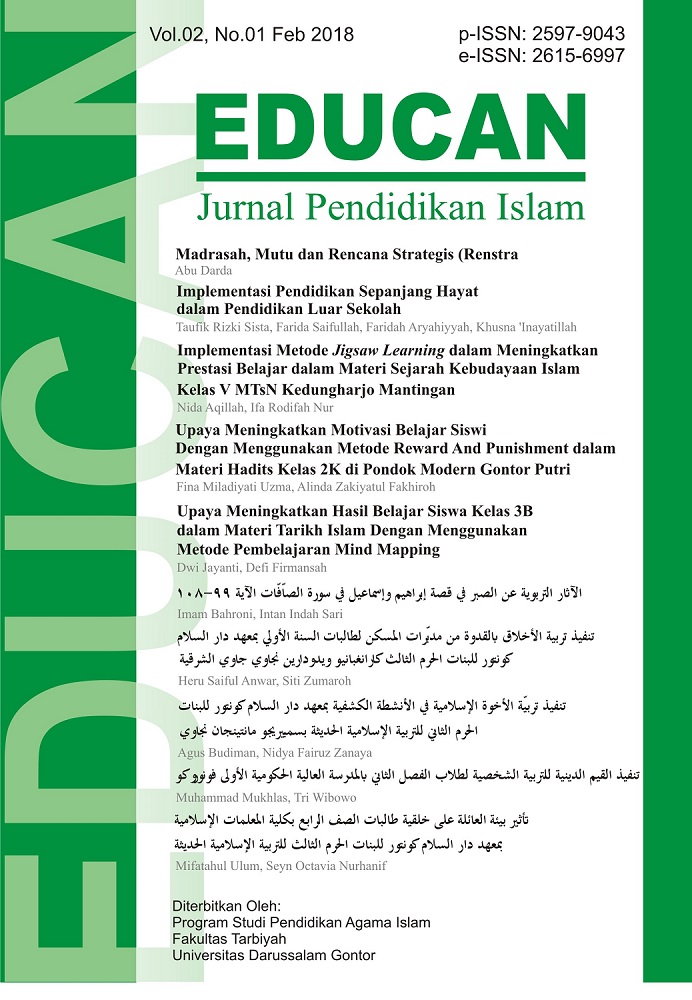
##submission.downloads##
Telah diserahkan
Diterima
Diterbitkan
Cara Mengutip
Terbitan
Bagian
Lisensi
1. PROPOSED POLICY FOR JOURNALS THAT OFFER OPEN ACCESS
Authors who publish with this journal agree to the following terms:
- Authors retain copyright and grant the journal right of first publication with the work simultaneously licensed under a Creative Commons Attribution License that allows others to share the work with an acknowledgement of the work's authorship and initial publication in this journal.
- Authors are able to enter into separate, additional contractual arrangements for the non-exclusive distribution of the journal's published version of the work (e.g., post it to an institutional repository or publish it in a book), with an acknowledgement of its initial publication in this journal.
- Authors are permitted and encouraged to post their work online (e.g., in institutional repositories or on their website) prior to and during the submission process, as it can lead to productive exchanges, as well as earlier and greater citation of published work (See The Effect of Open Access).
2. PROPOSED POLICY FOR JOURNALS THAT OFFER DELAYED OPEN ACCESS
Authors who publish with this journal agree to the following terms:
- Authors retain copyright and grant the journal right of first publication, with the work [SPECIFY PERIOD OF TIME] after publication simultaneously licensed under a Creative Commons Attribution License that allows others to share the work with an acknowledgement of the work's authorship and initial publication in this journal
- Authors are able to enter into separate, additional contractual arrangements for the non-exclusive distribution of the journal's published version of the work (e.g., post it to an institutional repository or publish it in a book), with an acknowledgement of its initial publication in this journal.
- Authors are permitted and encouraged to post their work online (e.g., in institutional repositories or on their website) prior to and during the submission process, as it can lead to productive exchanges, as well as earlier and greater citation of published work (See The Effect of Open Access).