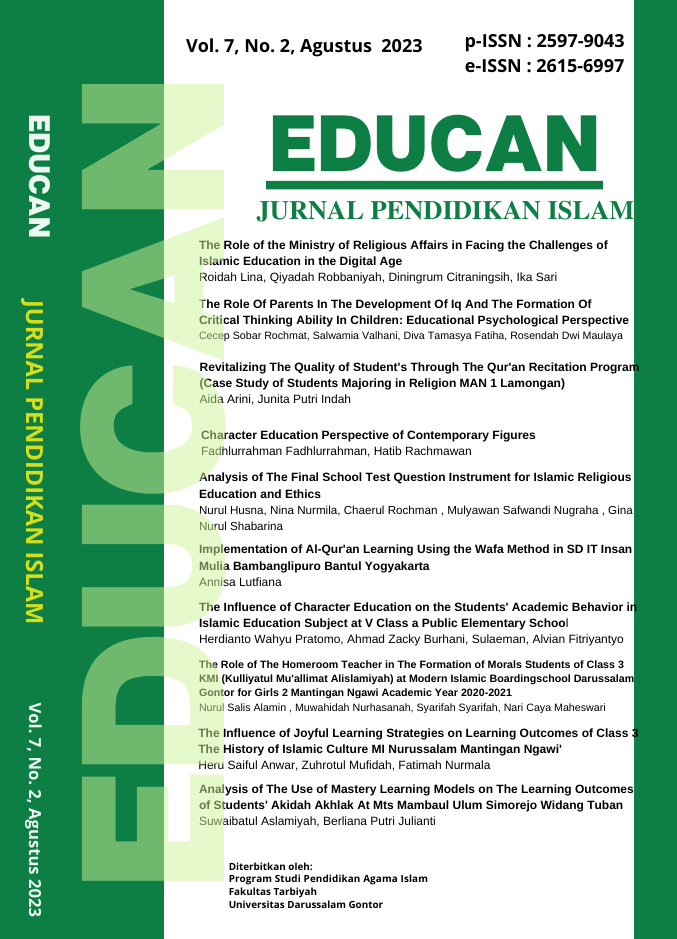
The Role Of Parents In The Development Of Iq And The Formation Of Critical Thinking Ability In Children: Educational Psychological Perspective
DOI:
https://doi.org/10.21111/educan.v7i2.10049Kata Kunci:
intelligence quotient,, educational psychology, critical thinking skills, child educationAbstrak
Educational psychology is a science that discusses all psychological problems in the educational process (teaching and learning). In the learning process, it is necessary to instill a tradition of thinking well and positively, one of which is thinking critically from an early age. Practicing curiosity about something will hone critical thinking patterns. When individuals think, what is needed is an intelligence quotient (IQ) to find out how much level a person has in applying critical thinking. This study aims to elaborate on how important parents' role is in developing IQ and forming necessary thinking skills in children. Critical thinking is a very important thinking skill because it is useful for solving problems in life. The method used in this study is library research, which collects data with textual sources in journals, articles, and books related to the discussion. The results showed that from the perspective of Educational Psychology, the role of parents is very significant in developing IQ and shaping critical thinking skills. Several main views are used: biological, behaviorism, cognitive, psychoanalysis and phenomenological perspectives. Therefore, in forming IQ and critical thinking skills, there needs to be habituation and experimentation with children's mindsets such as giving questions, giving conclusions, and trying to research something that is unknown. This research is expected to educate parents to understand child psychology better. ÂReferensi
Ahmad, Sulaiman, Syakarofath Nandy Agustin, (2018), “Berpikir Kritis:Mendorong
Introduksi dan Reformasi Konsep Dalam Psikologi Islamâ€, dalam Buletin Psikologi,
Vol. 26, No. 2.
Anggreani Chresty, (2015), “Peningkatan Kemampuan Berpikir Kritis Memalui Metode
Eksperimen Berbasis Lingkunganâ€, dalam Jurnal Pendidikan Usia Dini, Vol. 9, Edisi 2
Buhari, Luneto, (2014),“Jurnal Pendidikan Berbasis IQ, EQ, SQâ€, dalam Jurnal Irfani Vol.
, No. 1.
Desiani, Natalina, (2015), “Menumbuhkan Perilaku Berpikir Kritis Sejak Abak Usia
Diniâ€, dalam Jurnal Cakrawala Dini, Vol. 5, No. 1.
Dewi, Maharani, (2018), “Pendidikan Anak Perspektif Psikologi dan Pendidikan Islamâ€,
dalam Jurnal Pendidikan Islam, Vol. 1, No. 01.
Djaali, (2008) “Psikologi Pendidikanâ€, Jakarta : Bumi Aksara.
Fadhilah, Suralaga, (2021) “Psikologi Pendidikan:Implikasi dalam Pembelajaranâ€,
Depok, PT Raja Grafindo.
Fitria, Anggraini Gian, Pradini Susanthi, Sasmiati, Haenilah Een Y., Wijayanti Dwi
Kurnia, (2020), “Pengembangan Kemampuan Berpikir Kritis Anak Usia Dini Melalui
Storytelling Di TK Amartani Bandar Lampungâ€, dalam jurnal Pengabdian Dharma
Wacana, Vol. 1, No. 1.
Ginanjar, Agustin Ary. (2007) “Rahasia Sukses Membangkitkan ESQ Powerâ€, Jakarta:
Arga.
Ichsan, Muhammad, (2016), “Psikologi Pendidikan dan Ilmu Mengajar†dalam Jurnal
Edukasi, Vol. 2 No. 01.
Junier, Sakerebau, (2016), “Memahami Peran Psikologi Pendidikan Bagi Pembelajaranâ€,
dalam Jurnal BIA’ : Jurnal Teologi dan Pendidikan Kristen Kontekstual, Vol. 1, No.
Kartini, Kartono, (2011),“Kamus Lengkap Psikologiâ€, , (Jakarta : Raja Grafindo Persada).
Kulsum, Umi, (2021), “Peran Psikologi Pendidikan Bagi Pembelajaranâ€, dalam Jurnal
Mubtabiin, Vol.7.
Kurniah, Novrinda, Nina, Yulidesni, (2017), “Peran Orangtua Dalam Pendidikan Anak
Usia Dini Ditinjau Dari Latar Belakang Pendidikanâ€, Vol. 2, No. 1.
Muhaimin, Azzet Akhmad, (2010). “Mengembangkan Kecerdasan Spritual bagi Anakâ€,
Yogyakarta : Katahati,.
Muthmainnah, (2012), “Peran Orangtua dalam Menumbuhkan Pribadi Anak yang
Androgynius melalui Kegiatan Bermainâ€, Vol. 1, Edisi 1.
Nurliani, (2016), “Studi Psikologi Pendidikanâ€, dalam Jurnal As-Salam, Vol. 1, No.2.
Nurul, Muthmainnah Rahmita dan Purnamasari Mega, (2019), “Analisis Faktor Penyebab
Peserta Didik dengan IQ Tinggi Memperoleh Hasil Belajar Matematika Rendahâ€,
dalam Jurnal Pendidikan Matematika dan Matematika, Vol. 5, No. 1.
Ratna, Hidayah, Salimi Moh. S, Susiani Tri Saptuti, (2019), “berpikir kritis Skill: Konsep
dan Indikator Penelitianâ€, Vol. 02, No. 02
Resky, Hidayanti, Alimuddin, Syahri Andi Alim, (2020), “Analisis Kemampuan Berpikir
Kritis Dalam Memecahkan Msalah Matematika Ditinjau Dari Perbedaan Gender
Pada Siswa Kelas VIII.1 SMP N 2 Labakkangâ€, dalam Jurnal SIGMA, Vol.12.
Syane, Triwulandari, Supardi U.S., (2022), “Analisis Intelegensi dan Berpikir Kritis†,
Jurnal Pendidikan, Vol. VIII, No. 1.
Wasilatur, Rofiqoh, Syahroni Iza, Latipha Eva, (2021), “Analisis Kemampuan Berpikir
Kritis Melalui Pengenalan Fungsi Jam dan Konsep Waktu dengan Teori Schoenfeld
Menyelesaikan Masalah Anak TKâ€, dalam Jurnal Buah Hati, Vol. 8. No. 2
##submission.downloads##
Telah diserahkan
Diterbitkan
Cara Mengutip
Terbitan
Bagian
Lisensi
1. PROPOSED POLICY FOR JOURNALS THAT OFFER OPEN ACCESS
Authors who publish with this journal agree to the following terms:
- Authors retain copyright and grant the journal right of first publication with the work simultaneously licensed under a Creative Commons Attribution License that allows others to share the work with an acknowledgement of the work's authorship and initial publication in this journal.
- Authors are able to enter into separate, additional contractual arrangements for the non-exclusive distribution of the journal's published version of the work (e.g., post it to an institutional repository or publish it in a book), with an acknowledgement of its initial publication in this journal.
- Authors are permitted and encouraged to post their work online (e.g., in institutional repositories or on their website) prior to and during the submission process, as it can lead to productive exchanges, as well as earlier and greater citation of published work (See The Effect of Open Access).
2. PROPOSED POLICY FOR JOURNALS THAT OFFER DELAYED OPEN ACCESS
Authors who publish with this journal agree to the following terms:
- Authors retain copyright and grant the journal right of first publication, with the work [SPECIFY PERIOD OF TIME] after publication simultaneously licensed under a Creative Commons Attribution License that allows others to share the work with an acknowledgement of the work's authorship and initial publication in this journal
- Authors are able to enter into separate, additional contractual arrangements for the non-exclusive distribution of the journal's published version of the work (e.g., post it to an institutional repository or publish it in a book), with an acknowledgement of its initial publication in this journal.
- Authors are permitted and encouraged to post their work online (e.g., in institutional repositories or on their website) prior to and during the submission process, as it can lead to productive exchanges, as well as earlier and greater citation of published work (See The Effect of Open Access).