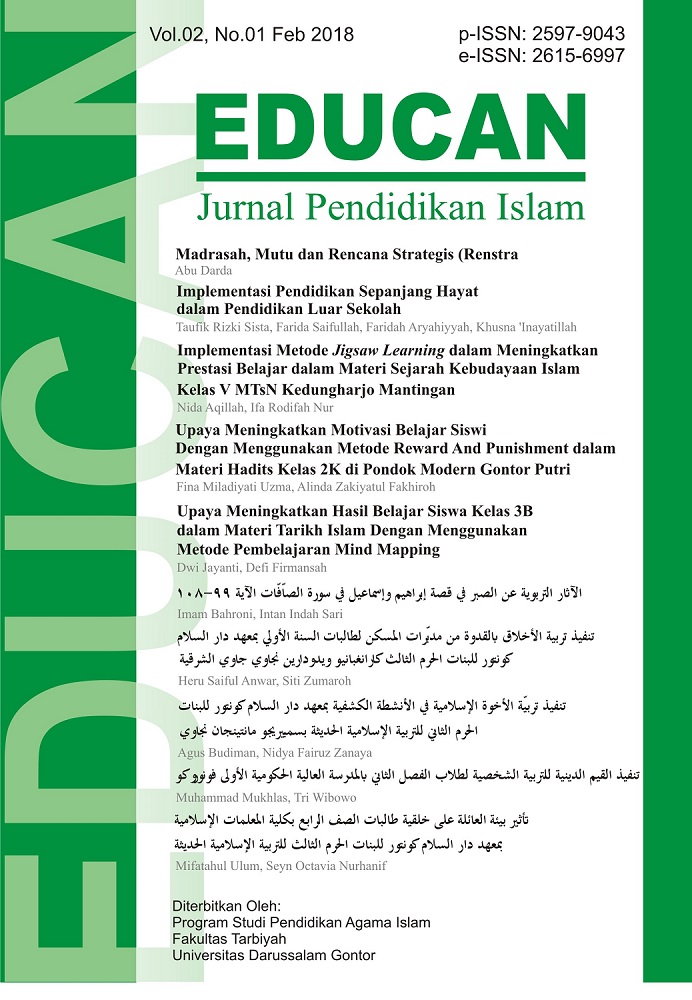
An Effort for Improving 2K Students’ Learning Achievement of Hadits Subject Using Reward and Punishment Method in Gontor for Girls
DOI:
https://doi.org/10.21111/educan.v2i1.1987Keywords:
Classroom action research, learning process, learning method, reward and punishment, hadits.Abstract
In the teaching and learning process, teachers have an important position and determinator whether or not the learning process success. The choice of appropriate learning method also need to be noticed by the teachers. Giving something new in the learning model will improve students’ spirit and achievement. One of the learning method is by implement the cooperative method which consists of various learning methods with group system. Then, the small groups are able to build students’ togetherness and resposibility between them. This research is Classroom Action Research (CAR). The model of Classroom Action Research chosen by the researcher is spiral model from Kemmis and Mc. Taggart. The research was done in some cycles and in every cycle consist of planning, acting, observing, and reflecting. Reward and punishment model can improve students’ learning achievement in Hadits subject for grade 2. This statement proved with the very good test result with the average passing socre 0.9% or 88%. Students study more dilligent, it is proved by students’ attitude toward the teacher while explaining the material. The students listening, pay attention, understand, memorize, and implement the materials that they learned.References
Al-Qur’an.
Ahmadi Abu dan Nur Uhbiyati, Ilmu Pendidikan, (Jakarta: Rineka Cipta. 2000).
Suharsimi, Arikunto. Psikologi Pendidikan dalam Perspektif Baru, (Jogjakarta: PT. Purwa Atmaja Prawira. 2013).
Bedjo M. Siswanto, Pengantar Managemen, (Jakarta: Bumi Aksara. 2013).
Clolim M.,et.al, Mengubah Perilaku Siswa dengan Pendekatan Positif, (Jakarta: BPK.Gunung Mulia. 1992).
Departemen Pendidikan Dan Kebudayaan, Kamus Besar Bahasa Indonesia, (Jakarta: Balai Pustaka,1995).
Trianto, Mendesain Model Pembelajaran Inovatif Progresif Konsep Landasan dan Implementasinya pada Kurikulum Tingkat Satuan Pendidikan. (Jakarta: Kencana Prenada Media Group, 2010).
Malayu S.P Hasibuan, Manajemen Sumber Daya Manusia. (Jakarta: Bumi Aksara. 2013).
Purwanto Ngalim, Ilmu Pendidikan Teoritas dan Praktis, (Bandung: Remaja Rosadakarya. 1995).
Pusat Bahasa Departemen Pendidikan Nasional, Kamus Besar Bahasa Indonesia. (Jakarta: Balai Pustaka. 2003).
Sugiyono, Metode Penelitian Pendidikan Pendekatan Kuantitatif, Kualitatif, dan R&D, (Bandung: CV Alfabeta. 2009).
Suharto Ahmad, Melacak Akar Filosofis Pendidikan Gontor, kajian metaforis syajarah thayyibah Gontor. (Yogyakarta: Namela).
Suwarno, Pengantar Ilmu Pendidikan. (Surabaya: Usahabaru. 1985).
Tisnawati Ernik Sule dan Kurniawan Saefullah, Pengantar Menejemen, (Jakarta: Kencana Prenada Media Group. 2009).
Trianto, Mendesain Model Pembelajaran Inovatif-Progresif Konsep Landasan dan Implementasinya pada Kurikulum Tingkat Satuan Pendidikan, (Jakarta: Kencana Prenada Media Group, 2010).
Downloads
Submitted
Accepted
Published
How to Cite
Issue
Section
License
1. PROPOSED POLICY FOR JOURNALS THAT OFFER OPEN ACCESS
Authors who publish with this journal agree to the following terms:
- Authors retain copyright and grant the journal right of first publication with the work simultaneously licensed under a Creative Commons Attribution License that allows others to share the work with an acknowledgement of the work's authorship and initial publication in this journal.
- Authors are able to enter into separate, additional contractual arrangements for the non-exclusive distribution of the journal's published version of the work (e.g., post it to an institutional repository or publish it in a book), with an acknowledgement of its initial publication in this journal.
- Authors are permitted and encouraged to post their work online (e.g., in institutional repositories or on their website) prior to and during the submission process, as it can lead to productive exchanges, as well as earlier and greater citation of published work (See The Effect of Open Access).
2. PROPOSED POLICY FOR JOURNALS THAT OFFER DELAYED OPEN ACCESS
Authors who publish with this journal agree to the following terms:
- Authors retain copyright and grant the journal right of first publication, with the work [SPECIFY PERIOD OF TIME] after publication simultaneously licensed under a Creative Commons Attribution License that allows others to share the work with an acknowledgement of the work's authorship and initial publication in this journal
- Authors are able to enter into separate, additional contractual arrangements for the non-exclusive distribution of the journal's published version of the work (e.g., post it to an institutional repository or publish it in a book), with an acknowledgement of its initial publication in this journal.
- Authors are permitted and encouraged to post their work online (e.g., in institutional repositories or on their website) prior to and during the submission process, as it can lead to productive exchanges, as well as earlier and greater citation of published work (See The Effect of Open Access).