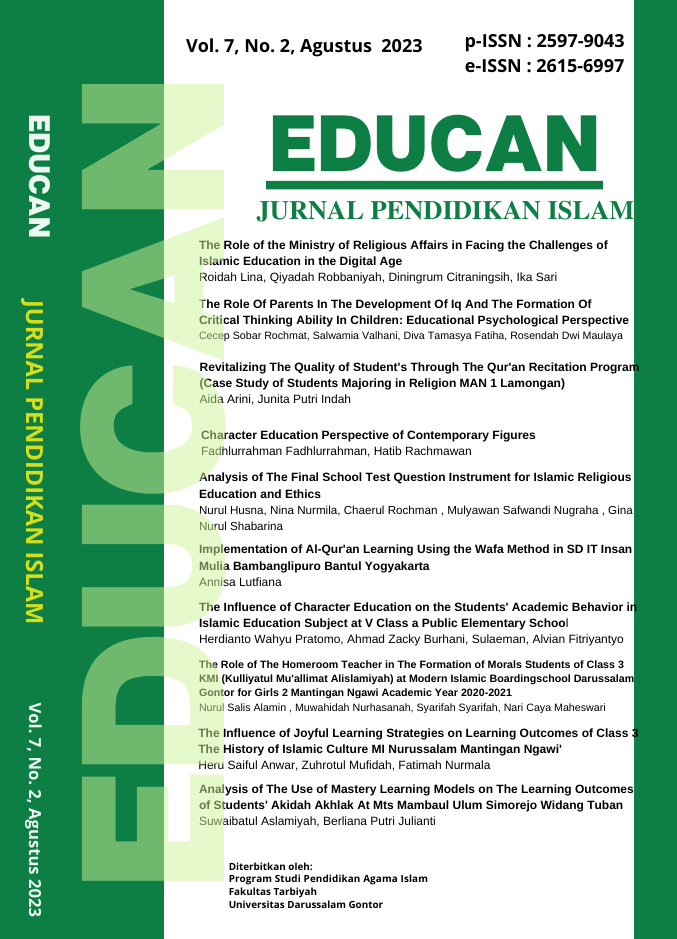
The Role of The Homeroom Teacher in The Formation of Morals Students of Class 3 KMI (Kulliyatul Mu'allimat Alislamiyah) at Modern Islamic Boardingschool Darussalam Gontor for Girls 2 Mantingan Ngawi Academic Year 2020-2021
DOI:
https://doi.org/10.21111/educan.v7i2.10304Keywords:
Role, Homeroom Teacher, Formation of MoralsAbstract
Each class is a work unit that remains solitary, the expression "unit" here alludes to the way that each class has its own qualities. Each class is a different work unit that capabilities as a subsystem. To control understudies at KMI (kulliyatul-Mu'allimat-Al-Iislamiyyah) instructors are required who can figure out the qualities of female understudies and can foster the ethics of female understudies "homeroom educator". An ever increasing number of individuals will succeed in the event that they impart positive and commendable characters. Training ought to coordinate parts of mental development (information and abilities), full of feeling (interest, ability, flexibility), and psychomotor (coordinated abilities) as well as reinforcing good person. Instructing and preparing are only a couple of the obligations. In teaching required upkeep and extension in innovation and science. While preparing implies creating abilities in understudies. In light of these suppositions, the exploration plans to dissect how the development of female understudies' ethics in class 3 KMI (Kulliyatul Mua'allimat Al-Islamiyah), what is the job of the homeroom educator in the arrangement of female understudies' ethics in class 3 KMI. This exploration utilizes subjective techniques which incorporate meetings, perception, and documentation, which are situated at Pondok Present day Darussalam Gontor Putri, Grounds 2, Mantingan, Ngawi. The consequences of information handling show that the job of the homeroom educator in the development of ethics in class 3 KMI understudies is more powerful, with the fundamental undertaking of the homeroom instructor as a critical thinking expertise in making a homeroom climate together, so the progress of doing the gaining capability and the measures from the job of the homeroom educator shows the outcomes that the female understudies in the class work on their ethics.References
Abdullah Nashih Ulwan, Tarbiyah al - Aulad Fi al - Islam, Terjemah Ahmas
Masjkur Hakim, 1992, dengan judul Pendidikan Anak Menurut Islam Kaidah
- Kaidah Dasar, (Bandung : PT Remaja Rosdakarya)
Abudin Nata, 2001, Filsafat Pendidikan Islam, (Jakarta : Logos Wacana Ilmu)
Agus Yasin, Wiwik Dwi Febriana Wati, Bahrudin Fahmi. 2022. “Implementasi
Manajemen Pendidikan Pesantren Dalam Pembentukan Karakter Santriwati
Di Pondok Modern Darussalam Gontor Putri 1.†El-Wasathiya 10 (02)
Agoes Soejanto, 2005, Psikologi Pembentukan, (Jakarta: PT. Rineka Cipta,)
Ahmad Amin, 1975, Etika Ilmu Akhlak, (Jakarta: Bulan Bintang)
Ahmad Tafsir, 1994, Ilmu Pendidikan dalam Perspektif Islam, (Bandung:Remaja
Rosdakarya)
Amita Diananda, 2018, Psikologi Remaja dan Permasalahannya, ISTIGHNA, Vol.
, No 1, Januari P-ISSN 1979-2824
Asmuki, Asmuki, and Wilda Al Aluf. 2018. “Pendidikan Karakter Di Pesantren.â€
Edupedia 2 (2): https://doi.org/10.35316/edupedia.v2i2.325
Barnawie Umary, 1988, Materi Akhlak, (Surabaya: CV.Ramadhani)
Desmita, Dra. M.Si, 2009, Psikologi Pembentukan Pesera Didik, (Bandung:PT.
Remaja Rosdakarya)
Dewa Ketut Sukatdi, 2002, Pengantar Pelaksanaan Program Bimbingan dan
Konseling di Sekolah, (Jakarta : PT Rineka Cipta)
Dimyati, Mudjiono, 2009, Belajar dan Pembelajaran (Jakarta: RinekaCipta)
Jamil Suprihatiningrum, 2013, Guru Profesional, (Jogjakarta: Ar- Ruzz Media)
Jean & Morris, 2013, Foundation of Teaching, an Introduction to Modern Education,
(Jogjakarta: Ar- Ruzz Media)
Marwani, Marwani, Megawati A, Kamaruddin Kamaruddin, and Markuna Markuna,
, “Model Pendidikan Karakter Berbasis Pesantren Di MIN 2 Kota
Makassar.†Jurnal Al-Qiyam 1 (1):p. 21–28.
https://doi.org/10.33648/alqiyam.v1i1.124
Jos Masdani, Pembentukan Anak, Psikologi bagian Psikiatri F.K. U.I (Majalah
Psikologi Populer anda)
Muhaimin, dkk. 1996, Strategi Belajar Mengajar (Penerapan dalam Pendidikan
Agama), (Surabaya: Citra Media)
Muhammad Athiyah Al-Abrasyi, Al-Tarbiyyah al-Islâmiyyah, ter. Bustami A. Gami
dan Djohar Bahry, 1979, Dasar-dasar Pokok Pendidikan Islam, (Jakarta:
Bulan Bintang)
Muh. Uzer usman, 1992, Menjadi guru profesional, (Bandung: PT Remaja
Rosdakarya)
Omar, M. M. Al-Toumy Al-SYABANI, 1979, Filsafat Pendidikan Islam, (Jakara:
Bulan Bintang)
Prayitno, 2004, Layanan Bimbingan Kelompok Dan Konseling Kelompok, (Padang:
Universitas Negeri Padang)
Syafaruddin dan Asrul, 2013, Kepemimpinan Pendidikan Kontemporer, (Bandung:
Citapustaka Media)
Sudarwan Danim, Prof. Dr. 2015, Pedagogi, Andragogi, dan Heutagogi (Bandung :
alfabeta)
Sopidi, Peran Penting Wali Kelas (dalam saefudin: 2010) p. 9,
https://www.google.com/ search? client= firefoxbd&q=peran+wali+kelas+sebagai+pengganti+orangtua+menurut+para+ahli
diakses pada tgl 11 des 2021 jam 14.17 Marimis Yamin, Kiat
Membelajarkan Siswa, ( Ciputat : Gp. Press g
roup, 2013 )
Wiguna, Nita, and Mislinawati Mahmud. 2018. “Usaha Wali Kelas Dalam
Menerapkan Nilai Karakter Siswasd Negeri 31 Banda Aceh.†Jurnal Ilmiah
Pendidikan Guru Sekolah Dasar FKIP Unsyiah 3 (April)
Zainal Abidin, 1989, Kepribadian Muslim, Semarang: Aneka Ilmu
Downloads
Submitted
Accepted
Published
How to Cite
Issue
Section
License
1. PROPOSED POLICY FOR JOURNALS THAT OFFER OPEN ACCESS
Authors who publish with this journal agree to the following terms:
- Authors retain copyright and grant the journal right of first publication with the work simultaneously licensed under a Creative Commons Attribution License that allows others to share the work with an acknowledgement of the work's authorship and initial publication in this journal.
- Authors are able to enter into separate, additional contractual arrangements for the non-exclusive distribution of the journal's published version of the work (e.g., post it to an institutional repository or publish it in a book), with an acknowledgement of its initial publication in this journal.
- Authors are permitted and encouraged to post their work online (e.g., in institutional repositories or on their website) prior to and during the submission process, as it can lead to productive exchanges, as well as earlier and greater citation of published work (See The Effect of Open Access).
2. PROPOSED POLICY FOR JOURNALS THAT OFFER DELAYED OPEN ACCESS
Authors who publish with this journal agree to the following terms:
- Authors retain copyright and grant the journal right of first publication, with the work [SPECIFY PERIOD OF TIME] after publication simultaneously licensed under a Creative Commons Attribution License that allows others to share the work with an acknowledgement of the work's authorship and initial publication in this journal
- Authors are able to enter into separate, additional contractual arrangements for the non-exclusive distribution of the journal's published version of the work (e.g., post it to an institutional repository or publish it in a book), with an acknowledgement of its initial publication in this journal.
- Authors are permitted and encouraged to post their work online (e.g., in institutional repositories or on their website) prior to and during the submission process, as it can lead to productive exchanges, as well as earlier and greater citation of published work (See The Effect of Open Access).