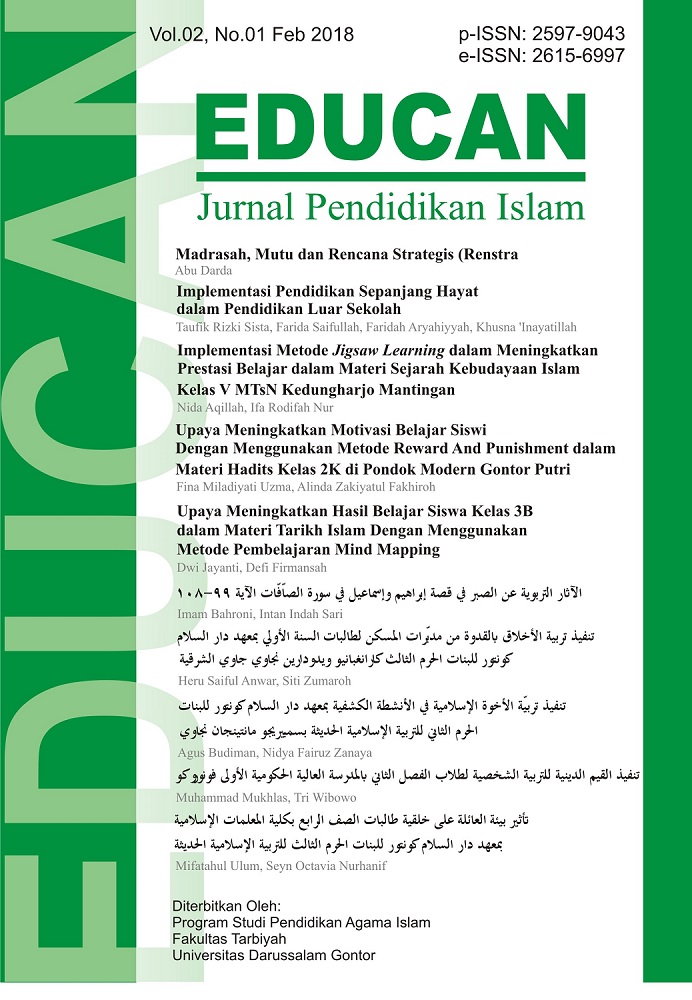
Madrasah, Quality and Strategic Plan
DOI:
https://doi.org/10.21111/educan.v2i1.2441Keywords:
Madrasah, quality, strategic plan, science, technology.Abstract
This paper aims to understand the the quality improvement of Madrasah as one of the Islamic education institutions of Indonesia, through the construction of strategic plan (renstra) for the development of Islamic education. Madrasah quality must be well managed so that it can realize the goals and noble values of Islamic education. Its missions are actually heavier than public schools because of the broader range of functions and tasks. Its goal as Islamic education institutions includes spiritual competence, religious character, in addition to social, personal, academic and vocational competencies. This paper finds out that managerial stages to improve the quality of madrasah are: inventory of main activities; strategy formulation; action plan and scheme of procedure for developing quality learning. According to the experience of KMI Pondok Modern Darussalam Gontor in the construction of the Science and Technology development strategic plan, it involves some actions, such as: To formulate a strategy; describe real challenges; goal achievement strategy; target and size for each strategy; SWOT analysis; alternative steps for solving; action plan and implementation program; and schedule of activities. The strategic objectives, including the following: curriculum and learning process; madrasah leadership and management; organization and institutions; workforce; financing and funding; learners; the role of the community; madrasah environment and culture.References
E. Mulyasa. Manajemen Berbasis Sekolah: Konsep, Strategi, dan Implementasi. (Bandung: PT Remaja RosdaKarya. 2007).
Fadjar, Malik. Visi Pembaharuan Pendidikan Islam. (Jakarta: LP3NI. 1998).
http://ismails3ip.staff.fkip.uns.ac.id/2012/01/23/penjaminan-mutu-pendidikan-rasah-melalui-akreditasi-studi-kebijakan-tentang-pelaksanaan-akreditasi-madrasah-aliyah-oleh-bap-sm-propinsi-jawa-tengah/ (akses 04-11-2014).
Ismail. Penjaminan Mutu Pendidikan Madrasah Melalui Akreditasi. (2012).
KMI Gontor. Rencana Induk Pengembangan Pendidikan Sains dan Teknologi 2007-2012. (2007).
Muhaimin, Suti’ah, dan Sugeng Listyo Prabowo. Manajemen Pendidikan: Aplikasinya dalam Penyusunan Rencana Pengembangan Sekolah/ Madrasah. (Jakarta: Kencana Prenada Media Group. 2012).
T. Hani Handoko. Manajemen. Edisi II. (Yogyakarta: BPFE. 1990).
Undang-undang Republik Indonesia No. 20 Tahun 2003 tentang Sistem Pendidikan Nasional, Bab I, Pasal I.
Downloads
Submitted
Accepted
Published
How to Cite
Issue
Section
License
1. PROPOSED POLICY FOR JOURNALS THAT OFFER OPEN ACCESS
Authors who publish with this journal agree to the following terms:
- Authors retain copyright and grant the journal right of first publication with the work simultaneously licensed under a Creative Commons Attribution License that allows others to share the work with an acknowledgement of the work's authorship and initial publication in this journal.
- Authors are able to enter into separate, additional contractual arrangements for the non-exclusive distribution of the journal's published version of the work (e.g., post it to an institutional repository or publish it in a book), with an acknowledgement of its initial publication in this journal.
- Authors are permitted and encouraged to post their work online (e.g., in institutional repositories or on their website) prior to and during the submission process, as it can lead to productive exchanges, as well as earlier and greater citation of published work (See The Effect of Open Access).
2. PROPOSED POLICY FOR JOURNALS THAT OFFER DELAYED OPEN ACCESS
Authors who publish with this journal agree to the following terms:
- Authors retain copyright and grant the journal right of first publication, with the work [SPECIFY PERIOD OF TIME] after publication simultaneously licensed under a Creative Commons Attribution License that allows others to share the work with an acknowledgement of the work's authorship and initial publication in this journal
- Authors are able to enter into separate, additional contractual arrangements for the non-exclusive distribution of the journal's published version of the work (e.g., post it to an institutional repository or publish it in a book), with an acknowledgement of its initial publication in this journal.
- Authors are permitted and encouraged to post their work online (e.g., in institutional repositories or on their website) prior to and during the submission process, as it can lead to productive exchanges, as well as earlier and greater citation of published work (See The Effect of Open Access).