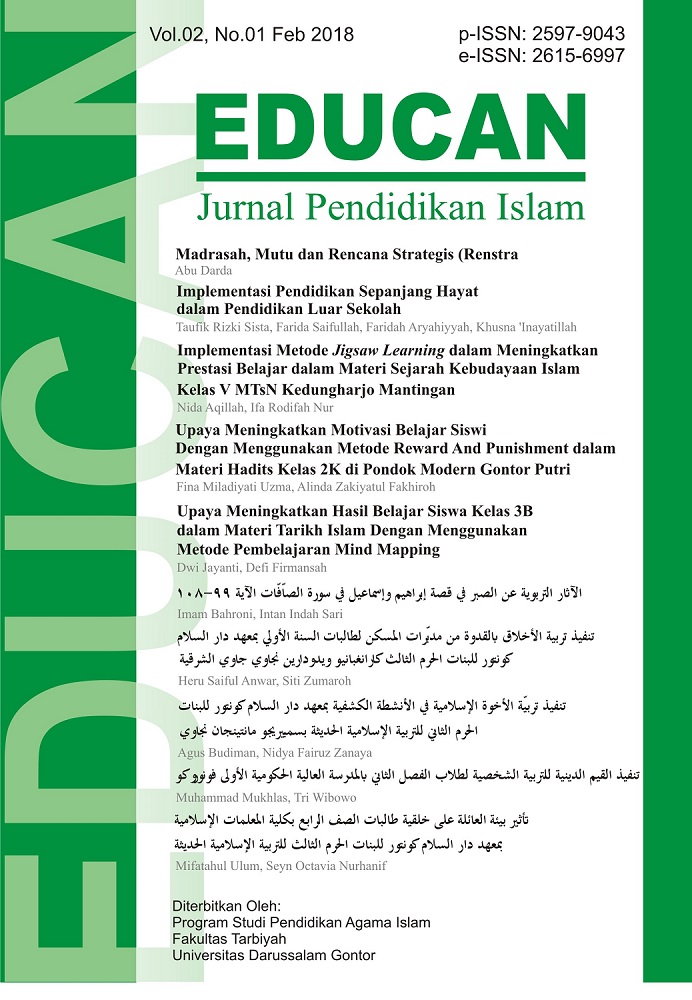
Anf Effort for Improving 3B Students’ Learning Result of Tarikh Islam Subject Using Mind Mapping Method in Gontor for Girls
DOI:
https://doi.org/10.21111/educan.v2i1.1981Keywords:
Classroom action research, Gontor, learning motivation, mind mapping method, tarikh Islam.Abstract
Some factors that affect learning process it is able to give positive support for the learning itself, but it also able to inhibit the learning process. The obstacles may affect people’s learning result and then they experience the learning process that not appropriate with what they want. These conditions impact to problem appaearance in the next learning process. Low students learning motivation will be an important obstacle in the learning process, because it can caused low students learning achievement. Thus, teachers are expected to improve students learning motivation to improve students learning achievement. This research is Classroom Action Research (CAR) which aim to give information about how the proper action to improve students learning reslt for Tarikh Islam subject in the learning process through mind mapping method. The result of this research showed that learning method and learning media that used by the teachers are very important to improve students’ understanding and it impact to students learning improvement in the certain subject. It can be seen from the research result that was done to the students grade 3B in Pondok Modern Darussalam Gontor for Tarikh Islam subject, the use of mind mapping method for this subject improve students learning result 28%.References
Al Buthy, Muhammad Sa’id Ramadhan,Dr, Sirah Nabawiyah, (Robbani Press, Jakarta,1999).
Bobbi Deporter, Quantum Teaching Mempraktekkan Quantum Learning Kelas, (Bandung: Kaifa, 2008).
Edmud Bachman, Metode Belajar Berpikir Krisis dan Inovatif, (Jakarta: Prestasi Puatakarya, 2001).
Hamka, Sejarah Umat Islam, Pustaka Nasional PTE LTD (Singapura: Cakrawala Islam, Mizan, 1987)
Melvin L. Silberman, Active Learning, 101 Cara Belajar Siswa Aktif, (Bandung: Nusamedia. 2004).
R. Teti Rostikawati, Mind Mapping dalam Metode Quantum Learning, (Jakarta: Kencana 2009)
Syaiful Bahri Djamaroh & Aswan Zain, Metode Belajar Mengajar, Cet. II, (Rineka Cipta).
Toni Buzan, Buku Pintar Mind Mapping, (Jakarta: PT Granada. 2008).
Downloads
Submitted
Accepted
Published
How to Cite
Issue
Section
License
1. PROPOSED POLICY FOR JOURNALS THAT OFFER OPEN ACCESS
Authors who publish with this journal agree to the following terms:
- Authors retain copyright and grant the journal right of first publication with the work simultaneously licensed under a Creative Commons Attribution License that allows others to share the work with an acknowledgement of the work's authorship and initial publication in this journal.
- Authors are able to enter into separate, additional contractual arrangements for the non-exclusive distribution of the journal's published version of the work (e.g., post it to an institutional repository or publish it in a book), with an acknowledgement of its initial publication in this journal.
- Authors are permitted and encouraged to post their work online (e.g., in institutional repositories or on their website) prior to and during the submission process, as it can lead to productive exchanges, as well as earlier and greater citation of published work (See The Effect of Open Access).
2. PROPOSED POLICY FOR JOURNALS THAT OFFER DELAYED OPEN ACCESS
Authors who publish with this journal agree to the following terms:
- Authors retain copyright and grant the journal right of first publication, with the work [SPECIFY PERIOD OF TIME] after publication simultaneously licensed under a Creative Commons Attribution License that allows others to share the work with an acknowledgement of the work's authorship and initial publication in this journal
- Authors are able to enter into separate, additional contractual arrangements for the non-exclusive distribution of the journal's published version of the work (e.g., post it to an institutional repository or publish it in a book), with an acknowledgement of its initial publication in this journal.
- Authors are permitted and encouraged to post their work online (e.g., in institutional repositories or on their website) prior to and during the submission process, as it can lead to productive exchanges, as well as earlier and greater citation of published work (See The Effect of Open Access).