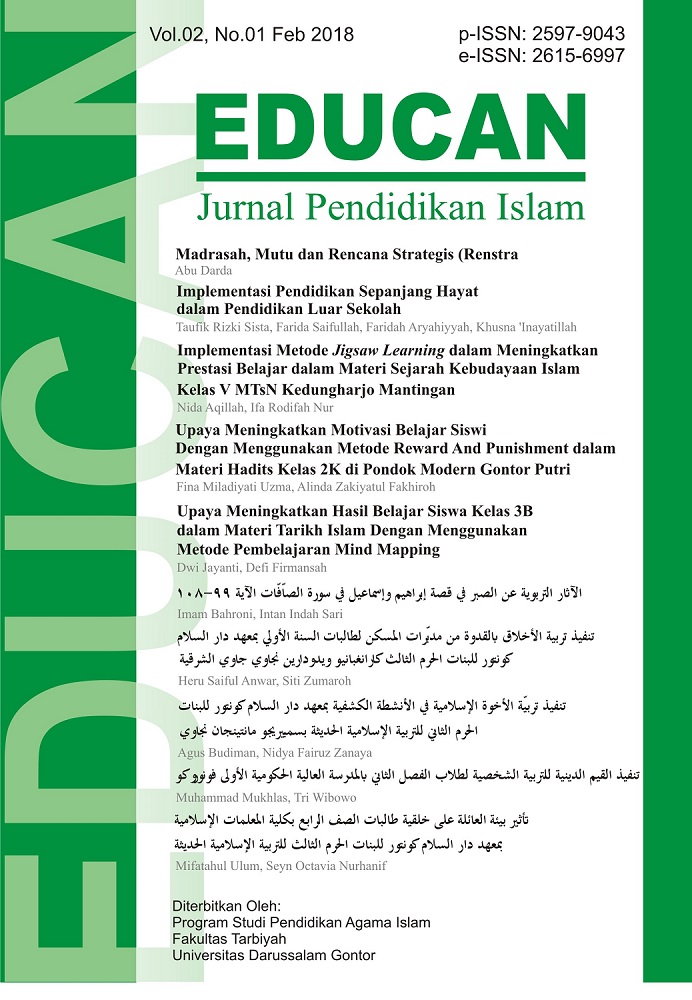
The Implementation of Jigsaw Learning in Improving VII Grade Students’ Achievement MTsN Kedungharjo Mantingan for Sejarah Kebudayaan Islam Subject
DOI:
https://doi.org/10.21111/educan.v2i1.1971Keywords:
Learning process, learning method, observing, planning, teaching.Abstract
In the teaching and learning process, teachers have an important position and determinator whether or not the learning process success. The choice of appropriate learning method also need to be noticed by the teachers. Giving something new in the learning model will improve students’ spirit and achievement. One of the learning method is by implement the cooperative method which consists of various learning methods with group system. Then, the small groups are able to build students’ togetherness and resposibility between them. The implementation of the method is this research was done in two steps and it is usually called as cycle. Every cycle consist of four steps; (1) planning, (2) acting, (3) observing, (4) reflecting. The result of the research showed that there is an improvement in students’ achievement toward Sejarah Kebudayaan Islam subject using jigsaw method. It is indicated that the implementation of jigsaw learning for Sejarah Kebudayaan Islam subject of grade V MTsn is effective in improving students’ achievement.References
Arends, R.I. Learning to Teeach Belajar Untuk Mengajar. Edisi Ketujuh. Buku Saku. Terj. Helly Prajitno Soetjipto & Sri Mulyantini Soetjipto. (Yogyakarta: Pustaka Belajar: 2008)
Daryanto. Penelitian Tindakan Kelas dan Penelitian Tindakan Sekolah. (Yogyakarta:Gava Media,2011)
Departemen Pendidikan dan Kebudayaan, Kamus Besar Bahasa Indonesia (Jakarta: Balai Pustaka, 1989)
Hamzah B. Uno, Nina Lamatenggo, Satria, Menjadi Peneliti PTK yang Profesional,(Jakarta: Bumi Aksara, 2011)
Huda, Miftahul.. Model-model Pengajaran dan Pembelajaran. (Yogyakarta :Pustaka Pelajar, 2014)
Isjoni, Cooperative Learning Mengembangkan Kemampuan Belajar Berkelompok (Bandung: Alfabeta, 2009)
Kurniasih, Imas dan Berlin Sani .Ragam. Pengembangan Model
Pembelajaran Untuk Peningkatan Profesional Guru, (Katapena. 2015).
Lie, Anita. Cooperative Learning (Jakarta: Gramedia Widiasarana Indonesia, 2002)
Nini Subini dkk, Psikologi Pembelajaran, (Jogjakarta:Mentari Pustaka, 2012).
Robert E. Slavin, Cooperative Learning Teori Riset dan Praktik, terj. Lita (Bandung: Nusa Media, 2009).
Rusman. Model-model Pembelajaran Mengembangkan Profesional Guru.( Jakarta :Rajawali Pers, 2012).
Saleh, Abdul Rahman, Madrasah dan Pendidikan Anak Bangsa, (Jakarta: PT Raja Grafindo Persada,2004).
Slameto, Belajar dan Faktor-Faktor Yang Mempengaruhinya (Jakarta: Rineka Cipta: 2003), hal. 2
Sunarto, Pengertian Prestasi Belajar, http://sunartombs. wordpress.com /2009/01/05/ pengertian prestasi -belajar /. Diakses tanggal 5 Juni 2010.
Sudjana, Nana, Cara Belajar Siswa Aktif Dalam Proses Belajar Mengajar, (Bandung: Sinar Baru, 1989).
Sugiyono, Metode Penelitian Pendidikan Pendekatan Kuantitatif, Kualitatif Dan R & D , (Bandung: Alfabeta, 2013)
Suyatno. Menjelajah Pembelajarana Inovatif. (Sidoarjo:Masmamedia Buana Pustaka, 2009).
Downloads
Submitted
Accepted
Published
How to Cite
Issue
Section
License
1. PROPOSED POLICY FOR JOURNALS THAT OFFER OPEN ACCESS
Authors who publish with this journal agree to the following terms:
- Authors retain copyright and grant the journal right of first publication with the work simultaneously licensed under a Creative Commons Attribution License that allows others to share the work with an acknowledgement of the work's authorship and initial publication in this journal.
- Authors are able to enter into separate, additional contractual arrangements for the non-exclusive distribution of the journal's published version of the work (e.g., post it to an institutional repository or publish it in a book), with an acknowledgement of its initial publication in this journal.
- Authors are permitted and encouraged to post their work online (e.g., in institutional repositories or on their website) prior to and during the submission process, as it can lead to productive exchanges, as well as earlier and greater citation of published work (See The Effect of Open Access).
2. PROPOSED POLICY FOR JOURNALS THAT OFFER DELAYED OPEN ACCESS
Authors who publish with this journal agree to the following terms:
- Authors retain copyright and grant the journal right of first publication, with the work [SPECIFY PERIOD OF TIME] after publication simultaneously licensed under a Creative Commons Attribution License that allows others to share the work with an acknowledgement of the work's authorship and initial publication in this journal
- Authors are able to enter into separate, additional contractual arrangements for the non-exclusive distribution of the journal's published version of the work (e.g., post it to an institutional repository or publish it in a book), with an acknowledgement of its initial publication in this journal.
- Authors are permitted and encouraged to post their work online (e.g., in institutional repositories or on their website) prior to and during the submission process, as it can lead to productive exchanges, as well as earlier and greater citation of published work (See The Effect of Open Access).