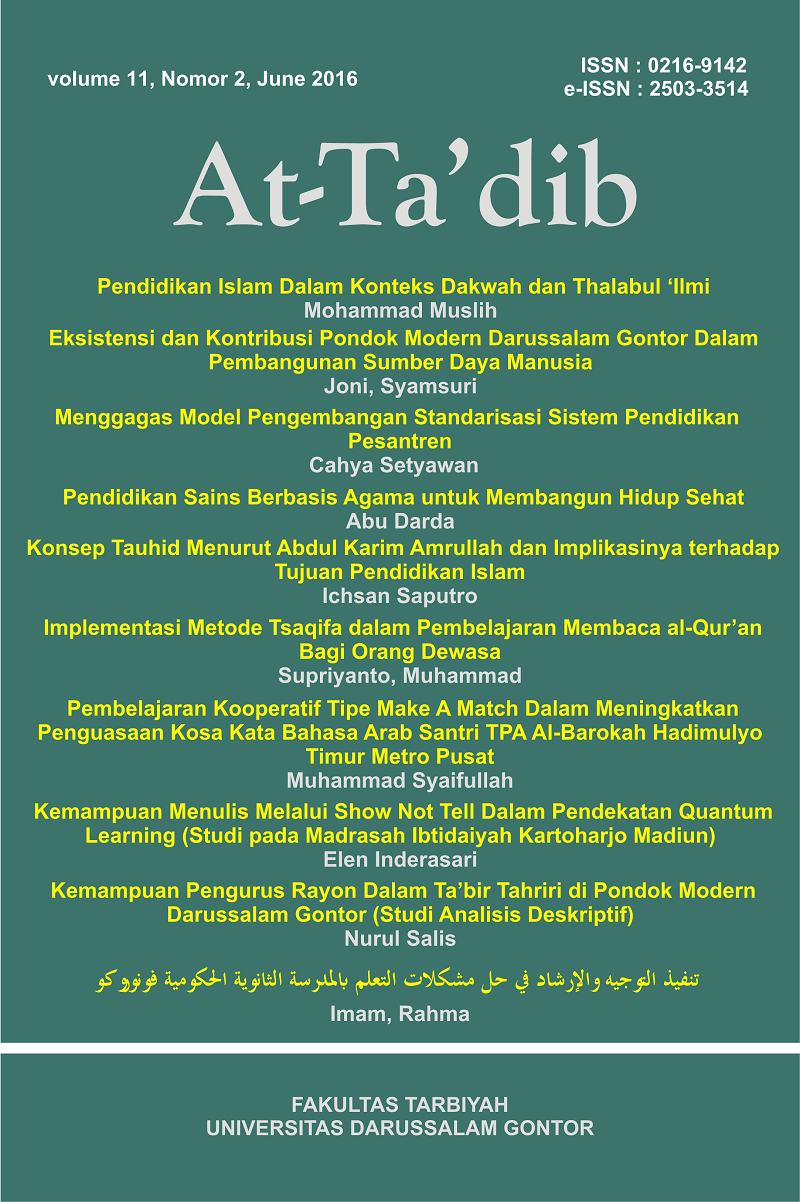
Implementasi Metode Tsaqifa dalam Pembelajaran Membaca al-Qur’an Bagi Orang Dewasa
DOI:
https://doi.org/10.21111/at-tadib.v11i2.780Keywords:
Learning Method, Reading Quran, Teaching Materials, Tsaqifa, Adult Education.Abstract
This study aims to assess the substance of the material in the methodof learning the Quran tsaqifa. This method is specifically designed for adultswho have not been able to read the Quran or who never learned and stillverbatim read. In addition, the method also put a target on the learner inorder to quickly be able to read the Quran. Therefore, in this research, theauthor tries to re-examine whether the method is rapid, promising thecontent of what is taught is completely in accordance with the rules ofArabic writing is good and right. This study shows that the materialsubstance of this method known arabic (hijaiyah) approach Indonesiantranslation or Latin letters. However, the use of transliteration standardyet to implement them, like the letter “qo†written “ko†letter “sho†written“soâ€. In addition, there is also a writing error dot on the letter, such letter“ta†which should dot two above letter, written under the letter. It is perhapsworth noting because if wrong in awarding a point it will be wrong in thepronunciation. Nevertheless, the overall method is already making a positivecontribution to learning to read the Quran. Kedepanya expected to appearnew methods in reading the Koran rather comprehensive. Not merelyconcerned with the ability to read quickly, but also pay attention to thesubstance of the material well.References
Adhim, Said Abdul. dkk. Nikmatnya Menangis Bersama Al-Quran. (Jakarta Timur: Istanbul. 2015).
Agama RI, Departemen. Al-Quran dan Terjemahnya. (Jakarta: Darus Sunnah. 2013).
Alex, S.S. Bahasa Indonesia Untuk Perguruan Tinggi. (Jakarta: Kencana Prenada Media Group. 2010).
Anam, Ahmad Syaiful. Pengantar Ilmu Tahsin. (Surakarta: Yuma Pustaka. 2013).
Annuri, Ahmad. Panduan Tahsin Tilawah Al-Quran dan Ilmu Tajwid. (Jakarta: Pustaka Al-Kautsar. 2010).
Anwar, Efendi. Bimbingan Tahsin dan Tajwid Al-Quran Utsmani. (Jakarta: Cahaya Qurani Press. 2012).
Hadi, Nor. Juz ‘Amma: Cara Mudah Membaca dan Memahami Al-Quran Juz Ke 30. (Jakarta: Erlangga. 2014).
Hamzah, Ali. Pendidikan Agama Islam Untuk Perguruan Tinggi. (Bandung: Alfabeta. 2014).
Harjanto. Perencanaan Pengajaran. (Jakarta: Rineka Cipta. 2006).
Ismawati, Esti. Bahasa Indonesia Untuk Karya Ilmiah. (Yogyakarta: Ombak. 2012).
Khallaf, Abdul Wahhab. Ilmu Ushul Fikih. (Kuwait: Darul Qalam. 1977).
Khon, Abdul Majid. Praktikum Qira’at: Keanehan Bacaan Al-Quran Qira’at Ashim dari Hafash. (Jakarta: Amzah. 2011).
Kurnaedi, Abu Ya’la. Tajwid Lengkap Asy-Syafi’i. (Jakarta: Pustaka Imam Asy-Syafi’i. 2014).
Mahmud dkk. Pendidikan Agama Islam Dalam Keluarga. (Jakarta: Permata Puri Media. 2013).
Majid, Abdul. Belajar dan Pembelajaran. (Bandung: Remaja Rosda Karya. 2012).
Mujib, Abdul. Ilmu Pendidikan Islam. (Jakarta: Kencana Prenada Media. 2006).
Mulyono. Strategi Pembelajaran menuju Efektivitas Pembelajaran di Aba Global. (Malang: UIN Maliki Press. 2012).
Mustofa, Syaiful. Strategi Pembelajaran Bahasa Arab Inovatif. (Malang: UIN-Maliki Press. 2011).
Nasih, Ahmad Munjin. Metode Dan Teknik Pembelajaran Pendidikan Agama Islam. (Bandung: Refika Aditama. 2009).
Sagala, Syaiful. Konsep Dan Makna Pembelajaran Untuk Membantu Memecahkan Problematika Belajar Dan Mengajar. (Bandung: Alfabeta. 2011).
Suma, Muhammad Amin. Ulumul Qur’an. (Jakarta: PT Raja Grafindo. 2013).
Susanto, Ahmad. Teori Belajar Dan Pembelajaran di Sekolah Dasar. (Jakarta: Kencana Prenada Media Group. 2013).
Suyadi. Strategi Pembelajaran Pendidikan Karakter. (Bandung: PT Remaja Rosdakarya. 2013).
Syarifuddin, Ahmad. Mendidik Anak, Membaca, Menulis, dan Mencintai Al-Quran. (Depok: Gema Insani. 2004).
Taqwim, Umar. Metode Tsaqifa, Belajar Al Qur'an dengan Mudah, Praktis dan Cepat. (Surakarta: al Qawam. 2014).
Zarkasyi, Imam. Tajwid: Bagaimana Cara Membaca Al-Quran dengan Baik untuk Pelajaran Permulaan. (Gontor: Trimurti Press. 2010).
Downloads
Submitted
Published
How to Cite
Issue
Section
License
Copyright Notice
Authors who publish with this journal agree to the following terms:
- Authors retain copyright and grant the journal right of first publication with the work simultaneously licensed under a Creative Commons Attribution License that allows others to share the work with an acknowledgment of the work's authorship and initial publication in this journal. Creative Commons Attribution-ShareAlike 4.0 International License.
- Authors are able to enter into separate, additional contractual arrangements for the non-exclusive distribution of the journal's published version of the work (e.g., post it to an institutional repository or publish it in a book), with an acknowledgment of its initial publication in this journal.
- Authors are permitted and encouraged to post their work online (e.g., in institutional repositories or on their website) prior to and during the submission process, as it can lead to productive exchanges, as well as earlier and greater citation of published work.
- The author warrants that the article is original, written by stated author(s), has not been published before, contains no unlawful statements, does not infringe the rights of others, is subject to copyright that is vested exclusively in the author and free of any third party rights, and that any necessary written permissions to quote from other sources have been obtained by the author(s).

AT-TA'DIB: Journal of Pesantren Education Published by Faculty of Tarbiyah, University of Darussalam Gontor, Indonesia is licensed under a Creative Commons Attribution-ShareAlike 4.0 International License.
Based on a work at https://ejournal.unida.gontor.ac.id/index.php/tadib/index