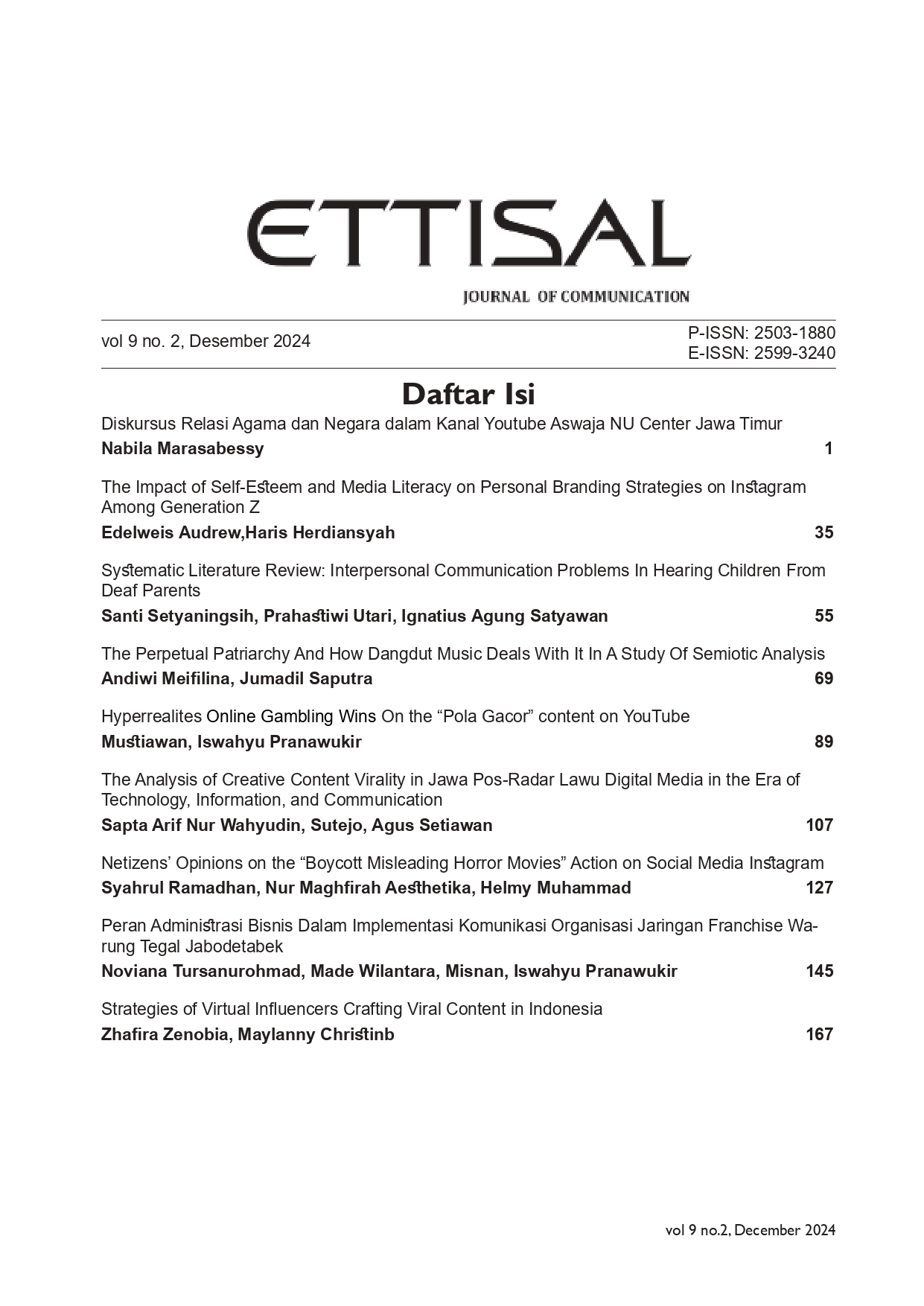
Diskursus Relasi Agama dan Negara dalam Kanal Youtube Aswaja NU Center Jawa Timur
Religion and State in Youtube: Understanding the Discourse in Aswaja NU's Channel
DOI:
https://doi.org/10.21111/ejoc.v9i2.11236Kata Kunci:
Relasi Agama dan Negara, YouTube, Nahdlatul ulamaAbstrak
The debate about the relationship between religion and the state in Indonesia has been going on since pre-independence times and the problem is still ongoing today. This debate occurred in various public spaces, including on social media, YouTube channels. Aswaja NU Center East Java is Nahdlatul Ualama's YouTube channel which also articulates discourse on the relations between religion and the state in Indonesia. The aim of this research is to find out how the relationship between religion and the state in Indonesia is interpreted on the Aswaja NU Center East Java YouTube channel and to find out the causes of this discourse continues to this day. This research approach is qualitative using Norman Fairclough's Critical Discourse Analysis method. This method analyzes discourse from linguistic aspects, aspects of discourse practice and the surrounding social context. The results of the research show that according to the East Java Aswaja NU Center, the most appropriate form of relationship between religion and the state to be implemented in Indonesia is the substantive model, namely the State prioritizes the implementation of religious values ​​in state life rather than the existence of religious symbols. Then the factor that causes the debate on the relationship between religion and the state in Indonesia continues to rage, namely because there is a history of the formulation of the basic state of Pancasila which has not been completed and Pancasila is still used as a political tool of the ruling regime.Referensi
Allcott, H., & Gentzkow, M. (2017). Social Media and Fake News in the 2016 Election. Journal of Economic Perspectives, 31(2), 211–236. https://doi.org/10.1257/jep.31.2.211
Andri Saubani. (2020, July 3). Ini Pernyataan Bersama Ormas Keagamaan Tolak RUU HIP. Republika Online. https://republika.co.id/share/qcw1ud409
Anshari, E. S. (1976). The Jakarta Charter of June 1945: A History of the Gentlemen’s Agreement between the Islamic and the Secular Nationalist in Modern Indonesia [M.A. Thesis]. McGill University.
Anshari, E. S. (1981). Piagam Jakarta 22 Juni 1945 dan Sejarah Konsensus Nasional antara Nasionalis Islami dan Nasionalis Sekuler tentang Dasar Negara Republik Indonesia 1945—1959. Pustaka Perpustakaan Salman ITB.
Anton Hariyadi. (2020). Siapa Yang Membutuhkan RUU HIP. In ADALAH : BULETIN HUKUM DAN KEADILAN (Vol. 4, pp. 17–26).
Arifin, S. (2021, December 7). Profil. Aswaja NU Center PWNU Jawa Timur. https://aswajanucenterjatim.or.id/profil-aswaja-nu-center
Asrori, M. (2020). Kesalahan Pandangan dalam RUU HIP Menurut Ketum ISNU. nu.or.id. https://www.nu.or.id/nasional/kesalahan-pandangan-dalam-ruu-hip-menurut-ketum-isnu-tgRMz
Atkins, A. (2002). Critical Discourse Analysis: A Letter to expatriates from Rt. Hon. Sir Norman Fowler MP. Tidak dipublikasikan.
Bagaskara, B., & Ruslan, A. (2019). Perancangan Video Explainer “Mengenal Dampak Penggunaan Gadget (Smartphone) Secara Eksesif Pada Anak†Untuk Orang Tua. PANTAREI, 3(03), Article 03. https://jom.fikom.budiluhur.ac.id/index.php/Pantarei/article/view/424
Bellah, R. N. (1991). Beyond Belief: Essays on Religion in a Post-Traditionalist World. University of California Press.
Bellah, R. N. (2005). Civil Religion in America. The MIT Press on Behalf of American Academy of Arts & Sciences, 134(4), 40–55. www.jstor.org/stable/20028013
Boland, B. J. (1971). THE STRUGGLE OF ISLAM IN MODERN INDONESIA. Springer Dordrecht.
Darma, Y. A. (2014). Analisis Wacana Kritis dalam Multiperspektif (Ed 1). Refika Aditama.
Fairclough, N. (1995). Critical discourse analysis: The critical study of language. Longman.
Feillard, A. (1999a). NU Vis a Vis Negara, Pencarian Isi, Bentuk dan Makna. LKiS Pelangi Aksara.
Feillard, A. (1999b). NU vis a vis Negara ; Pencarian Isi, Bentuk dan Makna. Lkis Pelangi Aksara.
Hadikusumo, K. B. (1954). Islam sebagai Dasar Negara dan Akhlak Pemimpin. Pustaka Rahayu.
Hashemi, N. (2021). Islam, Sekularisme dan Demokrasi Liberal. Islamic Renaissance Front.
Herman, H., Una, S., & Fitra, T. R. (2021). PANDANGAN PEMUDA PANCASILA KABUPATEN MUARO JAMBI TERHADAP RANCANGAN UNDANG-UNDANG HALUAN IDEOLOGI PANCASILA [Doctoral dissertation]. UIN Sulthan Thaha Saifuddin.
Indrawati, I. (2021). Islam dan Negara: Genealogi sekularisme Islam di Indonesia 1930-1983 [Phd, UIN Sunan Ampel Surabaya]. http://digilib.uinsby.ac.id/50938/
Jailani, I. A. (2014). PERGOLAKAN POLITIK ANTARA TOKOH MUSLIM DAN NASIONALIS PADA SAAT PENENTUAN DASAR NEGARA REPUBLIK INDONESIA. Karsa: Journal of Social and Islamic Culture, 22(2), Article 2. https://doi.org/10.19105/karsa.v22i2.531
Kurniawan, H. (2021, January 7). Sekularisme Prancis dan Amerika Serikat. Suara Kebebasan. https://suarakebebasan.id/sekularisme-prancis-dan-amerika-serikat/
Latief, M. (2017). Islam dan Sekularisasi Politik di Indonesia. TSAQAFAH, 13(1), Article 1. https://doi.org/10.21111/tsaqafah.v13i1.974
Maarif, A. S. (1996). Islam dan politik: Teori belah bambu, masa demokrasi terpimpin, 1959-1965—Ahmad Syafii Maarif—Google Books. Gema Insani Press. http://surl.li/ireao
Mahelingga, D. E. I. R. (2021). KEKUATAN INFOGRAFIS DAN PERANNYA DALAM BUKU PANGAN FUNGSIONAL. BACA: JURNAL DOKUMENTASI DAN INFORMASI, 42(1), 119. https://doi.org/10.14203/j.baca.v42i1.625
Mardatillah, A. (2020, June 13). Ini Dia Kritikan Ormas Keagamaan Terkait RUU Haluan Ideologi Pancasila. hukumonline.com. https://www.hukumonline.com/berita/a/ini-dia-kritikan-ormas-keagamaan-terkait-ruu-haluan-ideologi-pancasila-lt5ee488cccc51c
McQuail, D. (2011). Teori Komunikasi Massa (terj. Putri Iva Izzati) (6th ed.). Salemba Humanika.
Murod, M. (1999). NEGARA DAN ISLAM DI INDONESIA (Suatu Perbandingan Pemikiran Politik Abdurrahman Wahid Dan Amien Rais Tentang Hubungan Agama dan Negara) [Tesis]. Universitas Airlangga.
Natsir, M., & Anshari, E. S. (2001). Agama dan negara dalam perspektif Islam (Cet. 1). Media Da’wah.
Nisa’, K. (2020). PERDEBATAN PEMIKIRAN HUBUNGAN AGAMA DAN NEGARA DI INDONESIA [Skripsi]. INSTITUT AGAMA ISLAM NEGERI (IAIN) SALATIGA.
Nurdin, A. A. (2016a). Revisiting Discourse on Islam and State Relation in Indonesia: The View of Soekarno, Natsir and Nurcholis Madjid. Indonesian Journal of Islam and Muslim Societies, 6(1), 63–92.
Nurdin, A. A. (2016b). Revisiting discourse on Islam and state relation in Indonesia: The view of Soekarno, Natsir and Nurcholish Madjid. Indonesian Journal of Islam and Muslim Societies, 6(1), Article 1. https://doi.org/10.18326/ijims.v6i1.63-92
Pardoyo. (1993). Sekularisasi dalam polemik (Cet. 1). Pustaka Utama Grafiti.
Persada, S. (2020, July 16). FPI Demo di DPR, Bawa Isu “Lumat†RUU HIP. Tempo. https://nasional.tempo.co/read/1365838/fpi-demo-di-dpr-bawa-isu-lumat-ruu-hip
Sahidah, A. (2019). AGAMA SIPIL DI AMERIKA SERIKAT: TELAAH TERHADAP GAGASAN DAN PERAN ROBERT N. BELLAH. SIMULACRA, 2(1), 5–20.
Shaleh, A. I., & Wisnaeni, F. (2019). Hubungan agama dan negara menurut pancasila dan undang-undang dasar negara republik indonesia tahun 1945. Jurnal Pembangunan Hukum Indonesia, 1(2), 237–249.
Soekarno, & Parikesit, S. (2016). Dibawah Bendera Revolusi (Jilid 1). Banana Books.
Solikhati, S. (2018). SIMBOL KEAGAMAAN DALAM ISLAM DAN IDEOLOGI TELEVISI. Islamic Communication Journal, 2(2), Article 2. https://doi.org/10.21580/icj.2017.2.2.2165
Stieglitz, S., & Dang-Xuan, L. (2013). Emotions and Information Diffusion in Social Media-Sentiment of Microblogs and Sharing Behavior. Journal of Management Information Systems, 29(4), 217–248.
Suryanegara, A. M. (2009). API SEJARAH. Salamadani Pustaka Semesta.
Syarif, F. (2019). IJTIHAD POLITIK NU: NEGARA PANCASILA ADALAH NEGARA ISLAM. Alfuad: Jurnal Sosial Keagamaan, 3(2), Article 2. https://doi.org/10.31958/jsk.v3i2.1625
Triharso, O. A. (2008). PEMBANGUNAN IDEOLOGI, PENDIDIKAN PANCASILA DAN MASYARAKAT GOTONG ROYONG. Jurnal Pelangi Ilmu, 2(1).
Weismueller, J., Paul Harrigan, Kristof Coussement, & Tina Tessitore. (2021). What Makes People Share Political Content on Social Media? The Role of Emotion, Authority and Ideology. Computers in Human Behavior, 129, 8.
Zainuddin, A. R. (1992). Kekuasaan dan negara pemikiran politik Ibnu Khaldun (Cet. 1). Gramedia Pustaka Utama
##submission.downloads##
Diterbitkan
Terbitan
Bagian
Lisensi

Artikel ini berlisensiCreative Commons Attribution-NonCommercial-ShareAlike 4.0 International License.
Copyright Notice
Authors retain full copyright and grant Ettisal: Journal of Communication the right of first publication. The published work is simultaneously licensed under a Creative Commons Attribution–NonCommercial–ShareAlike 4.0 International License (CC BY-NC-SA 4.0).
This license allows others to share and adapt the work for non-commercial purposes, provided proper credit is given to the author(s) and the journal, a link to the license is included, and any derivative works are distributed under the same license.
Additional Distribution Rights
Authors may enter into separate, non-exclusive agreements for the distribution of the journal’s published version of their work—such as depositing it in institutional repositories or including it in edited books—provided that the initial publication in Ettisal: Journal of Communication is acknowledged.
Pre- and Post-Publication Sharing
Authors are permitted and encouraged to share their work online (e.g., through institutional repositories, academic networking platforms, or personal websites) before, during, and after the submission process. Such practices promote scholarly exchange and can enhance the visibility and citation impact of the published work.
License Statement:
All articles published in Ettisal: Journal of Communication are licensed under the Creative Commons Attribution–NonCommercial–ShareAlike 4.0 International License (CC BY-NC-SA 4.0).