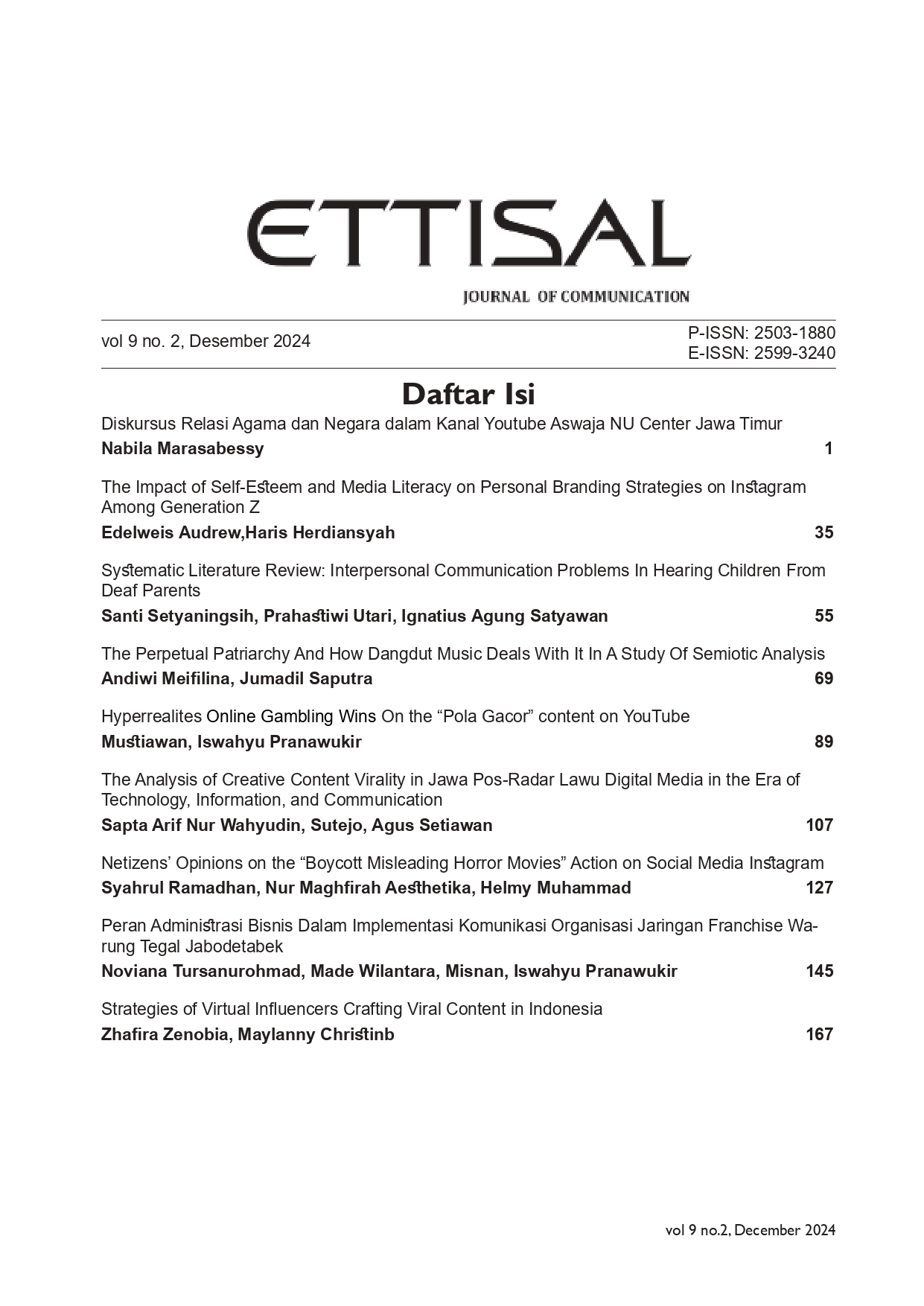
Netizens' Opinions on the "Boycott Misleading Horror Movies" Action on Social Media Instagram
DOI:
https://doi.org/10.21111/ejoc.v9i2.12670Keywords:
Opinion, Netizen, Boycott, Horror MovieAbstract
This study aims to analyze netizen responses to the boycott of horror films that use religious symbols on Instagram social media, as well as identify factors that influence netizen behavior after watching the film. This research uses a qualitative method with a content analysis approach and a netnography study. The results show that the majority of netizens support the boycott of films that are considered misleading and damaging to the faith, with the film «Kiblat» as one example that is considered to harass Islamic symbols. Netizens› reactions are influenced by various factors, including social factors, personality,religiosity, age, and the role of social media. Instagram, as the main platform, allowed netizens to express their opinions regarding the boycott of this horror movie, which shows that social media has an important role in shaping public opinion and can have a significant impact on the film industry in Indonesia. Netizens› negative reactions to the use of religious symbols in horror films reflect a high sensitivity to religious issues, especially when they are perceived to undermine faith values. This research provides important insights into how religious symbols in horror films can trigger widespread social reactions among social media users, as well as how such reactions can influence trends in the creative industry in Indonesia, particularly in the production of films involving religious elements.References
Ahmadi, M. (2020). Dampak Perkembangan New Media Pada Pola Komunikasi Masyarakat. Jurnal Komunikasi Dan Penyiaran Islam, 4(1), 26–37. Retrieved from https://ejournal.iai-tabah.ac.id/index.php/alamtaraok/article/view/499
Aistrope, T., & Fishel, S. (2020). Horror, apocalypse and world politics. International Affairs, 96(3), 631–648. https://doi.org/10.1093/ia/iiaa008
Al FAZZATIL A`LA. (2022). ANALISIS KOMENTAR NETIZEN MELALUI INSTAGRAM AKUN @DAGELANMUSIK TERHADAP KONTEN TELEVISI INDONESIA. ×”×רץ, (8.5.2017), 2003–2005.
Alapján-, V. (2016). BAB III METODE PENELITIAN. (Sekaran), 1–23.
Anggara, A., Widiono, S., Tri Hidayat, A., & Sutarman, S. (2022). Analysis of Netizen Comments Sentiment on Public Official Statements on Instagram Social Media Accounts. International Journal of Advances in Data and Information Systems, 3(2), 87–97. https://doi.org/10.25008/ijadis.v3i2.1244
Asti, G. K., Febriana, P., Aesthetika, N. M., Studi, P., Komunikasi, I., Bisnis, F., … Mckee, A. (n.d.). Representasi pelecehan seksual perempuan dalam film. (2012), 79–87.
Damayanti, A. (2020). Instagram sebagai Medium Komunikasi Risiko di Masa Pandemi COVID-19: Studi Netnografi terhadap Komunitas Online KawalCOVID19.id. Jurnal Komunikasi Pembangunan, 18(02), 176–193. https://doi.org/10.46937/18202032355
Dr. Nursapia Harahap, M. . P. (2020). PENELITIAN KUALITATIF. (september 2016), 1–6.
Holilah, I. (n.d.). DAMPAK MEDIA TERHADAP PERILAKU MASYARAKAT. In Dampak Media Terhadap Perilaku Masyarakat Ilah holilah.
Isko, R. (2022). ANALISIS ISI KUALITATIF OPINI PUBLIK TERHADAP PENGATURAN PENGGUNAAN PENGERAS SUARA DI MASJID PADA MEDIA SOSIAL YOUTUBE.
Michelle, A., & Susilo, D. (2021). The Effect of Instagram Social Media Exposure on Purchase Decision. ETTISAL : Journal of Communication, 6(1), 36. https://doi.org/10.21111/ejoc.v6i1.6242
Mutiah, T., & Rafiq, A. (2021). Instagram Media Baru Penyebaran Berita (Studi pada akun @feydown_official). Jurnal Media Penyiaran, 1(2), 58–62. https://doi.org/10.31294/jmp.v1i2.852
Qadri, M. (2020). Pengaruh Media Sosial Dalam Membangun Opini Publik. Qaumiyyah: Jurnal Hukum Tata Negara, 1(1), 49–63. https://doi.org/10.24239/qaumiyyah.v1i1.4
Rohman, H., & Aesthetika, N. M. (2021). Analysis of Instagram Media Account @Sapawargasby Surabaya City Government About Covid-19 Information. Indonesian Journal of Public Policy Review, 14, 1–5. https://doi.org/10.21070/ijppr.v14i0.1149
Sponsored, I., Brain, I. Y., Article, T., Journal, I., Review, I. L., Journal, I., … Review, I. L.
Downloads
Published
Issue
Section
License

This work is licensed under a Creative Commons Attribution-NonCommercial-ShareAlike 4.0 International License.
Copyright Notice
Authors retain full copyright and grant Ettisal: Journal of Communication the right of first publication. The published work is simultaneously licensed under a Creative Commons Attribution–NonCommercial–ShareAlike 4.0 International License (CC BY-NC-SA 4.0).
This license allows others to share and adapt the work for non-commercial purposes, provided proper credit is given to the author(s) and the journal, a link to the license is included, and any derivative works are distributed under the same license.
Additional Distribution Rights
Authors may enter into separate, non-exclusive agreements for the distribution of the journal’s published version of their work—such as depositing it in institutional repositories or including it in edited books—provided that the initial publication in Ettisal: Journal of Communication is acknowledged.
Pre- and Post-Publication Sharing
Authors are permitted and encouraged to share their work online (e.g., through institutional repositories, academic networking platforms, or personal websites) before, during, and after the submission process. Such practices promote scholarly exchange and can enhance the visibility and citation impact of the published work.
License Statement:
All articles published in Ettisal: Journal of Communication are licensed under the Creative Commons Attribution–NonCommercial–ShareAlike 4.0 International License (CC BY-NC-SA 4.0).