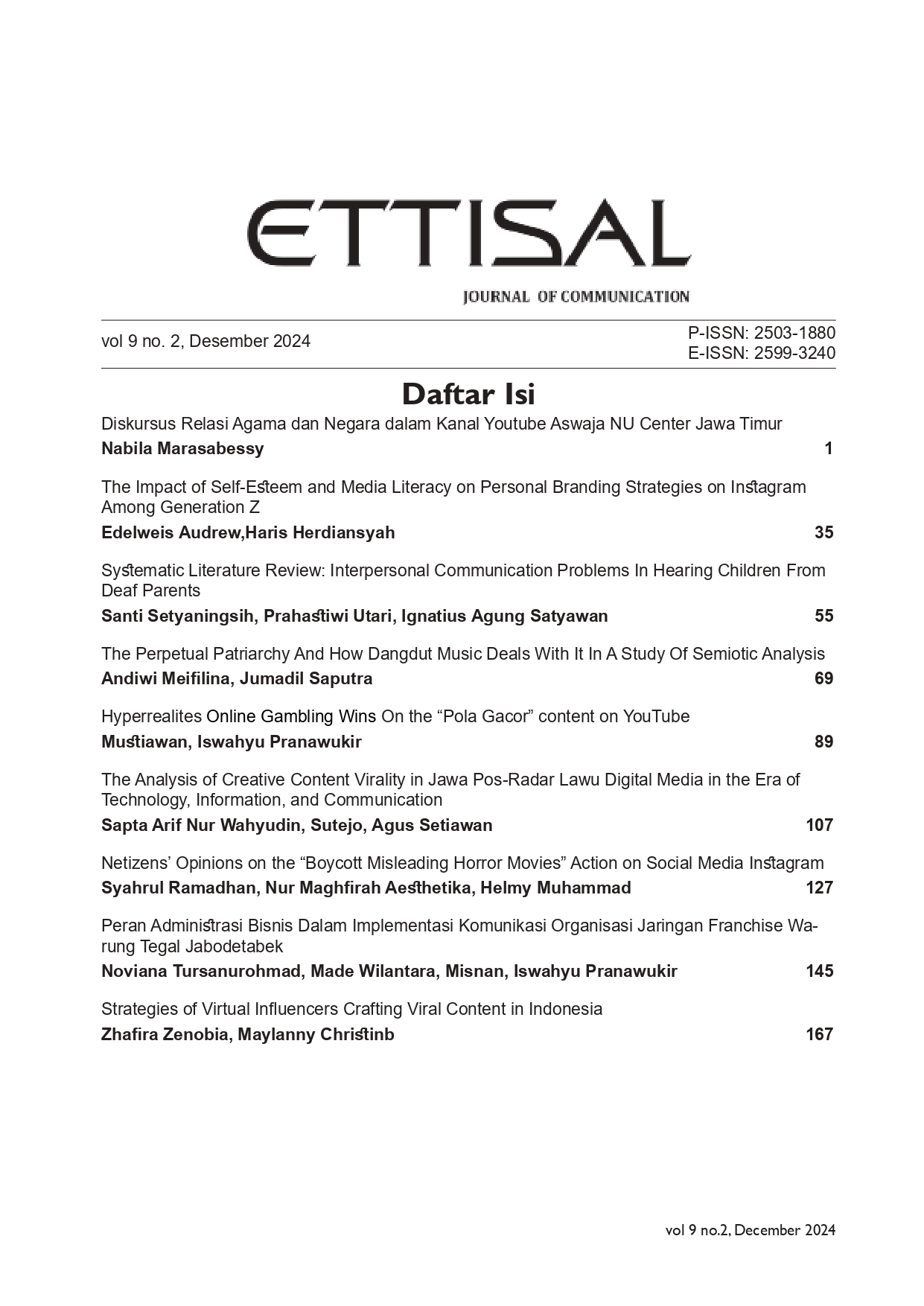
Systematic Literature Review: Interpersonal Communication Problems In Hearing Children From Deaf Parents
DOI:
https://doi.org/10.21111/ejoc.v9i2.12315Keywords:
Systematic Literature Review, Deaf Parents, Hearing Children, Interpersonal CommunicationAbstract
The main problem in families in which there are Deaf parents and Hearing children is the problem of communication, both verbally and in sign language. Hearing children with Deaf parents are able to communicate in two ways, either verbally with non-Deaf people or using sign language with Deaf people. Communication between children and Deaf parents is an important problem in their social and emotional development. This study aims to determine the communication problems that arise between children and Deaf parents. The main focus is to explore the obstacles experienced by children in understanding and conveying messages from their parents who have hearing impairments. This study uses the Systematic Literature Review (SLR) method. Researchers found 127 Scopus articles in a search using Science Direct and with the help of Mendeley and VOSViewer which were then filtered into 18 articles to be analyzed descriptively. The findings show that lack of communication should not be a reason why Deaf parents cannot have access or information about their children. And appreciate that hearing children or Children of Deaf Adults or CODA have different ways of communicating with Deaf parents, the Deaf community and the hearing or non-Deaf community.References
Journal
A.C. Jones, R. Gutierrez, A.K.Ludlow. (2021). Emotion production of facial exxpressions: A comparison of deaf and hearing children. Journal Communication Disorder 92 (2021) 106113
Ayu Zulia, Suheri Harahap, Anang Anas Azhar. POLA KOMUNIKASI INTERPERSONAL GURU SLB DALAM MEMPERKENALKAN PENDIDIKAN SEKSUAL DI SLB NEGERI AUTIS SUMATERA UTARA. SIBATIK JOURNAL |VOLUME 2 NO.3 ( FEBRUARY 2023). 953-962
Bernadette A.M. Vermejj dkk (2023). Effects in language development of young children with language delay during early intervention. Journal of Communication Disorder 103 (2023) 10632
Grandon, Benedicte and Anne Vilain. (2020). Development of fricative in French speaking school aged children using cochlear implants and children with normal hearing. Journal of Communication Disorder 86 (2020) 1055996.
Gumelar, Gilang; Hanny Hafiar; Priyo Subekti. (2018). Bahasa Isyarat Indonesia sebagai Budaya Tuli Melalui Pemaknaan Anggota Gerakan Untuk Kesejahhteraan Tunarungu. Kajian Ilmu Komunikasi 48 No. 1 (2018) : 65-78. Doi: http://dx.doi.org/10.21831/informasi.v48i1.17727
Harrison, Jane dkk. (2019). Views from the borderline: Extracts from my life as a coloured child of Deaf adults, growing up in apartheid South Africa. African Journal of Disability.
Heffernan, Georgina. Nixon, Elizabeth. (2023) Experiences of Hearing Children of Deaf Parents in Ireland. Journal of Deaf Studies and Deaf Education 2023, 28, 399-407.
Kamaruzzaman. (2016). Analisis Keterampilan Komunikasi Interpersonal Siswa. Jurnal Konseling Gusjigang 2(2). Doi: 10.24176/JKG.V212.744
Licthtif, Ida dkk (2020). Assesing deaf and hearing children’s communication in Brasil. Journal Communication Disorder 44 (2020) 223-235.
Merchan, Ana, dkk. (2022). Executive functions in deaf and hearing children: The mediating role of language skills in inhibitory control. Journal of Experimental Child Psychologu 2018 (2022) 105374.
M. Harwansyah Putra Sinaga,Annisya Rahma Simanullang, Alimatuk Sakdiyah Pulungan,Mutiara Harahap. Deskripsi Masalah Anak Tuna Rungu di SD Swasta At-Taufiq. Al-Hayat: Natural Sciences, Health & Environment Journal. Volume 1 No 2 (2023) 80-88.
Naomi Caseli, Phd. Dkk. (2021). Deaf Children of Hearing Parents Have Age – Level Vocabulary Growth When Exposed to American Sign Language by 6 Months of Age. The Journal of Pediatrics 2021:232:229-36.
Nomfundo F. Moroe dkk. (2018). Hearing children of Deaf Parents: Gender and birth order in the delegations of the interpreterrolein culturally Deaf Families. African Journal of Disability.
Ormel A. Ellen, Martine A.R. Gijsel dkk. (2020). Semantic categorization: A Comparison between deaf and hearing children. Journal of Communication Disorder 43 (2020) 347-360.
Sebastioan V. Funk Runa dkk. (2023). Representasi Masyarakat yang Inklusif dan Ekslusif dalam Film CODA. Journal Mahasiswa Komunikasi, Volume 3 No, 2 Oktober 2023 hal. 204-2015
Sinha Dutta, Shancari. (2023). Hearing Children with Deaf Parents : Growing Up with Unique Communication Challenges. Journal Medical Life Science
Singleton, Jenny L., and Matthew D. Tittle. (2020). Deaf Parents and Their Hearing Children. The Journal of Deaf Studies Education 5(3):221-36.
Sutrisnadipraja, Grace; Nathasya Shesilia; Sheila Putri F; Weny Pandia Sembiring. (2019). Intervensi Psikoedukasi dalam Mengatasi Stigma dan dalam Gerkatin Kepemudaan. Jurnal Bakti Masyarakat Indonesia 2(1).
Yuswati, Hanifah. Agus Setiawati, Farida. (2022). Peran Orang Tua dalam mengembangkan Bahasa Anak Pada Usia 5 6 Tahun. Journal Obsesi: Jurnal Pendidikan Anak Usia Dini Volume 6 Issue 5 (2022) Hal: 5029-5040.
Undang- Undang
[UU] UU No. 8 Tahun 2016 tentang Penyandang Disabilitas
Website
kemendikbud.go.id. 2023. Hari Disabilitas Internasional 2023: Kemendikbud Menggaungkan Semangat dan iklim Inklusivitas. Diakses pada tanggal 7 Januari 2024. https://www.kemdikbud.go.id/main/blog/2023/12/hari-disabilitas-internasional-2023-kemendikbudristek-menggaungkan-semangat-dan-iklim-inklusivitas
Pusat Bahasa Isyarat Indonesia
Downloads
Published
Issue
Section
License

This work is licensed under a Creative Commons Attribution-NonCommercial-ShareAlike 4.0 International License.
Copyright Notice
Authors retain full copyright and grant Ettisal: Journal of Communication the right of first publication. The published work is simultaneously licensed under a Creative Commons Attribution–NonCommercial–ShareAlike 4.0 International License (CC BY-NC-SA 4.0).
This license allows others to share and adapt the work for non-commercial purposes, provided proper credit is given to the author(s) and the journal, a link to the license is included, and any derivative works are distributed under the same license.
Additional Distribution Rights
Authors may enter into separate, non-exclusive agreements for the distribution of the journal’s published version of their work—such as depositing it in institutional repositories or including it in edited books—provided that the initial publication in Ettisal: Journal of Communication is acknowledged.
Pre- and Post-Publication Sharing
Authors are permitted and encouraged to share their work online (e.g., through institutional repositories, academic networking platforms, or personal websites) before, during, and after the submission process. Such practices promote scholarly exchange and can enhance the visibility and citation impact of the published work.
License Statement:
All articles published in Ettisal: Journal of Communication are licensed under the Creative Commons Attribution–NonCommercial–ShareAlike 4.0 International License (CC BY-NC-SA 4.0).