Multikulturalisme Dalam Video Game Dragon Age: Inquisition
DOI:
https://doi.org/10.21111/ettisal.v1i2.718Keywords:
multiculturalism, new media, semiotics, video gamesAbstract
Abstract With the development of technology today, video games are not just simple entertainment media. Supported by the advancement of newest technology, video games able to have content, just like cinema and films. With its content, video games can not be separated from the reality that determines the content in the process of production. Including values, cultures, and ideologies that are not always visible and latent. So through this study, the authors attempted to see how the video game Dragon Age: Inquistion, popular video games Bioware under the auspices of EA Software made in America. With topics related to multiculturalism, topics that related to idea how race and cultural diversity are represented in the media. America itself into a unique country, known as a melting pot of diverse cultures in the world. But do all races and culture are equally represented in the media?Or maybe there is some stereotype to particular race and culture? So through this study, the authors attempted to see how multiculturalism represented, especially through video games.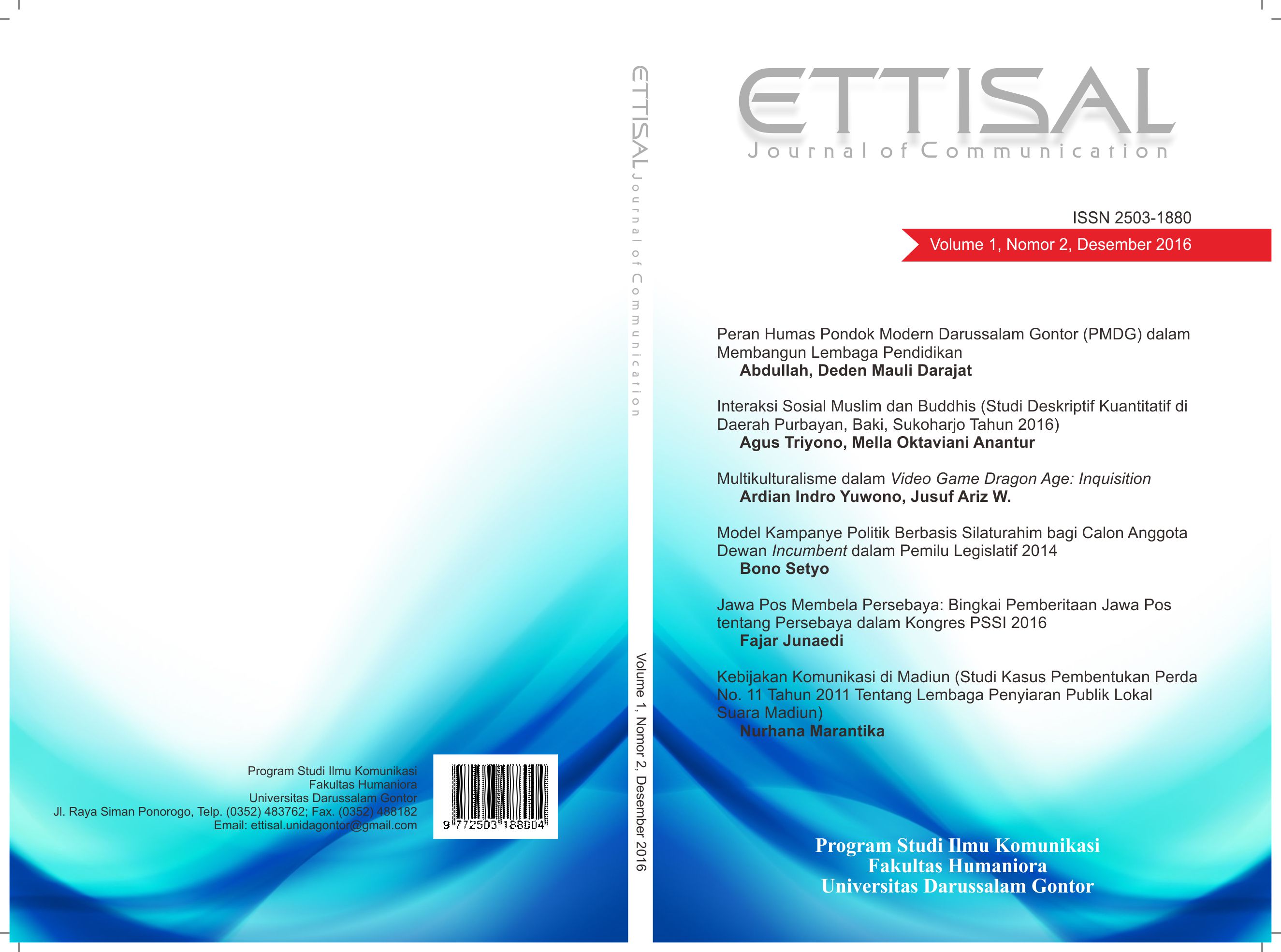
Downloads
Published
Issue
Section
License
Copyright Notice
Authors retain full copyright and grant Ettisal: Journal of Communication the right of first publication. The published work is simultaneously licensed under a Creative Commons Attribution–NonCommercial–ShareAlike 4.0 International License (CC BY-NC-SA 4.0).
This license allows others to share and adapt the work for non-commercial purposes, provided proper credit is given to the author(s) and the journal, a link to the license is included, and any derivative works are distributed under the same license.
Additional Distribution Rights
Authors may enter into separate, non-exclusive agreements for the distribution of the journal’s published version of their work—such as depositing it in institutional repositories or including it in edited books—provided that the initial publication in Ettisal: Journal of Communication is acknowledged.
Pre- and Post-Publication Sharing
Authors are permitted and encouraged to share their work online (e.g., through institutional repositories, academic networking platforms, or personal websites) before, during, and after the submission process. Such practices promote scholarly exchange and can enhance the visibility and citation impact of the published work.
License Statement:
All articles published in Ettisal: Journal of Communication are licensed under the Creative Commons Attribution–NonCommercial–ShareAlike 4.0 International License (CC BY-NC-SA 4.0).