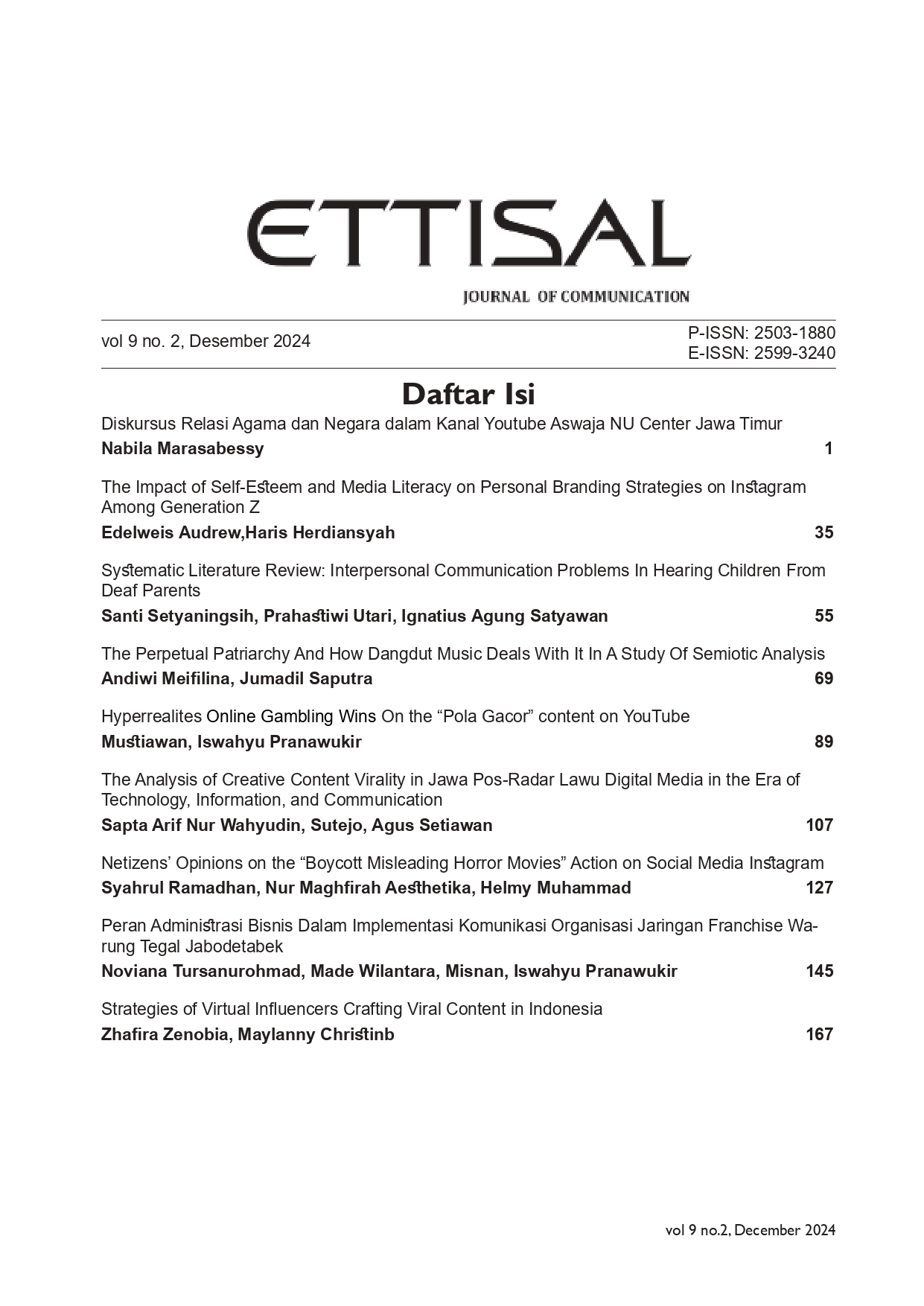
Strategies of Virtual Influencers Crafting Viral Content in Indonesia
DOI:
https://doi.org/10.21111/ejoc.v9i2.13251Keywords:
Virtual Influencer, Digital Storytelling, Representation, TikTokAbstract
Virtual influencers are becoming increasingly popular on social media, with many major brands targeting young consumers preferring virtual influencers as they are easier to manage compared to human influencers. This study aims to analyze the digital storytelling strategies and representations of virtual influencers from various countries, specifically Indonesia, the United States, and Brazil, on social media platforms like TikTok. Using a qualitative method with narrative analysis, this study found that virtual influencers reflect significant cultural and market differences based on their promotional focus and content style. For instance, Indonesian virtual influencer Arbie Seo promotes products from the brand Nabati, and Lentari Pagi focuses on promoting sports events like e-football. Meanwhile, American virtual influencer Lil Miquela collaborates with major brands like Dior, and Lu do Magalu from Brazil promotes household products. Digital storytelling is compelling as it unconsciously draws audiences into following storylines by integrating multimedia elements presented by virtual influencer content. This strategy not only enhances audience engagement but also increases the potential for content to go viral. This study provides insights into how virtual influencers build audience connections through storytelling and appealing representations.References
Andersson, Sobek, V., & Tim. (2020). Virtual Avatars, Virtual Influencers & Authenticity.
Berryman, R., Abidin, C., & Leaver, T. (2021). a Topography of Virtual Influencers. AoIR Selected Papers of Internet Research. https://doi.org/10.5210/spir.v2021i0.12145
Byun, K. J., & Ahn, S. J. (2023). A Systematic Review of Virtual Influencers: Similarities and Differences between Human and Virtual Influencers in Interactive Advertising. Journal of Interactive Advertising, 23(4), 293–306. https://doi.org/10.1080/15252019.2023.2236102
Choudhry, A., Han, J., Xu, X., & Huang, Y. (2022). “I Felt a Little Crazy Following a ‘Doll.’†Proceedings of the ACM on Human-Computer Interaction, 6(GROUP), 1–28. https://doi.org/10.1145/3492862
Christin, M., Obadyah, A., & Ali, D. (2021). Transmedia Story Telling. In Syiah Kuala University Press.
Claeys, P., Charry, K., & Tessitore, T. (2024). To be real or not to be real? The effect of genuine (vs. nongenuine) depictions of social media influencers on followers’ wellâ€being and brand purchase intention. Psychology & Marketing. https://doi.org/https://doi.org/10.1002/mar.21920
Conti, M., Gathani, J., & Tricomi, P. P. (2022). Virtual Influencers in Online Social Media. IEEE Communications Magazine, 60(8), 86–91. https://doi.org/10.1109/MCOM.001.2100786
Creswell, J., & Creswell, D. (2018). Research Design Qualitative, Quantitative & Mixed Methods Approaches (5th editio). Sage Edge.
Drenten, J., & Brooks, G. (2020). Celebrity 2.0: Lil Miquela and the rise of a virtual star system. Feminist Media Studies, 20(8), 1319–1323. https://doi.org/10.1080/14680777.2020.1830927
Ge, J., & Gretzel, U. (2018). Emoji rhetoric: a social media influencer perspective. Journal of Marketing Management, 34(15–16), 1272–1295. https://doi.org/10.1080/0267257X.2018.1483960
Hudders, L., De Jans, S., & De Veirman, M. (2021). The commercialization of social media stars: a literature review and conceptual framework on the strategic use of social media influencers. International Journal of Advertising, 40(3), 327–375. https://doi.org/10.1080/02650487.2020.1836925
Kapoor, P. S., Balaji, M. S., Jiang, Y., & Jebarajakirthy, C. (2022). Effectiveness of Travel Social Media Influencers: A Case of Eco-Friendly Hotels. Journal of Travel Research, 61(5), 1138–1155. https://doi.org/10.1177/00472875211019469
Lee, S.-L. (2021). The Meanings of Fashion on the Social Media of Virtual Influencer Lil Miquela. Journal of Digital Convergence, 19(9), 323–333. Retrieved from https://doi.org/10.14400/JDC.2021.19.9.323
Meng, L. (Monroe), Bie, Y., Yang, M., & Wang, Y. (2024). The effect of human versus virtual influencers: The roles of destination types and self-referencing processes. Tourism Management, 106(May 2024), 104978. https://doi.org/10.1016/j.tourman.2024.104978
Mrad, M., Ramadan, Z., & Nasr, L. I. (2022). Computer-generated influencers: the rise of digital personalities. Marketing Intelligence & Planning, 40(5). https://doi.org/. https://doi. org/10.1108/mip-12-2021-0423
Muniz, F., Stewart, K., & Magalhães, L. (2024). Are they humans or are they robots? The effect of virtual influencer disclosure on brand trust. Journal of Consumer Behaviour, 23(3), 1234–1250. https://doi.org/10.1002/cb.2271
Muslimah, D. D., & Sunengsih, A. (2023). A Bibliometric Analysis of Virtual Influencer. 01(12), 1353–1360. https://doi.org/https://doi.org/10.58812/wsis.v1i12.421
Nicoli, N., Henriksen, K., & Komodromos, M. (2022). Investigating digital storytelling for the creation of positively engaging digital content. 17(2), 157–173. https://doi.org/10.1108/EMJB-03-2021-0036
Oktan, A. (2024). Intertextuality in the Body Designs of AI-Based Virtual Influencers. 16(3). https://doi.org/https://doi.org/10.21659/rupkatha.v16n3.02
Pratiwi, T. S., Putri, Y. R., & Sugandi, M. S. (2015). Analisis Semiotika Roland Barthes Terhadap Logo Calais Tea. E-Proceeding of Management, 2(3), 4327–4336. Retrieved from https://openlibrary.telkomuniversity.ac.id/home/catalog/id/104472/slug/analisis-semiotika-roland-barthes-terhadap-logo-calais-tea.html%0Ahttps://core.ac.uk/download/pdf/299904072.pdf
Ricko, R., & Junaidi, A. (2019). Analisis Strategi Konten Dalam Meraih Engagement pada Media Sosial Youtube ( Studi Kasus Froyonion ). Prologia, 3(1), 231–237. https://doi.org/https://doi.org/10.24912/pr.v3i1.6245
Rodrigo-MartÃn, Rodrigo-MartÃn, & Muñoz-Sastre. (2021). Virtual Influencers as an advertising tool in the promotion of brands and products. Study of the commercial activity of Lil Miquela. 69–90. https://doi.org/10.4185/RLCS-2021-1521
Roy, D., & Chakraborty, J. (2023). “Forever young, beautiful, and scandal-freeâ€: Exploring the Ethical Frames and Crafted Authenticity in the Animated Images of Female Virtual Influencers. Global Media Journal-Indian Edition, 15(1), 1–23.
Rudzika, S. (2024). Representation of Socially Significant Issues in the Communication of Virtual Influencers on Social Medium Instagram. 73–84. https://doi.org/10.22364/ms23.08
Sands, S., Campbell, C. L., & Plangger, K. (2022). Unreal in fl uence : leveraging AI in in fl uencer marketing. 56(6), 1721–1747. https://doi.org/10.1108/EJM-12-2019-0949
Shin, Y., & Lee, S. (2023). Issues of virtual fashion influencers’ reproduced bodies: a qualitative analysis based on body discourse. Fashion and Textiles, 10(1). https://doi.org/10.1186/s40691-023-00349-5
Silva, de B., & Campos, de O. (2022). Avatar marketing: A study on the engagement and authenticity of virtual influencers on Instagram. Social Network Analysis and Mining. https://doi.org/https://doi.org/10. 1007/s13278-022-00966-w
Silva, E. S., & Bonetti, F. (2021). Journal of Retailing and Consumer Services Digital humans in fashion : Will consumers interact ? Journal of Retailing and Consumer Services, 60(December 2020), 102430. https://doi.org/10.1016/j.jretconser.2020.102430
Sorosrungruang, T., Ameen, N., & Hackley, C. (2024). How real is real enough? Unveiling the diverse power of generative AI-enabled virtual influencers and the dynamics of human responses. Psychology and Marketing, (August). https://doi.org/10.1002/mar.22105
Thomas, V. L., & Fowler, K. (2020). Close Encounters of the AI Kind : Use of AI Influencers As Brand Endorsers Close Encounters of the AI Kind : Use of AI Influencers As Brand Endorsers. Journal of Advertising, 0(0), 1–15. https://doi.org/10.1080/00913367.2020.1810595
Wibawa, R. C., Pratiwi, C. P., Wahyono, E., Hidayat, D., & Adiasari, W. (2022). Virtual Influencers : Is The Persona Trustworthy? Jurnal Manajemen Informatika (JAMIKA), 12(1), 51–62. https://doi.org/10.34010/jamika.v12i1.6706
Yan, J., Xia, S., Jiang, A., & Lin, Z. (2024). The effect of different types of virtual influencers on consumers’ emotional attachment. Journal of Business Research, 177(April), 114646. https://doi.org/10.1016/j.jbusres.2024.114646
Yu-Hao, L., & Yuan, C. W. (Tina). (2023). I’m not a puppet, i’m a real boy! Gender presentations by virtual influencers and how they are received. Computers in Human Behavior, 149. https://doi.org/https://doi.org/10.1016/j.chb.2023.107927
Downloads
Published
Issue
Section
License

This work is licensed under a Creative Commons Attribution-NonCommercial-ShareAlike 4.0 International License.
Copyright Notice
Authors retain full copyright and grant Ettisal: Journal of Communication the right of first publication. The published work is simultaneously licensed under a Creative Commons Attribution–NonCommercial–ShareAlike 4.0 International License (CC BY-NC-SA 4.0).
This license allows others to share and adapt the work for non-commercial purposes, provided proper credit is given to the author(s) and the journal, a link to the license is included, and any derivative works are distributed under the same license.
Additional Distribution Rights
Authors may enter into separate, non-exclusive agreements for the distribution of the journal’s published version of their work—such as depositing it in institutional repositories or including it in edited books—provided that the initial publication in Ettisal: Journal of Communication is acknowledged.
Pre- and Post-Publication Sharing
Authors are permitted and encouraged to share their work online (e.g., through institutional repositories, academic networking platforms, or personal websites) before, during, and after the submission process. Such practices promote scholarly exchange and can enhance the visibility and citation impact of the published work.
License Statement:
All articles published in Ettisal: Journal of Communication are licensed under the Creative Commons Attribution–NonCommercial–ShareAlike 4.0 International License (CC BY-NC-SA 4.0).