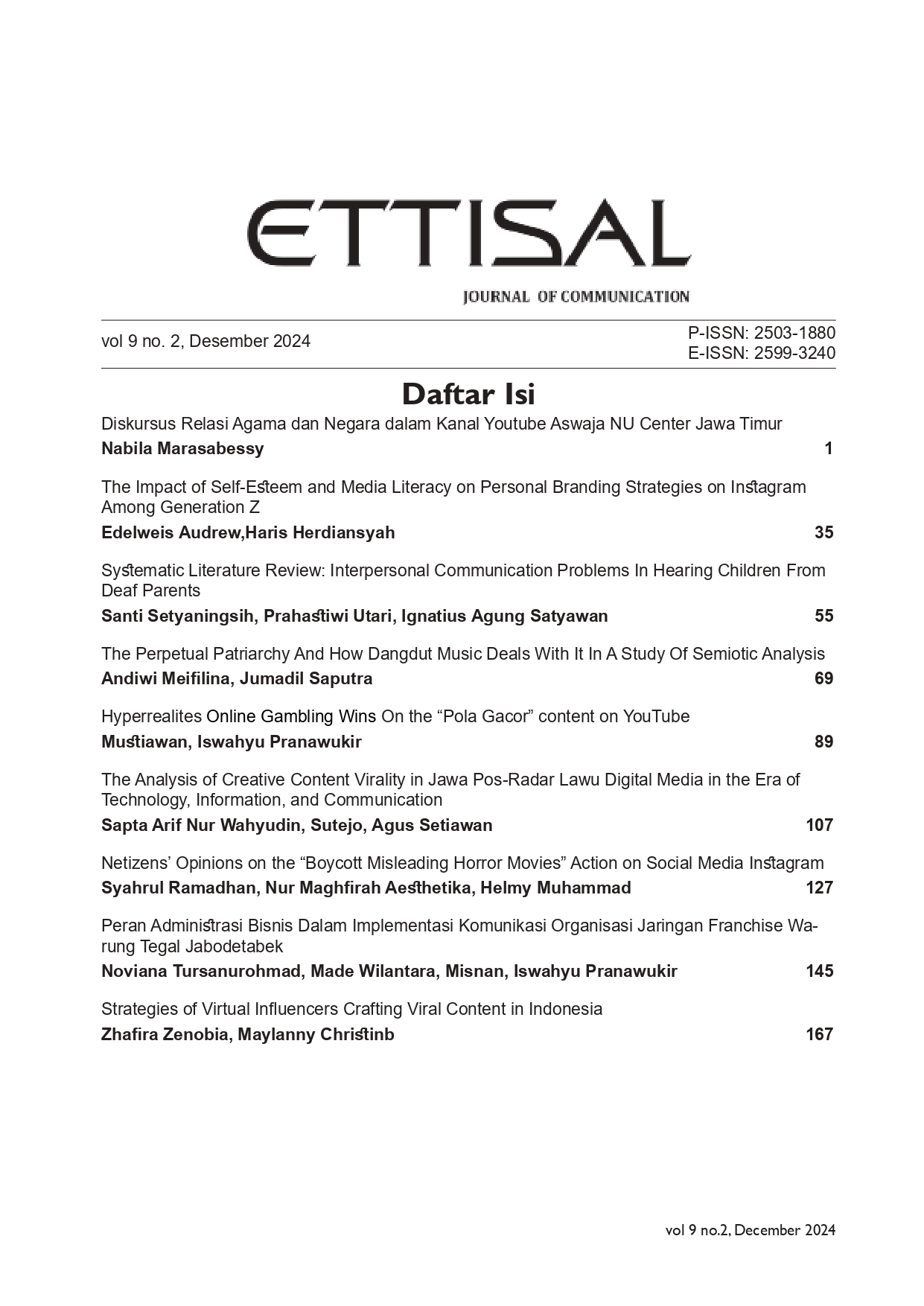
Peran Administrasi Bisnis Dalam Implementasi Komunikasi Organisasi Jaringan Franchise Warung Tegal Jabodetabek
DOI:
https://doi.org/10.21111/ejoc.v9i2.12855Keywords:
Warung Tegal Franchise, Administrative Management, Business Communication, SOP, Customer SatisfactionAbstract
This study aims to analyze the role of business administration in implementing organizational communication within the Warung Tegal (Warteg) franchise network in the Jabodetabek area. The research employs a qualitative descriptive method, focusing on analyzing the realities faced by the Warteg franchise network regarding business administration and organizational communication. The findings reveal that although the Jabodetabek Warteg franchise has adopted the franchise model, its impact on elevating the status of traditional Warteg establishments remains insignificant. Several positive factors were identified, including (1) profitability due to the provision of staple foods, (2) an automated operational system that does not require startup or specific marketing strategies, (3) a well-established brand, (4) a clear operational system, (5) a modern 3S (Neat, Clean, Compact) building concept, and (6) an effective application of the GFC (Good, Fast, Cheap)principle. However, there are still some limitations, such as (1) a lack of strong positioning, both functionally (addressing hunger) and emotionally (appealing to a specific consumer segment), (2) the product’s brand character has not achieved top-of-mind awareness among consumers, (3) a lack of differentiation in terms of taste or customer experience, (4) suboptimal location strategy due to limited parking space, and (5) challenges in meeting online order demands. Additionally, the study uncovers opportunities for further development, such as flexible partnership packages that offer a quick return on investment, well-established managerial SOPs, franchisers assisting with location selection, and a cooperative leadership role. A key finding is that, among seven Warteg franchises, the “New Bahari†(WNB) network has successfully implemented digital technology through an ERP (Enterprise Resource Planning) system with real-time control applications, YouTap POS and YouTap BOS.References
Adha, R. N., Qomariah, N., & Hafidzi, A. H. (2019). Pengaruh Motivasi Kerja, Lingkungan Kerja, Budaya Kerja Terhadap. Jurnal Penelitian Ipteks, 4(1), 47–62.
Adi, K. (2019). Pengolahan Informasi Dan Persepsi Konsumen Di Era Revolusi Industri 4.0. Majalah Ilmiah Pelita Ilmu, 2(2). https://doi.org/10.37849/mipi.v2i2.171
Afriaris, S., & Windartini, S. (2021). Model Pengembangan Strategi Komunikasi Bisnis untuk Mencapai Tujuan Pemasaran pada Usaha Kecil Menengah (Studi Kasus Pada Konsep Usaha Rumah Tangga Kerak Nasi). Jurnal Ekobistek, 12–20. https://doi.org/10.35134/ekobistek.v9i1.65
Alamsyah, A., Sukma, A. H., & ... (2023). Pola Komunikasi Organisasi Dalam Proses Rekrutmen Anggota Baru Partai Golkar. Expose: Jurnal Ilmu …, 6(2), 141–150. https://doi.org/10.33021/exp.v6i2.4864
Aulia Febriyanti, Nadia Septiani, & Dwi Epty Hidayaty. (2023). Leadership Strategy for Tegal Warteg Business Development (Warteg) Rossa. Formosa Journal of Applied Sciences, 2(6), 1041–1050. https://doi.org/10.55927/fjas.v2i6.4637
Bungin, B. (2006). Sosiologi Komunikasi: Teori, Paradigma dan Diskursus Teknologi Komunikasi di Masyarakat. Kencana Prenada.
Diah Novianti, M., Susanto, T., Hatta, H., & Johannes, R. (2018). Kajian Identifikasi Faktor Untuk Pengembangan Usaha Warung Tegal (Warteg) Masuk Mall (Studi Kasus Di Jabodetabek). Journal of Entrepreneurship, Management, and Industry (JEMI), 1(September), 3.
Dian, P. (2019). Strategi Komunikasi Persuasif Dalam Meningkatkan Jumlah Debitur Di Pt. BNI (Persero) Tbk Kantor Cabang Padang. Jom Fisip, 6.
Dwi Astuti, ah, Wahyuni, S., Setiawan, A., & Yunianto Wibowo, B. (2022). The Role of The Iconic Food Exposure Model: “Warung Tegal†(Warteg) Manuver in the Disaster of the Covid-19 Pandemic in Central Java, Indonesia. Jurnal Admisi Dan Bisnis, 23(1), 35–46. https://jurnal.polines.ac.id/index.php/admisi
Evi Zahara. (2018). Peranan Komunikasi Organisasi Pimpinan Organisasi. Peranan Komunikasi Organisasi Bagi Pimpinan Organisasi, 1829–7463(April).
Fadli, M. R. (2021). Memahami desain metode penelitian kualitatif. HUMANIKA, 21(1). https://doi.org/10.21831/hum.v21i1.38075
Fajri, T. N., & Shauki, E. R. (2023). Potensi Food Loss Dan Food Waste Pada Umkm: Mfca, Nudging Dan Neutralization Theory. Jurnal Aplikasi Akuntansi, 7(2), 328–345. https://doi.org/10.29303/jaa.v7i2.187
FAUZI, S. N. M. (2021). PENERAPAN METODE MENGUBAH TEKS WAWANCARA MENJADI KARANGAN NARASI UNTUK MENINGKATKAN KEMAMPUAN BERBAHASA INGGRIS SISWA KELAS VIII A MTs NEGERI 2 PURBALINGGA SEMESTER GASAL TAHUN PELAJARAN 2019/2020. LANGUAGE : Jurnal Inovasi Pendidikan Bahasa Dan Sastra, 1(1), 1–13. https://doi.org/10.51878/language.v1i1.354
Hanifah, A. K., & Hartriyanti, Y. (2023). Efektivitas Berbagai Jenis Metode Pelatihan Untuk Meningkatkan Kapasitas Kader Posyandu Dalam Upaya Pencegahan Stunting Pada Balita. Journal of Nutrition College, 12(2), 121–134. https://doi.org/10.14710/jnc.v12i2.36823
Hardiansah, M. F. (2019). Hubungan Keaktifan Berorganisasi Dan Budaya Organisasi Dengan Prestasi Akademik Pengurus Himpunan Mahasiswa Jurusan Pendidikan Ekonomi Periode 2017. JPEKA: Jurnal Pendidikan Ekonomi, Manajemen Dan Keuangan, 3(1). https://doi.org/10.26740/jpeka.v3n1.p47-54
Luthfiyah, F. (2020). Metode Penelitian Kualitatif (Sistematika Penelitian Kualitatif). In Bandung: Rosda Karya.
Novianti Mirsa Diah*, S. T. (2018). IDENTIFYING WARUNG TEGAL DEVELOPMENT FACTORS: A PRELIMINARY ANALYSIS ON WARUNG TEGAL IN JABODETABEK, INDONESIA. RJOAS, 12(20), 81–85. https://doi.org/https://doi.org/10.18551/rjoas.2018-12.14
Pasaribu, R. (2020). Optimalisasi Media Online Sebagai Solusi Promosi Pemasaran Umkm Di Semarang Pada Masa Pandemi Covid-19. Jurnal Komunikasi Dan Media, 1(1). https://doi.org/10.24167/jkm.v1i1.2848
Pertiwi, A. (2018). Studi Fenomenologi Tentang Konsep Diri Wanita Shopaholic Di Kota Bandar Lampung. Journal of Chemical Information and Modeling, 0(0), 0.
Rizaldi, D. F., Abdillah, J., Naufal, M., Yaqin, M. A., & Fauzan, A. C. (2022). Survei Pengukuran Fleksibilitas Software Menggunakan Metode Systematic Literature Review. ILKOMNIKA: Journal of Computer Science and Applied Informatics, 4(1), 53–66. https://doi.org/10.28926/ilkomnika.v4i1.253
Salsabila, S. N., & Suyanto, A. (2020). ANALISIS PEMETAAN E-COMMERCE KECANTIKAN BERDASARKAN BRAND EQUITY. Jurnal Mitra Manajemen, 4(2). https://doi.org/10.52160/ejmm.v4i2.347
Saputra, A. (2019). Survei Penggunaan Media Sosial Di Kalangan Mahasiswa Kota Padang Menggunakan Teori Uses and Gratifications. Baca: Jurnal Dokumentasi Dan Informasi, 40(2), 207. https://doi.org/10.14203/j.baca.v40i2.476
Sugiyono. (2013). Metode penelitian kuantitatif, kualitatif dan R&D (3rd ed.). Alfabeta.
Sukma, A. H., & Pranawukir, I. (2020). Perencanaan dan Strategi Komunikasi Jaringan Franchise Warung Tegal Kharisma Bahari. WACANA: Jurnal Ilmiah Ilmu Komunikasi, 19(2).
Supartha, W. gede, & Sintaasih, D. K. (2017). Pengantar perilaku Organisasi; Teori, kasus dan Aplikasi penelitian. In Universitaa Udayana. https://simdos.unud.ac.id/uploads/file_pendidikan_1_dir/b9ca64feeb1d962d5d06f51ea4d7577b.pdf
Susanto, T., Novianti, M. D., Johannes, R., Hatta, H., Rilman, A. D., & Budipriyanto, A. (2020). Factors Affecting Business Development of Warung Tegal: The Case of Warung Tegal in Jabodetabek. Jurnal Pangan Halal, 92(Icame 2018), 564–574. https://doi.org/10.2991/icame-18.2019.59
WIDATI, E., & MADANIAH, A. (2021). How Could Warung Tegal Franchise’S System Become Interesting? Iccd, 3(1), 176–181. https://doi.org/10.33068/iccd.vol3.iss1.332
Wijaya, I. S. (2015). Perencanaan dan Strategi Komunikasi. Lentera, XVIII(1).
Yusanto, Y. (2020). Ragam Pendekatan Penelitian Kualitatif. JOURNAL OF SCIENTIFIC COMMUNICATION (JSC), 1(1). https://doi.org/10.31506/jsc.v1i1.7764
Zamzami, & Sahana, W. (2021). Strategi Komunikasi Organisasi. Journal Educational Research and Social Studies, 2(April).
Downloads
Published
Issue
Section
License

This work is licensed under a Creative Commons Attribution-NonCommercial-ShareAlike 4.0 International License.
Copyright Notice
Authors retain full copyright and grant Ettisal: Journal of Communication the right of first publication. The published work is simultaneously licensed under a Creative Commons Attribution–NonCommercial–ShareAlike 4.0 International License (CC BY-NC-SA 4.0).
This license allows others to share and adapt the work for non-commercial purposes, provided proper credit is given to the author(s) and the journal, a link to the license is included, and any derivative works are distributed under the same license.
Additional Distribution Rights
Authors may enter into separate, non-exclusive agreements for the distribution of the journal’s published version of their work—such as depositing it in institutional repositories or including it in edited books—provided that the initial publication in Ettisal: Journal of Communication is acknowledged.
Pre- and Post-Publication Sharing
Authors are permitted and encouraged to share their work online (e.g., through institutional repositories, academic networking platforms, or personal websites) before, during, and after the submission process. Such practices promote scholarly exchange and can enhance the visibility and citation impact of the published work.
License Statement:
All articles published in Ettisal: Journal of Communication are licensed under the Creative Commons Attribution–NonCommercial–ShareAlike 4.0 International License (CC BY-NC-SA 4.0).