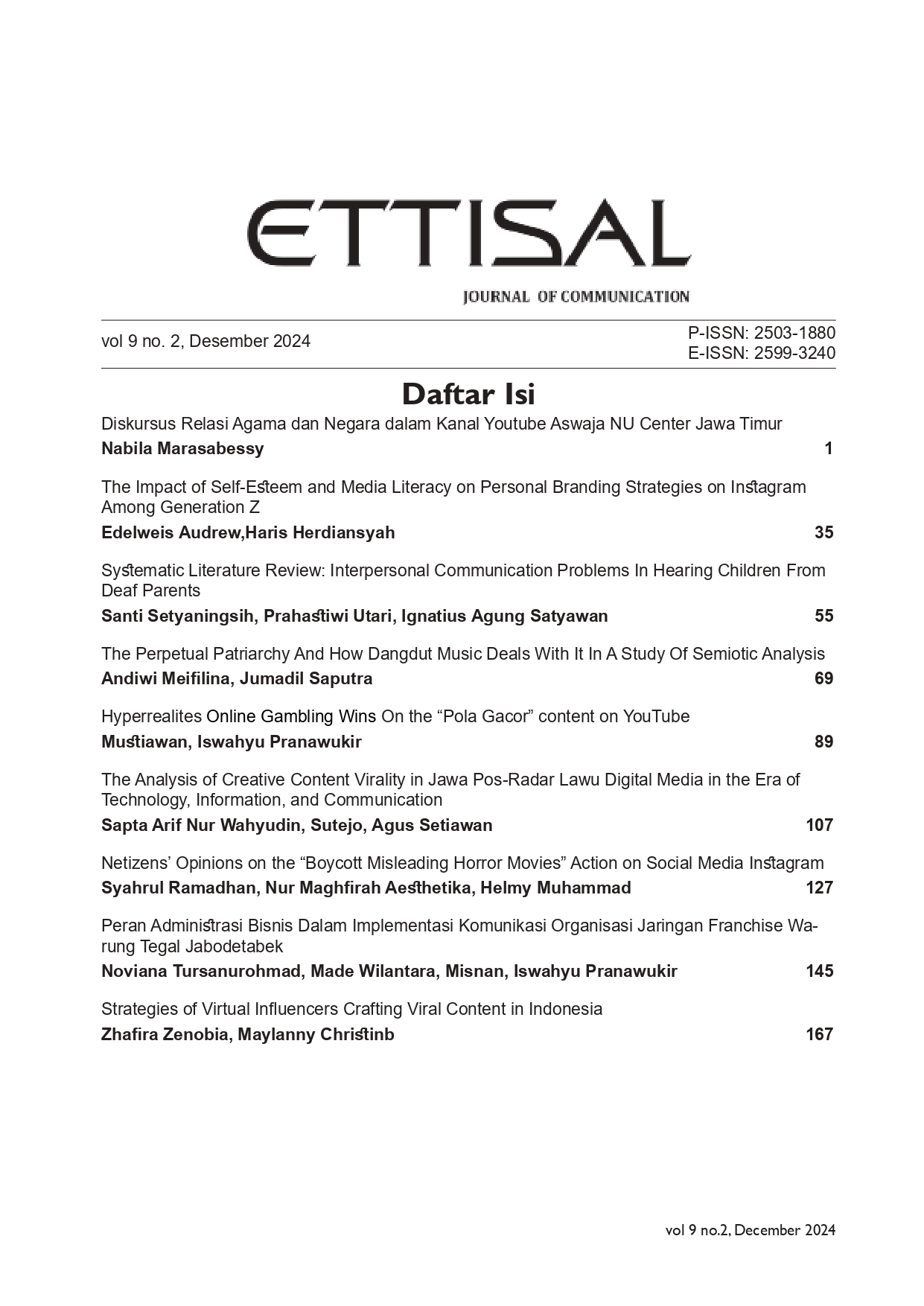
Hyperrealites Online Gambling Wins on The "Pola Gacor" Content Youtube
DOI:
https://doi.org/10.21111/ejoc.v9i2.12451Keywords:
Hyperreality, Online Gambling, Roland Barthes, YouTube Content, Gacor PatternAbstract
This research aims to analyze the phenomenon of hyperreality in YouTube content which displays "gacor patterns" in online gambling. Using a qualitative approach with a critical paradigm, this study applies Roland Barthes' semiotic method to explore how visual signs and text in the content shape perception and behavior The findings show that visual signs such as the highlighting of big winning numbers, the use of bright colors, and emotional expressions of content creators, as well as provocative texts such as "gacor patterns" and "auto max win" create denotative and connotative meanings that blur the boundaries between reality and reality. Fantasy analysis reveals that this content constructs a hyperreality of winning, where the representation of a big win becomes more dominant than the actual reality. This hyperreality encourages gambling behavior in the hope of getting a similar win, which in reality is very dependent on luck. The next myth is about instilling an ideology or belief about normalizing online gambling behavior in society. This content can normalize online gambling practices and make it an activity that is accepted and desired by society. This has the potential to change the public's perception of gambling, making it appear to be a legitimate, legal, halal, and effective way to earn money. Thus ignoring the fact that online gambling is a high-risk activity that can cause significant financial losses.References
Andayani, D. (2024). Kominfo Blocks 1.9 million Online Gambling Content From July 2023-22 May 2024. News.Detik.Com. https://news.detik.com/berita/d-7355672/kominfo-blokir-1-9-juta-konten-judi-online-sejak-juli-2023-22-mei-2024
Auer, M., & Griffiths, M. D. (2022). Gambling Before and During the COVID-19 Pandemic Among Online Casino Gamblers: An Empirical Study Using Behavioral Tracking Data. International Journal of Mental Health and Addiction, 20(3), 1722–1732. https://doi.org/10.1007/s11469-020-00462-2
Bastiaansen, A. (2019). Mythologies Revisited. Routledge.
Baudrillard, J. (1994). Simulacra and Simulation University of Michigan Press.
Bignell, J. (2021). Reading Barthes in the Age of Social Media. Polity Press.
Cahyaningrum, R., Purnamasari, D., & ... (2024). Hyperreality: Analysis of Viral Content Among TikTok Content Creators. MEDIALOG: Journal of Science..., VII(I), 117–128. http://www.jurnal-umbuton.ac.id/index.php/Medialog/article/view/4965%0Ahttp://www.jurnal-umbuton.ac.id/index.php/Medialog/article/download/4965/2582
Chandler, D. (2017). Semiotics: The Basics. Routledge.
Covington, P., Adams, J., & Sargin, E. (2016). Deep Neural Networks for YouTube Recommendations. Proceedings of the 10th ACM Conference on Recommender Systems, 191–198. https://doi.org/10.1145/2959100.2959190
Creswell, J. W. (2014). Research Design: Qualitative, Quantitative, and Mixed Methods Approaches (4th ed.). SAGE Publications.
Creswell, J. W., & Poth, C. N. (2018). Qualitative Inquiry and Research Design: Choosing Among Five Approaches (4th ed.). Sage Publications.
Delfabbro, P., King, D., & Griffiths, M. D. (2014). From Adolescent to Adult Gambling: An Analysis of Longitudinal Gambling Patterns in South Australia. Journal of Gambling Studies, 30(3), 547–563. https://doi.org/10.1007/s10899-013-9384-7
Denzin, N. K., Lincoln, Y. S., & (Eds.). (2018). The SAGE Handbook of Qualitative Research. Sage Publications.
Derevensky, J., Sklar, A., Gupta, R., & Messerlian, C. (2010). An Empirical Study Examining the Impact of Gambling Advertisements on Adolescent Gambling Attitudes and Behaviors. International Journal of Mental Health and Addiction, 8(1), 21–34. https://doi.org/10.1007/s11469-009-9211-7
Gainsbury, S. M., Hing, N., Delfabbro, P. H., & King, D. L. (2014). A taxonomy of gambling and casino games via social media and online technologies. International Gambling Studies, 14(2), 196–213. https://doi.org/10.1080/14459795.2014.890634
Hartley, J. (2023). Signification and Communication: From Saussure to Barthes. Sage Publications.
Haryono, C. G. (2020). Falsehood Lives in Advertising Hyperreality. Prophetic: Communication Journal, 12(2), 232. https://doi.org/10.14421/pjk.v12i2.1662
King, D., Delfabbro, P., & Griffiths, M. (2010). The Convergence of Gambling and Digital Media: Implications for Gambling in Young People. Journal of Gambling Studies, 26(2), 175–187. https://doi.org/10.1007/s10899-009-9153-9
Ladouceur, R., Sylvain, C., Boutin, C., Lachance, S., Doucet, C., Leblond, J., & Jacques, C. (2001). Cognitive Treatment of Pathological Gambling. The Journal of Nervous and Mental Disease, 189(11), 774–780. https://doi.org/10.1097/00005053-200111000-00007
Livingstone, S., & Smith, P. K. (2014). Annual Research Review: Harms experienced by child users of online and mobile technologies: the nature, prevalence and management of sexual and aggressive risks in the digital age. Journal of Child Psychology and Psychiatry, 55(6), 635–654. https://doi.org/10.1111/jcpp.12197
Maharani, R. P., Rahmawati, U., & Sari, D. N. (2022). Hyperreality of Tik Tok Users. Journal of Communication and Culture, 3(1), 1–11. https://doi.org/10.54895/jkb.v3i1.861
Masut, V. R., Wijanarko, R., & Pandor, P. (2023). Objectification of Subjects in Contemporary Culture based on Jean Baudrillard's Concept of Hyperreality. Indonesian Journal of Philosophy, 6(3), 303–315.
Nickerson, R. S. (1998). Confirmation Bias: A Ubiquitous Phenomenon in Many Guises. Review of General Psychology, 2(2), 175–220. https://doi.org/10.1037/1089-2680.2.2.175
Paul, C. (2020). Semiotics and Visual Representation in the Digital Age. Oxford University Press.
Rajagukguk, T. P., & Sofianto, K. (2020). Hyperreality Simulacra And Reproduction Of Pubg Game Signs. A more humane goal, 10(1), 118–136. https://www.pubgmobile.com/en-US/,
Riyanto, A. D. (2024). Hootsuite (We are Social): Data Digital Indonesia 2024. Www.Andi.Link.Com. https://andi.link/hootsuite-we-are-social-data-digital-indonesia-2024/
Rusmana, D. (2014). Semiotic Philosophy. CV Pustaka Setia.
Sobur, A. (2013). Communication Semiotics. Rosda.
Turkle, S. (2011). Alone Together: Why We Expect More from Technology and Less from Each Other. Basic Books.
Twenge, J. M. (2017). iGen: Why Today’s Super-Connected Kids Are Growing Up Less Rebellious, More Tolerant, Less Happy--and Completely Unprepared for Adulthood. Atria Books.
Wardah, F. (2024, June 26). PPATK: More than 1,000 DPR and DPRD members play online gambling. Www.VoaIndonesia.Com. https://www.voaindonesia.com/a/ppatk-lebih-1-000-anggota-dpr-dan-dprd-main-judi-online/7674973.html
Wardhana, A. A. N. A. S. (2022). Hyperreality in Online Video Games: Simulation, Simulacra and Hyperreality of Garena Free Fire. PERSPECTIVE, 11(2), 607–614. https://doi.org/10.31289/perspektif.v11i2.6011
Wood, R. T. A., & Griffiths, M. D. (2007). A qualitative investigation of problem gambling as an escapeâ€based coping strategy. Psychology and Psychotherapy: Theory, Research and Practice, 80(1), 107–125. https://doi.org/10.1348/147608306X107881
Yin, R. K. (2023). Case Study Research and Applications: Design and Methods (7th ed.). Sage Publications.
Downloads
Published
Issue
Section
License

This work is licensed under a Creative Commons Attribution-NonCommercial-ShareAlike 4.0 International License.
Copyright Notice
Authors retain full copyright and grant Ettisal: Journal of Communication the right of first publication. The published work is simultaneously licensed under a Creative Commons Attribution–NonCommercial–ShareAlike 4.0 International License (CC BY-NC-SA 4.0).
This license allows others to share and adapt the work for non-commercial purposes, provided proper credit is given to the author(s) and the journal, a link to the license is included, and any derivative works are distributed under the same license.
Additional Distribution Rights
Authors may enter into separate, non-exclusive agreements for the distribution of the journal’s published version of their work—such as depositing it in institutional repositories or including it in edited books—provided that the initial publication in Ettisal: Journal of Communication is acknowledged.
Pre- and Post-Publication Sharing
Authors are permitted and encouraged to share their work online (e.g., through institutional repositories, academic networking platforms, or personal websites) before, during, and after the submission process. Such practices promote scholarly exchange and can enhance the visibility and citation impact of the published work.
License Statement:
All articles published in Ettisal: Journal of Communication are licensed under the Creative Commons Attribution–NonCommercial–ShareAlike 4.0 International License (CC BY-NC-SA 4.0).