
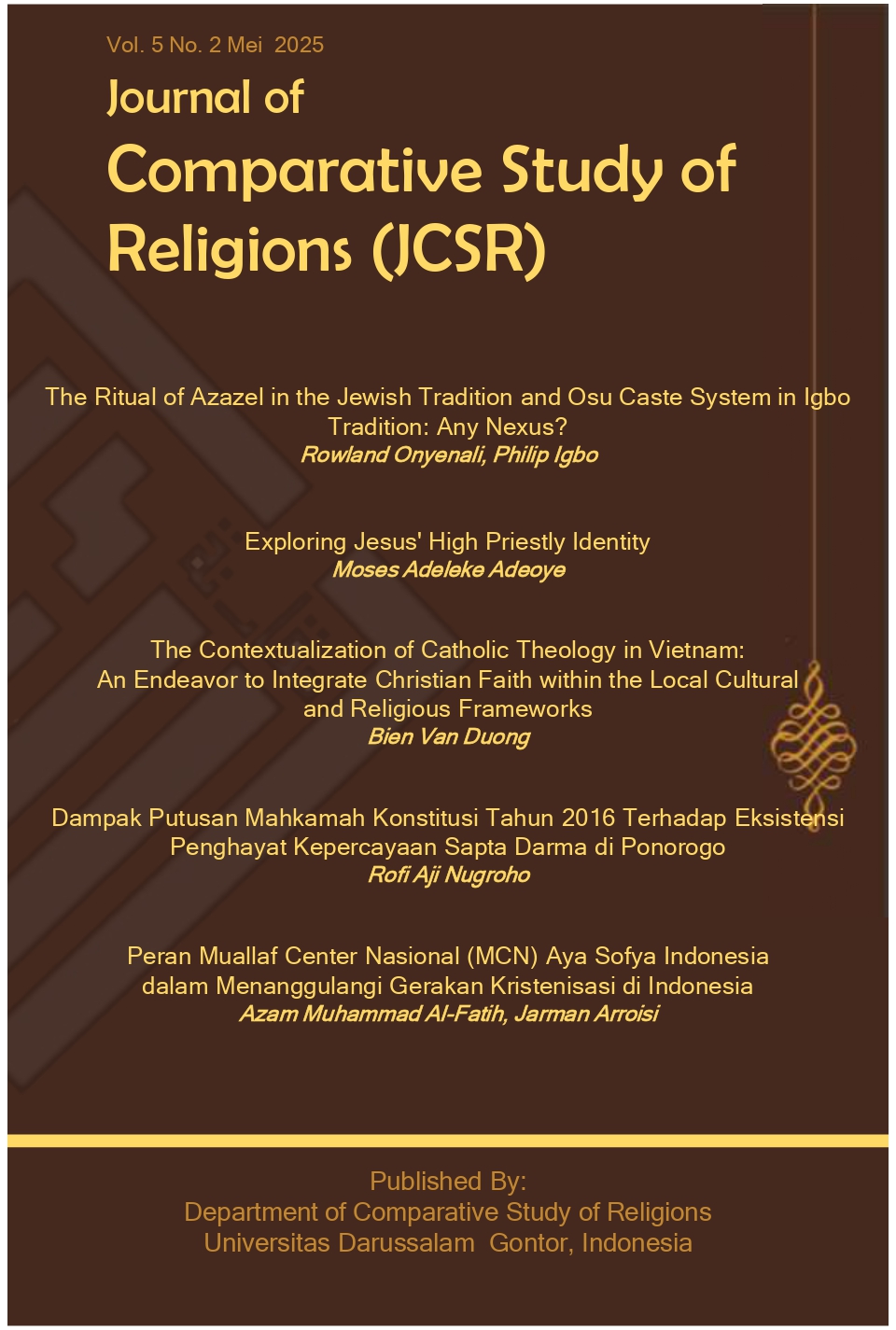
Dampak Putusan Mahkamah Konstitusi Tahun 2016 Terhadap Eksistensi Penghayat Kepercayaan Sapta Darma di Ponorogo
DOI:
https://doi.org/10.21111/jcsr.v5i2.13979Abstract
Belief or spirituality in Indonesia used to be a practice embraced by some people. Today, it has evolved into a form of belief in God Almighty, which leads to the understanding that its adherents do not belong to a particular religious category. Post-reform, these believers, including those who adhere to Sapto Darmo, experience social pressure from society, which causes them to feel restricted in carrying out their worship. Nonetheless, Sapto Darmo believers have managed to overcome these obstacles, even though they are forced to follow the prevailing religious lessons in schools. This study aims to determine the condition of Sapto Darmo believers in Ponorogo after the decision of the Constitutional Court and to know the government's protection of the civil rights of spirituality. The researcher uses the Grounded Research method and the sociology of religion approach which aims to find out the condition of Sapto Darmo believers in Ponorogo after the Constitutional Court's decision and to find out the government in protecting the civil rights of believers. In understanding the Sapto Darmo believers and knowing how the existence of Sapto Darmo in Ponorogo, the results of this study can be taken are, The government's attitude to citizens and this circular letter to follow up on the Constitutional Court Decision Number 97 / PUU-XIV / 2016 dated October 18, 2017 and the Minister of Home Affairs Regulation Number 118 of 2017 concerning Family Card Blanks, Registers and Civil Registration Certificate Excerpts.References
Adian, Husaini. Aliran Kepercayaan (Sejarah Dah Masalahnya Pasca Putusan MAHKAMAH KONSTITUSI). jakarta: INSIST, 2018.
Andriawan, Bagus, and Nurcahyo Abraham. “STUDI PERKEMBANGAN ALIRAN KEBATINAN KEROHANIAN SAPTA DARMA DI KABUPATEN MAGETAN TAHUN 1956-2011.†JURNAL AGASTYA 04 (2014). https://doi.org/http://doi.org/10.25273/ajsp.v4i02.828.
Gunawan. Sosiologi Agama: Memahami Teori Dan Pendekatan. Angewandte Chemie International Edition, 6(11), 951–952., 2020.
Hakiki, Kiki Muhamad. “Politik Identitas Agama Lokal: Studi Kasus Aliran Kebatinan.†Al-Adyan XI, no. 1 (2011): 159–74.
Hakiki, Kiki Muhammad, Pendekatan Antropologi, and Dalam Kajian. “Kiki Muhammad Hakiki, Aliran Kebatinan.....†Al-Adyan 6, no. 2 (2011): 63–76.
Jarman, Arroisi. Aliran Kepercayaan, Kebatinan Dan Sinkretisme. Cetakan pe. ngawi: perum ansor, 2017.
Kamil, Kartapraja. Aliran Kebatinan Dan Kepercayaan Di Indonesia. jakarta: penerbit yayasan MASAGUNG, 1985.
M, Rasyidi. Islam Dan Kebatinan. Cetakan 4. jakarta: bulan bintang, 1977.
Mahkamah Konstitusi. “Putusan Nomor 97/PUU-XIV/2016,†no. 6 (2016): 154–55. https://www.mkri.id/public/content/persidangan/putusan/97_PUU-XIV_2016.pdf.
Petir, Abimanyu. Mistik Kejawen. Edited by Adee Roshya. Pertama. yogyakarta: PALAPA, 2014.
Ridin, Sofwan. Menguak Seluk Beluk Aliran Kebatinan. Edited by Mahmud Sya’’rani and Muhaimin Ahmad. Kedua. semarang: CV.Aneka Ilmu, 2002.
Downloads
Published
How to Cite
Issue
Section
License

This work is licensed under a Creative Commons Attribution-NonCommercial-ShareAlike 4.0 International License.
The author whose published manuscript approved the following provisions:Â
The right of publication of all material published in the journal / published in the JCSR is held by the editorial board with the knowledge of the author (moral rights remain the author of the script).
The formal legal provisions for access to digital articles of this electronic journal are subject to the terms of the Creative Commons Attribution-NonCommercial-ShareAlike 4.0 International License (CC BY-NC-SA 4.0), which means that JCSR reserves the right to save, transmit media or format, Database), maintain, and publish articles without requesting permission from the Author as long as it keeps the Author's name as the owner of Copyright.
Printed and electronic published manuscripts are open access for educational, research and library purposes. In addition to these objectives, the editorial board shall not be liable for violations of copyright law.


2.png)
