

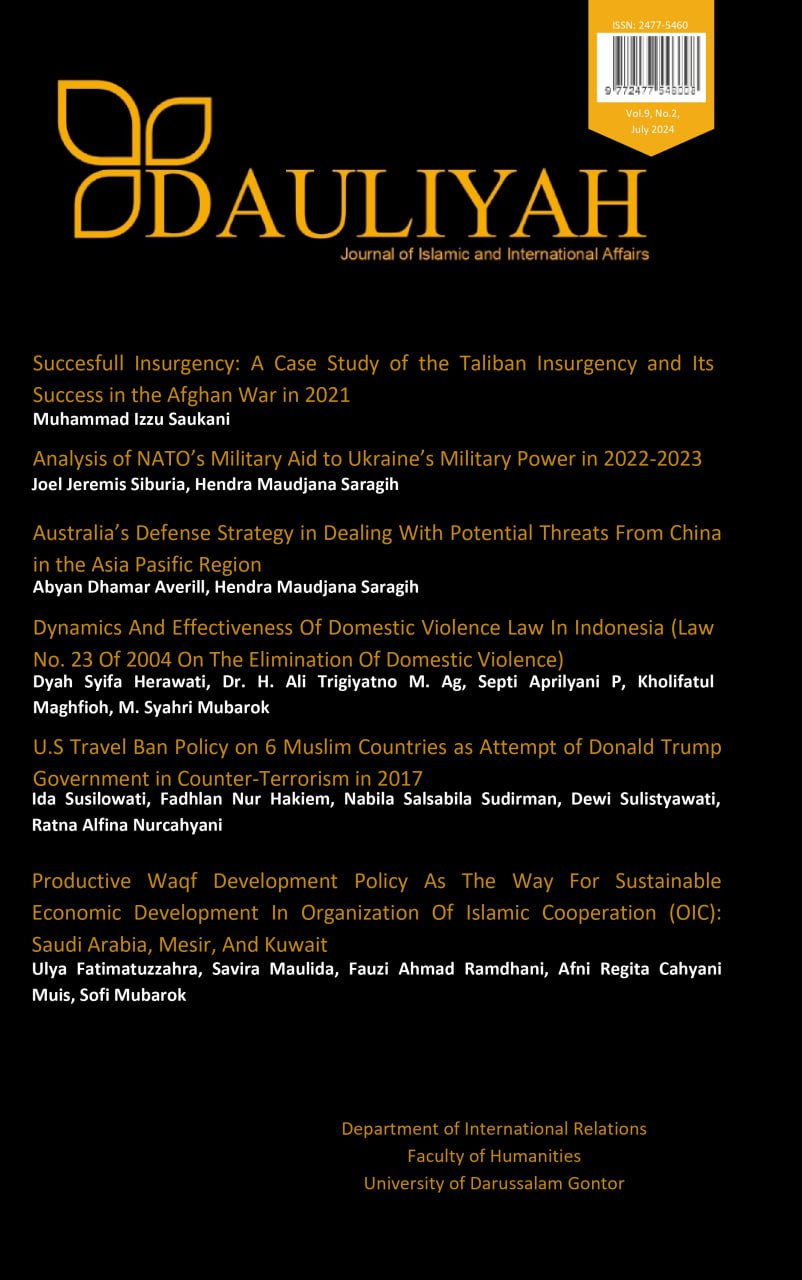
AUSTRALIA'S DEFENSE STRATEGY IN DEALING WITH POTENTIAL THREATS FROM CHINA IN THE ASIA PACIFIC REGION
DOI:
https://doi.org/10.21111/dauliyah.v9i2.15197Abstrak
The AUKUS alliance, a three-way strategic defence partnership between Australia, the United Kingdom and the United States, was announced with the aim of building a nuclear submarine fleet. The research method used in this analysis is a qualitative approach, focusing on foreign policy studies and literature reviews related to geopolitical relations in the Asia-Pacific region. The author uses the concept of foreign policy to understand how the threat from China affects Australia's security strategy. The strategy aims to better position Australia to contribute to regional security and stability, as China’s increasing self-sufficiency and the risk of military conflict between major powers in the Indo-Pacific region increase. The document provides a grim assessment of security in the Pacific and sets out a massive increase in defence expenditures to restructure the Australian military to cope with the changing security environment in Asia-Pacific. The review also focuses on the operationalization of a deterrence by a denial strategy, which includes the acquisition of a more powerful and lethal long-range attack capability and the upgrading of Australian northern bases to force rotations. This strategy emphasizes the importance of suppressing China's "competitive tactics" through a combination of military capabilities, diplomacy and alliances with traditional partners.Referensi
Creswell, J. W. (2018). Research Design: Qualitative, Quantitative, and Mixed
Methods Approaches.
James N. Rosenau, Gavin Boyd, Kenneth W. Thompson. 1976. World Politics: An
Introduction. New York: The Free Press. Hal. 15
Hamzah, I. S. 2016. Potensi Ancaman Kebangkitan Kuasa Ekonomi dan Ketentaraan
China dalam Rantau Asia Pasifik. Jurnal Sains Insani.
Holmes, O. J. (2013). Whole of government approach: maximizing unity of effort
between the Department of Defense (DoD), Department of State (DoS), and the United
States Agency for International Development (USAID) (Doctoral dissertation, Fort Leavenworth, KS: US Army Command and General Staff College).
Izuyama, M., & Ishihara, Y. (2018). Australia, India and the Indo-Pacific Concept. East
Asian Strategic Review
Nindyawati, M. A. (2020). Relations between Australia and China in Asia-Pacific
Region. Case Study: China's Expansionism in Asia-Pacific. TRANSBORDERS:
International Relations Journal, 4(1), 13-23.
Oktavianto, F. 2023. Implikasi AUKUS Terhadap Hubungan Ekonomi Australia dan
Tionglok Tahun 2021-2022. BHUVANA: Journal of Global Studies.
Stefanus Hendri Putra. 2023. Konstruksi Strategi Kompartementalisasi Australia
Dalam Hubungan Diplomatik Dengan Republik Rakyat Tiongkok Masa
Kepemimpinan Scott Morrison. Jurnal Indonesia Sosial Teknologi
Ulum, A. B. & Windiani, R. 2023. Gejolak Indo-Pasifik: Analisis Kebijakan Australia
Dalam Merespon Ancaman Tiongkok Di Kawasan Indo-Pasifik. Journal of
International Relations.
Australia China Bilateral Relations. Accesed on https://china.embassy.gov.au/bjng/auchbilateral.html
Australia-China Relationship Overview. Accesed on https://china.embassy.gov.au/bjng/relations1.html
Clementine G. Starling, Christian Trotti, and Tyson Wetzel. (2022). The next National
Defense Strategy must get Russia right. Accesed on https://www.atlanticcouncil.org/in depth-research-reports/issue-brief/the-next-national-defense-strategy-must-get-russiaright/
Dr Marcus Hellyear, Andrew Nicholls. (2022). ‘Impactful projection’ Long-range
strike options for Australia. Australian Strategic Policy Institute.
https://www.aspi.org.au/report/impactful-projection-long-range-strike-optionsaustralia
International Institute for Strategic Studies. Australia’s 2023 Defence Strategic Review.
https://www.iiss.org/publications/strategic-comments/2023/australias-2023-defencestrategic-
review/
Lam Tran. (2023). Unpacking Australia’s 2023 Defence Strategic Review. Center for
Strategic & International Studies. https://www.csis.org/blogs/new-perspectivesasia/
unpacking-australias-2023-defence-strategic-review
Mada, K. (2022, April 26). China Kecam Ancaman AS-Australia pada Negara-negara
Pasifik Selatan. Kompas.
https://www.kompas.id/baca/internasional/2022/04/26/china-kecam-ancamanterbuka-
as-australia
Navdeep Suri. (2023). Australia-China relations: The great unravelling. Accesed on
https://www.orfonline.org/research/australia-china-relations-the-great-unravelling-
Overview of Australia-China Relations. Accesed on
https://www.europarl.europa.eu/meetdocs/2009_2014/documents/danz/dv/0220_11_1
/0220_11_1en.pdf
Parliament of Australia. Australia- China relations.
https://www.aph.gov.au/About_Parliament/Parliamentary_Departments/Parliamentary
_Library/pubs/BriefingBook47p/AustraliaChinaRelations
Satake, T. (2023). The Rise of “Minilateralism” in the Indo-Pacific: the Quad &
AUKUS. Japan SPOTLIGHT March / April 2023
Stephen Kuper. (2023). Leveraging AUKUS to deliver a common long-range strike
loyal wingman. https://www.defenceconnect.com.au/geopolitics-and-policy/12223-
leveraging-aukus-to-deliver-a-common-long-range-strike-loyal-wingman
The Economist. (2023). Fearing China, Australia rethinks its defence strategy.
https://www.economist.com/asia/2023/04/25/fearing-china-australia-rethinks-itsdefence-
strategy
The Indo Pacific and its strategic challenges: An Australian Perspective. Speech by Mr
Peter Varghese AO, Chancellor of The University of Queensland, to the Institute of
South East Asian Studies, Singapore, 8 January 2019
The Japan Times. (2024). Australia unveils new defense strategy, with eye on 'coercive'
China. https://www.japantimes.co.jp/news/2024/04/17/asia-pacific/politics/australiadefense-
strategy-china/
United States Study Centre. (2023). AUKUS’ strategic deterrence good for the nation
and region. https://www.ussc.edu.au/aukus-strategic-deterrence-good-for-the-nationand-
region
Xinhua. (2022, July 10). China dan Australia sepakat memperlancar hubungan
bilateral. Antara News. https://www.antaranews.
##submission.downloads##
Telah diserahkan
Diterbitkan
Terbitan
Bagian
Lisensi
Hak Cipta (c) 2024 DAULIYAH

Artikel ini berlisensiCreative Commons Attribution-NonCommercial-ShareAlike 4.0 International License.
All articles published in Dauliyah Journal are licensed under a Creative Commons Attribution 4.0 International License (CC BY 4.0).
This license permits anyone to copy, redistribute, remix, transform, and build upon the material for any purpose, even commercially, provided the original work is properly cited.


