

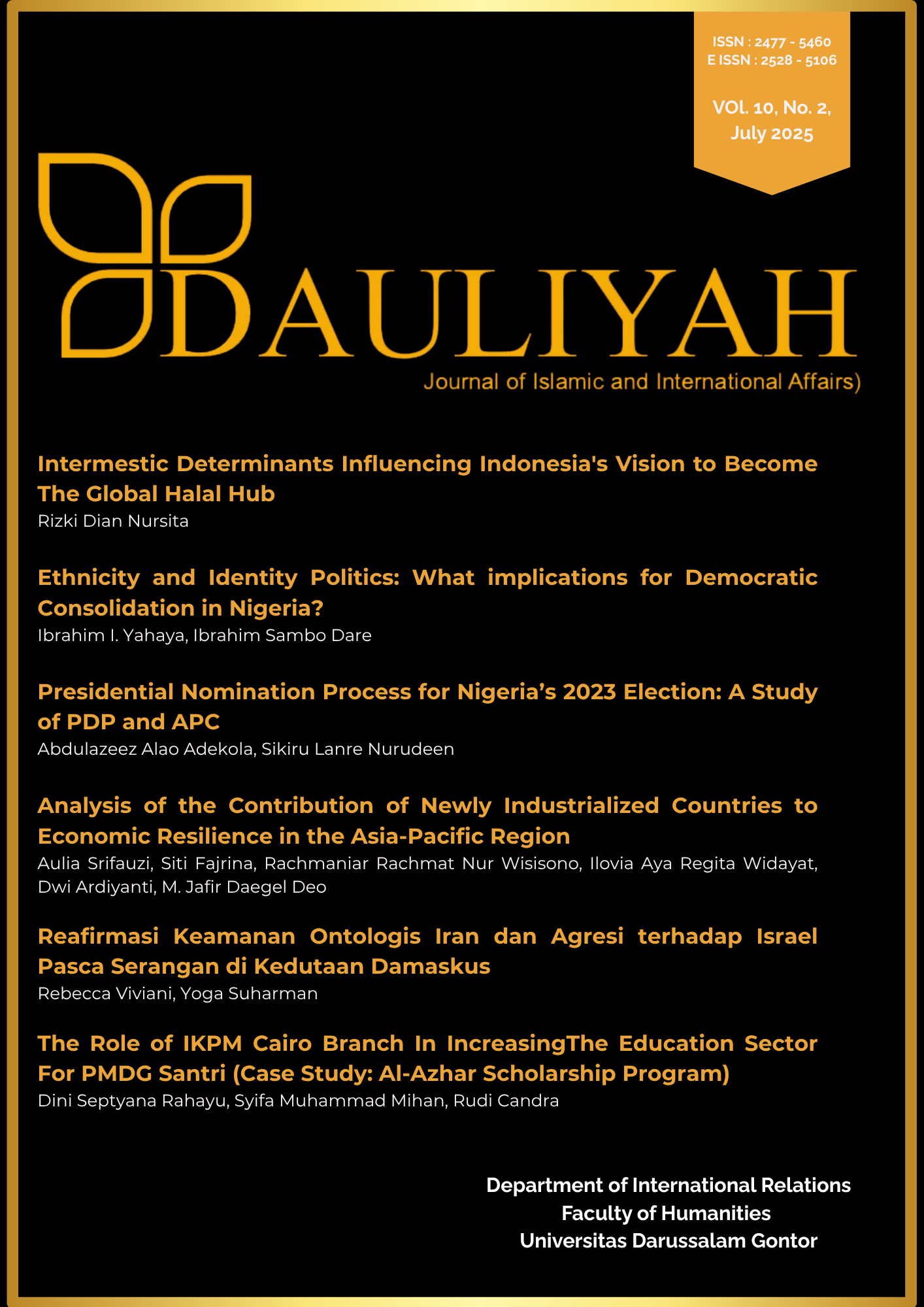
Analysis of the Contribution of Newly Industrialized Countries to Economic Resilience in the Asia-Pacific Region
DOI:
https://doi.org/10.21111/dauliyah.v10i2.14813Abstract
The Asia-Pacific region has experienced rapid economic growth in recent decades, primarily influenced by the strategic role of Newly Industrialized Countries (NICs) such as South Korea, Taiwan, Singapore, and Hong Kong. This study examines the role of NICs in enhancing the Asia-Pacific region’s economic resilience through increased production diversification, regional supply chain integration, technological innovation, and financial stability. Through a descriptive-qualitative approach and secondary data analysis, it is found that NICs act as the primary drivers of regional growth by increasing the volume of intra-regional trade, attracting foreign investment, and creating innovation centers that accelerate high-tech-based economic transformation. In addition, the ability of NICs to manage macroeconomic stability and fiscal resilience also strengthens the region’s resilience to external shocks, such as the global financial crisis and geopolitical disruption. This research confirms the importance of collaboration among countries in the Asia-Pacific to optimize the role of NICs in strengthening the region’s economic resilience sustainably.References
Aprianti, R. (2015). Media Penyiaran di Negara Industri Baru Asian (Taiwan, Korea Selatan, Singapura dan Hong Kong) dalam Era Globalisasi Tela’ah kajian dari: Junhao Hong dan Yu-Chiung Hsu.
Broadbent, K. P. (1992). Challenges for development in the Asia-Pacific region: the information sector, South Korea and the Philippines *.
Burton, C. (1989). The role of the NICS in Southeast Asia’s political and economic development. International Journal.
Chang, K. M. (2019). Between Spiritual Economy and Religious Commodification: Negotiating Temple Autonomy in Contemporary China. China Quarterly, 242(June 2013), 440–459. https://doi.org/10.1017/S030574101900122X
Chu, Y.-H. (2019). The East Asian NICs: a state-led path to the developed world. Cambridge.
Febreani, Y. K. (2022). Penguatan Kerjasama ASEAN Plus Three (APT) untuk Penanganan dan Mitigasi Dampak Negatif Ekonomi dari Pandemi Covid-19. Jurnal Hubungan Internasional, 15(1), 1–19. https://doi.org/10.20473/jhi.v15i1.31254
Hatuel-Radoshitzky, M., & Heistein, A. (2020). Global Governance and COVID-19: Why International Cooperation Still Matters. Challenges of Global Governance Amid the COVID-19 Pandemic, 10–12.
Henley, D., & Nordholt, H. S. (2015). Environment, Trade and Society in Southeast Asia. Brill. https://library.oapen.org/bitstream/handle/20.500.12657/32177/613433.pdf?sequence=1#page=70
Heywood, A. (2014). Global Politics. In Global Politics. https://doi.org/10.1007/978-1-137-34927-9
Hobday, M. (1994). The Electronics Industries of the Asia-Pacific: Exploiting International Production Networks for Economic Development.
Institute For Security & Development Policy. (2025). Taiwan’s Semiconductor Manufacturing Industry and Its Role in the International Supply Chain.
Jacobson, David. (2019). Old nations, new world : conceptions of world order. Routledge.
Juliandini, N. (2020). STRATEGI INSTITUTIONAL BALANCING DI KAWASAN ASIA PASIFIK. 4(1).
Kegley, C. (2008). World Politics: Trend and Transformation. http://books.google.cz/books?id=JFVlaSN6CwsC
Ministry of Economy and Finance. (2023). Ministry of Economy and Finance. www.moef.go.kr
Nugrahani, F. (2010). Metodologi Penelitian Kualitatif: Teori dan Aplikasi.
Office, R. (2022). Development of the financial services sector in Hong Kong.
Paldam, M. (2003). Economic freedom and the success of the Asian tigers: An essay on controversy. European Journal of Political Economy, 19(3), 453–477. https://doi.org/10.1016/S0176-2680(03)00012-0
Park, H., Sim, B., Zhao, B., & Nam, E. W. (2022). Public Health Financing and Responses to COVID-19: Lessons from South Korea. Healthcare (Switzerland), 10(4). https://doi.org/10.3390/healthcare10040750
Prakash, A. (2022). Regional Integration in Indo-Pacific: Connectivity, Cooperation, and New Supply-Chain Linkages.
Republic Of Singapore. (2022). REPUBLIC OF SINGAPORE THE REVENUE AND EXPENDITURE ESTIMATES FOR THE.
Rosyidin Mohamad. (2020). Teori Hubungan Internasional Dari Perspektif Klasik Sampai Non-Barat (Monalisa & Hayati Yayat Sri, Eds.; 1st ed.). Rajawali Pers.
Skulska, Boguslawa., Skulska, Bogusława., & Jankowiak, A. H. . (2011). Faces of competitiveness in Asia Pacific. Wroclaw University of Economics.
Srifauzi, A., & Fajrina, S. (2023). Peluang Dan Tantangan Aceh Pada Forum Kerjasama Imt-Gt (Indonesia-Malaysia-Thailand Growth Triangle) Dalam Peningkatan Investasi. PIR.
Yani, Y. M., & Nizmi, Y. E. (2018). Penerapan Konsep Cross Border Regions (CBRs) dalam Kerja Sama Ekonomi Sub-regional Indonesia-Malaysia-Singapura Growth Triangle (IMS-GT). Insignia Journal of International Relations, 5(1), 31. https://doi.org/10.20884/1.ins.2018.5.1.819
Downloads
Submitted
Accepted
Published
Issue
Section
License
Copyright (c) 2025 DAULIYAH

This work is licensed under a Creative Commons Attribution-NonCommercial-ShareAlike 4.0 International License.
All articles published in Dauliyah Journal are licensed under a Creative Commons Attribution 4.0 International License (CC BY 4.0).
This license permits anyone to copy, redistribute, remix, transform, and build upon the material for any purpose, even commercially, provided the original work is properly cited.


