

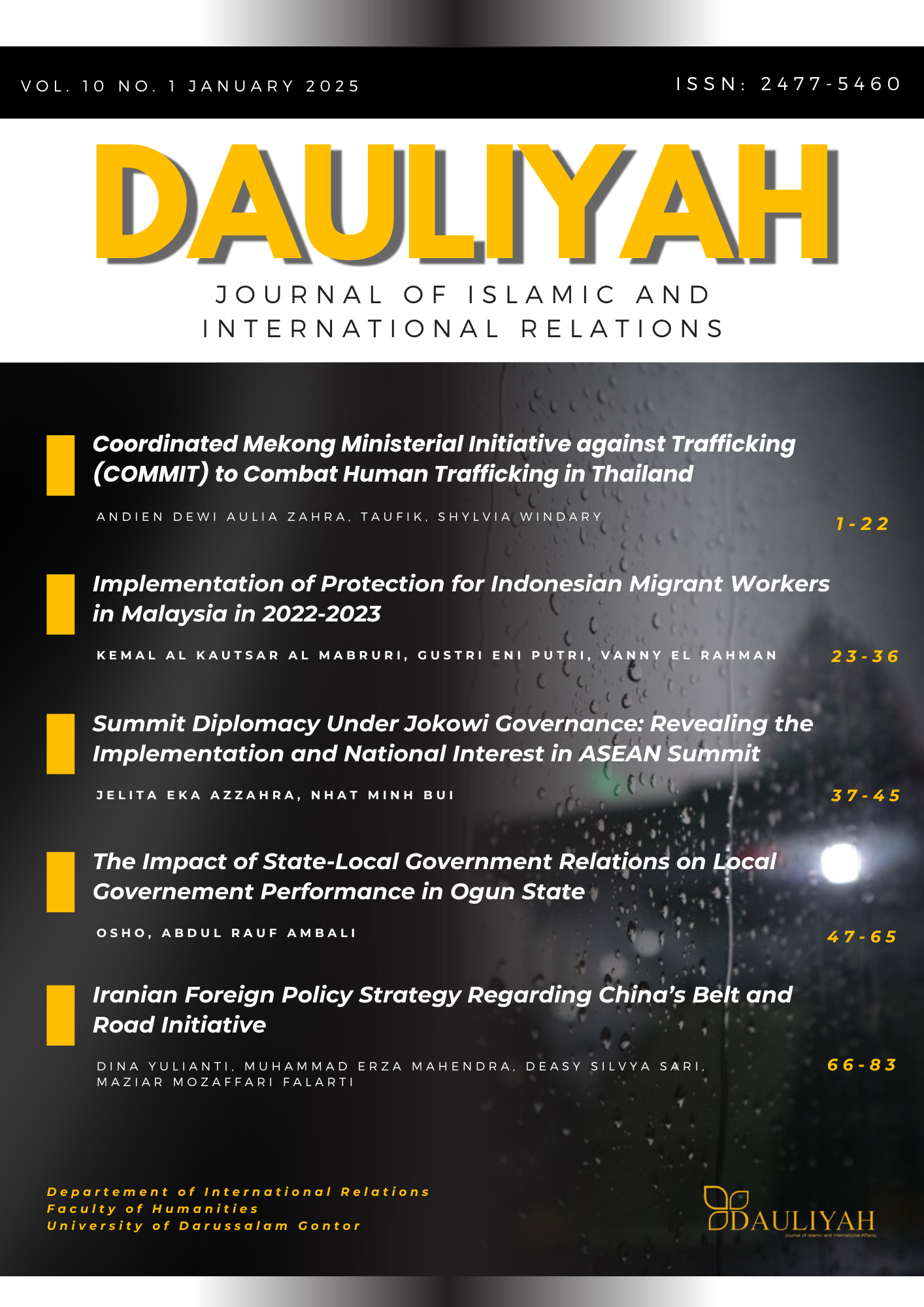
The Impact of State-Local Government Relations on Local Government Performance in Ogun State
DOI:
https://doi.org/10.21111/dauliyah.v10i1.13912Abstract
This study examines the impact of state-local government relations on the performance of local governments in Ogun States, Nigeria, with an emphasis on how such relationship affects local government performances. Local governments are critical in driving economic development and delivering essential services to improve citizens' well-being. However, their performance is often constrained by imbalances in the relationship with state governments. This research employed a mixed-methods approach, including descriptive analysis, multicollinearity tests, factor analysis, and regression analysis, to assess the dynamics of state-local interactions. Primary data were gathered through interviews with local government officials, policymakers, and development experts, alongside questionnaires distributed within selected local governments. Secondary sources comprised government reports, academic literature, and policy documents. Three local governments were purposively selected from the state, with 400 questionnaires administered across Abeokuta North, Yewa North, and Sagamu local government. Findings indicate that local governments lack financial autonomy, with state approval required for service delivery and infrastructure projects, thereby hampering sustainable progress. Although a generally cooperative relationship exists, the financial dependence of local governments on state allocations due to the joint account system limits their accountability and capacity for independent infrastructure development. The study recommends enhancing local government autonomy through policy reforms, technical support, and staff training, alongside formalized communication protocols to strengthen intergovernmental collaboration. Keywords: State-local government relations, local government autonomy, poverty reduction, sustainable development, NigeriaReferences
Adebayo, T., & Balogun, O. (2022). Corruption and governance challenges in poverty alleviation programs in Nigeria. Journal of Development Policy, 45(3), 245-260.
Adebayo, T., Balogun, O., & Ogunleye, J. (2023). Macroeconomic factors and rural poverty in Nigeria: A sectoral analysis. African Economic Review, 32(1), 78-95.
Adeola, F., & Okonkwo, K. (2022). Infrastructure deficits and agricultural productivity in rural Nigeria. Journal of Agricultural Development, 10(4), 123-140.
Adesanya, B., Olajuwon, T., & Yusuf, R. (2023). Bridging the rural-urban divide in Nigeria: Implications for poverty alleviation. Urban and Rural Studies, 18(2), 134-151.
Ahmed, A., & Bello, T. (2022). Governance systems and local government performance: A framework for integration. Journal of Governance and Development, 49(3), 178–195.
Akintola, R., & Eze, K. (2023). Fiscal autonomy and resource dependency in Nigerian local governments. African Journal of Public Administration, 27(2), 112–130.
Alabi, G., & Ojo, M. (2022). Poverty, inequality, and growth: Insights from rural Nigeria. Nigerian Journal of Economic Studies, 29(4), 342-360. Liberto Daniel (2020) Endogenous Growth Theory Definition. Retrieved from https://www.investopedia.com/terms/e/endogenousgrowththeory.asp on 17th March, 2021
Musa, Y., & Kolawole, A. (2021). Participatory governance and stakeholder engagement in local government. International Journal of Public Sector Management, 34(5), 456–474.
Odetola, F., & Adebayo, L. (2024). Network governance and intergovernmental collaboration: Lessons for Nigerian local governments. Policy Studies Journal, 41(1), 34–52.
Okafor, J., & Ajayi, L. (2021). Attracting foreign direct investment for sustainable development in Nigeria. International Journal of Development Economics, 12(2), 101-118.
Okoye, O., & Onyekwena, C. (2023). Reducing inequality through social safety nets and education initiatives: Lessons for Nigeria. Journal of Public Policy and Administration, 40(6), 233-250.
Oladipo, A., Sulaiman, R., & Usman, K. (2021). Historical shifts in Nigeria’s rural development policies: From colonialism to independence. Historical Perspectives on Development, 15(1), 56-72.
Olajide, F., Adewale, S., & Ibrahim, Y. (2023). Enhancing agricultural productivity through technology and finance in Nigeria. Journal of Sustainable Agriculture, 35(5), 189-205.
Olasupo, A., & Balogun, O. (2021). Principal-agent dynamics in Nigerian governance: Implications for performance accountability. Governance Review, 18(1), 89–102. Pragyandeepa (2021). Criticism Against the Theory of Big Push (15 Main Pillars) Retrieved from https://www.economicsdiscussion.net/theories/criticism-against-the-theory-of-big-push-15-main-pillars/4604 on 17th March, 2020.
Uma, K. E., & Eboh, F. E. (2013). Corruption, economic development, and emerging markets: Evidence from Nigeria. Asian Journal of Management Sciences and Education, 2(3), 56–67.
Umoru D. & Onimawo J.A. (2018) National Policy and Big-Push Theory of Development in Nigeria: Moving Away From Low-Level Economic Equilibrium. Scientific Papers of Silesian University of Technology, organization and management series vol. 116 No. 1995
World Bank. (2021). Nigeria’s poverty and inequality report: Key findings. Washington, DC: World Bank.
Downloads
Submitted
Accepted
Published
Issue
Section
License
Copyright (c) 2025 Mahmud Osho, Prof.

This work is licensed under a Creative Commons Attribution-NonCommercial-ShareAlike 4.0 International License.
All articles published in Dauliyah Journal are licensed under a Creative Commons Attribution 4.0 International License (CC BY 4.0).
This license permits anyone to copy, redistribute, remix, transform, and build upon the material for any purpose, even commercially, provided the original work is properly cited.


