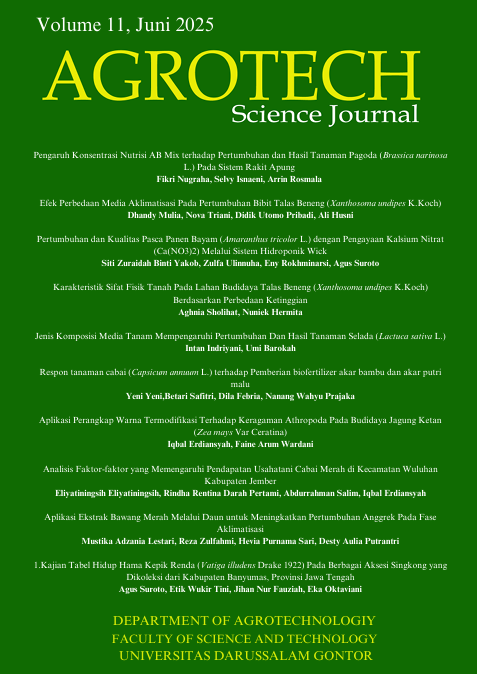
Respon Tanaman Cabai (Capsicum annuum L.) terhadap Pemberian Biofertilizer Akar Bambu dan Akar Putri Malu
Response of Chili Pepper Plant to The Apllication of Bamboo Root and Putri Malu Root Biofertilizer
DOI:
https://doi.org/10.21111/agrotech.v11i01.14711Keywords:
Biofertilizer, cabai, akar bambu, akar putri maluAbstract
Cabai (Capsicum annuum L) adalah komoditas sayuran yang memiliki nilai ekonomi yang tinggi. Pemberian nutrisi melalui pemupukan merupakan faktor penting dalam budidaya cabai untuk dapat meningkatkan produksi. Biofertilizer merupakan material yang berisi mikroba fungsional yang dapat membantu penyerapan nutrisi untuk tanaman. Tujuan dari penelitian ini adalah untuk mengetahui respon tanaman cabai terhadap pemberian biofertilizer yang berasal dari akar bambu (AB) dan akar putri malu (PM). Penelitian ini menggunakan Rancangan Acak Kelompok (RAK) dengan 1 faktor, 10 perlakuan dan 3 kali ulangan. Perlakuan yang digunakan yaitu biofertilizer AB konsentrasi 0%, 25%, 50%, 75%, 100% dan biofettilizer PM konsentrasi 0%, 25%, 50%, 75%, dan 100%. Hasil penelitian menunjukkan bahwa perlakuan biofertilizer AB dan PM memberikan pengaruh sangat signifikan terhadap parameter hari muncul bunga (HST), jumlah buah (buah), bobot per buah (g), dan bobot buah per tanaman (g). Perlakuan AB 100% dan PM 100% merupakan perlakuan terbaik di semua parameter pengamatan dengan memberikan hari muncul bunga tercepat (30.17 – 30.92 HST), jumlah buah terbanyak (36.9 – 41.08 buah), bobot buah tertinggi (4.3 g), dan bobot buah per tanaman tertinggi (161.36 – 176.86 g).References
Abdiani, S., Kakar, K., Gulab, G., & Aryan, S. (2019). Influence of biofertilizer application methods on growth and yield performances of green pepper. International Journal of Innovative Research and Scientific Studies, 2(4), 68-74.
Annisa, P., & Gustia, H. (2017). Respon pertumbuhan dan produksi tanaman melon terhadap pemberian pupuk organic cair tithonia diversifolia. Prosiding seminar Nasional. 104-114
Astija, A., Yulisa, Y., Alibasyah, L., & Febriani, V.
I. (2022). Plant growth promoting rhizobacteria akar bambu, kacang hijau, dan putri malu untuk meningkatkan pertumbuhan bintil akar kacang hijau. Bioscientist, 10(2), 651-661.
Bhattacharya, P. N., & Jha, D. K. (2012). Plant growth-promoting rhizobacteria (PGPR): emergence in agriculture. World Journal of Microbiology and Biotechnology 28: 1327-1350. Boraste, A., Vamsi, K.K., Jhadav, A., Khaimar, Y.,
Gupta, N., Trivedi, S., Patil, P., Gupta, G., Gupta, M., Mujapara, A.K., & Joshi, B. (2009). Biofertilizers: a novel tool for agriculture. International Journal of Microbiology Research, 1(2), 23-31.
Diep, C.N. & Hieu, T.N. (2013). Phosphat and potassium solubilizing bacteria from weathered materials of denatured rock mountain, Ha Tien, Kien Giang Province Vietnam. Journal Life Science, 1(3), 88-92.
Fonte, S. J., Yeboah, E., Ofori, P., Quansyah, G.W., Vanlauwe, B., Six, J. (2009). Fertilizer and residue quality effect on organic matter
stabilization in soil aggregates. Soil Science Society of America Journal, 73(3), 961-966.
Garcia-Fraile, P., Menendez, E., Rivas, R. (2015). Role of bacterial biofertilizers in agriculture and forestry. Aims Bioengineering journal, 2(3), 183-205.
Gautam, S.S., Gondwal, M., Soni, R., & Gautam,
B.P.S. (2022). Potash biofertilizers: current development, formulation, and application. Trends of Applied Microbiology for Sustainable Economy. https://doi.org/10.1016/B978-0- 323-91595-3.00014-8
Glick, B. R. (2012) Plant growth-promoting bacteria: mechanism and applications. Scientifica. 2012(1).
Gou, J., Suo, S., Shao, K., Zhao, Q., Yao, D., Li, H., Zhang, J., Rensing, C. (2020). Biofertilizers with beneficial rhizobacteria improved plant growth and yield in chili (Capsicum annuum L.). world Journal of Microbiology and Bioetchnology. 36(86), 1-12.
Hapsoh, Gusmawartati, Amri, A., Diansyah, A. (2017). Respon pertumbuhan dan produksi tanaman cabai keriting (Capsicum annuum L.) terhadap aplikasi pupuk kompos dan pupuk anorganik di polybag, Jurnal Hortikultura Indonesia, 8(3), 203-208
Hu, T., Gu, J., Zhen, L., Lv, R., Chang, F., Feng,
A.J. (2021). Influences of potassium solubilizing bacteria and K-feldspar on enzyme activities and metabolic activities of the bacterial communities in kiwifruit planting soil. Journal of Genetic Applied Micribiology, 67, 106–113.
Irfan, A., Azis, M. A., Jamin, F. S. (2022). Pengaruh beberapa PGPR terhadap pertumuhan dan produksi cabai rawit (Capsicum frustescens L.). Jurnal Lahan Pertanian Tropis, 1(1), 17-21.
Jha, Y. (2017). Potassium mobilizing bacteria: enhance potassium intake in paddy to regulates membrane permeability and accumulate carbohydrates under salinity stree. Brazilian Journal of Biological Sciences, 4(8), 333-344.
Kakar, K., Wahocho, N.A., Memon, N., Jamro, G.M., Khandro, M. N., Anwar, M., Naqeebullah. (2024). Assesing the effect of
potassium nutrition on the chilies (Capsium annuum) nursery growth and production. Journal Applied Research and Plant Science, 5(2), 183-189.
Khan, M.S., Zaidi, A., & Wani, P.A. (2019). Role of plant growth promoting rhizobacteria in the remediation of metal contaminated soil. Environmental chemistry Letter, 7, 1-19.
Khoso, M.A., Wagan, S., Alam, I., Hussain, A.,
Ali, Q., Saha, S., Poudel, T. R., Mangwhar, H., & Liu, F. (2024). Impact of plant growth- promoting rhizobacteria (PGPR) on plant nutrition and root characteristics: current perspective. https://www.sciencedirect.com/journal/pla nt-stress
Maya, B., Gauchan, D. P., Khanal, S. N., & Lamichhane, J. (2022). Isolation and characterization of plant growth promoting rhizobacteria from bamboo rhizosphere and their role in plant growth promotion. Nepal Journal of Science and Technology, 21(1), 1-12.
Meena, V.S., Maurya, B.R., Verma, J.P., Meena,
R.S. (2016). Potassium Solubilizing Microorganisms for Sustainable Agriculture; Springer: Uttar Pradesh, India. Ndese, T. V. P., Kamagi, D. D. W., Lawalata, H. J., Mokosuli, Y. S., & Taulu, M. L. S. (2024). The effect of biofertlizer (Jakaba) fertilizer on vegetative groeth of chili plants (Capsicum annuum). Advances in Tropical Biodiversity
and Environmental Sciences, 8(3), 119-124.
Prabhavathi, K., Bidari, B.I., Shashidhara, G.B., Math, K.K. (2009). Effect of levels and sources of potassium on yield and nutrient uptake by chilli (Capsicum annuum L.) in a vertisol. Asian Journal of Soil Science, 49(1), 49-51.
Pramudyani, L., Sabur, A., Yasin, M., & Yani, W. (2021). Red chiili performance in acid upland applied with biofertilizer. IOP Conf. series: Earth and Environtmental Science, 012163.
Rafii, A. K., Djarwatiningsih, Pribadi, D. U. (2023). Pengaruh konsentrasi dan waktu pemberian pupuk hayati terhadap
pertumbuhan dan produksi cabai rawit (Capsicum frustencens L.). Agrium, 26(2), 111-
Rofidah, N.I., Yulianah, I. & Respatijarti. (2018). Korelasi antar komponen hasil dengan hasil pada populasi F6 Tanaman cabai merah besar (Capsicum annuum L.). Jurnal Produksi Tanaman, 6(2), 230-235.
Sabina, K. C., Kumal, S., Katuwal, D. R., & Shresta, R. K. (2023). Effect of different levels of potassium and their split application on growth and yield of chili (Capsicum annuum L.). Asian Jpurnal of Agricultural and Horticultural Reseacrh, 10(4), 364-373
Sadiyah, N., Khoirunnisa, L., Wicaksono, D. A., Ramadiana, S., & Rugayah. (2019). Analisis korelasi antara karakter agronomi dengan produksi cabai merah. Jurnal Agroteknologi, 1(2), 1-7.
Sanchez-Cruz, R., Vazquez, I. T., Batista-Garcia,
R. A., Mandez-Santiago, E. W., Zanchez- Carbente, M. R., Leija, A., Lira-Ruan, V., Hernandez, G., Wong-Villareal, A., Folch- Mallol, J.L. (2019). Isolation and characterization of endophytes from nodules of Mimosa pudica with
biotechnological potential. Microbilogical research, 218, 76-86.
Susilawati, S., Ammar, M., Irmawati, I., Harun, M.U., Sodikin, E., & Ichwan, B. (2022). Pertumbuhan dan frekuensi panen cabai merah dengan pemberian pupuk NPK pada kondisi suboptimal secara terapung. Jurnal Ilmu-Ilmu Pertanian Indonesia, 24(2), 126-131.
Torabian, S., Farhangi-Abriz, S., Qin, R., Noulas, C., Sathuvali, V., Charlton, B., Loka, D.A. (2021). Potassium: a vital macronutrient in potato production-a review. Agronomy, 11(3), 543
Zhang, A., Zhao, G., Gao, T., Wang, W. (2013). Solubilization of insoluable potassium and phosphate by Paenibacillus kribnesis CX-7: soil microorganism with biological control potential. African Journal of Microbiology Research, 7(1), 41-47
Zvinavashe, A. T., Lim, E., Sun, H., & Marelli, B. (2019). A bioinspired approach to engineer seed microenvironment to boost germination and mitigate soil salinity. PNAS. 116(51), 25555-25561.
https://doi.org/10.1073/pnas.1915902116
Downloads
Submitted
Accepted
Published
How to Cite
Issue
Section
License
Copyright (c) 2025 Gontor Agrotech Science Journal

This work is licensed under a Creative Commons Attribution-NonCommercial-ShareAlike 4.0 International License.
The author whose published manuscript approved the following provisions:
1. The right of publication of all material published in the journal / published in the Gontor AGROTECH Science Journal is held by the editorial board with the knowledge of the author (moral rights remain the author of the script).
2. The formal legal provisions for access to digital articles of this electronic journal are subject to the terms of the Attribution 4.0 International, which means that Gontor AGROTECH Science Journal reserves the right to save, transmit media or format, Database), maintain, and publish articles without requesting permission from the Author as long as it keeps the Author's name as the owner of Copyright.
3. Printed and electronic published manuscripts are open access for educational, research and library purposes. In addition to these objectives, the editorial board shall not be liable for violations of copyright law.