
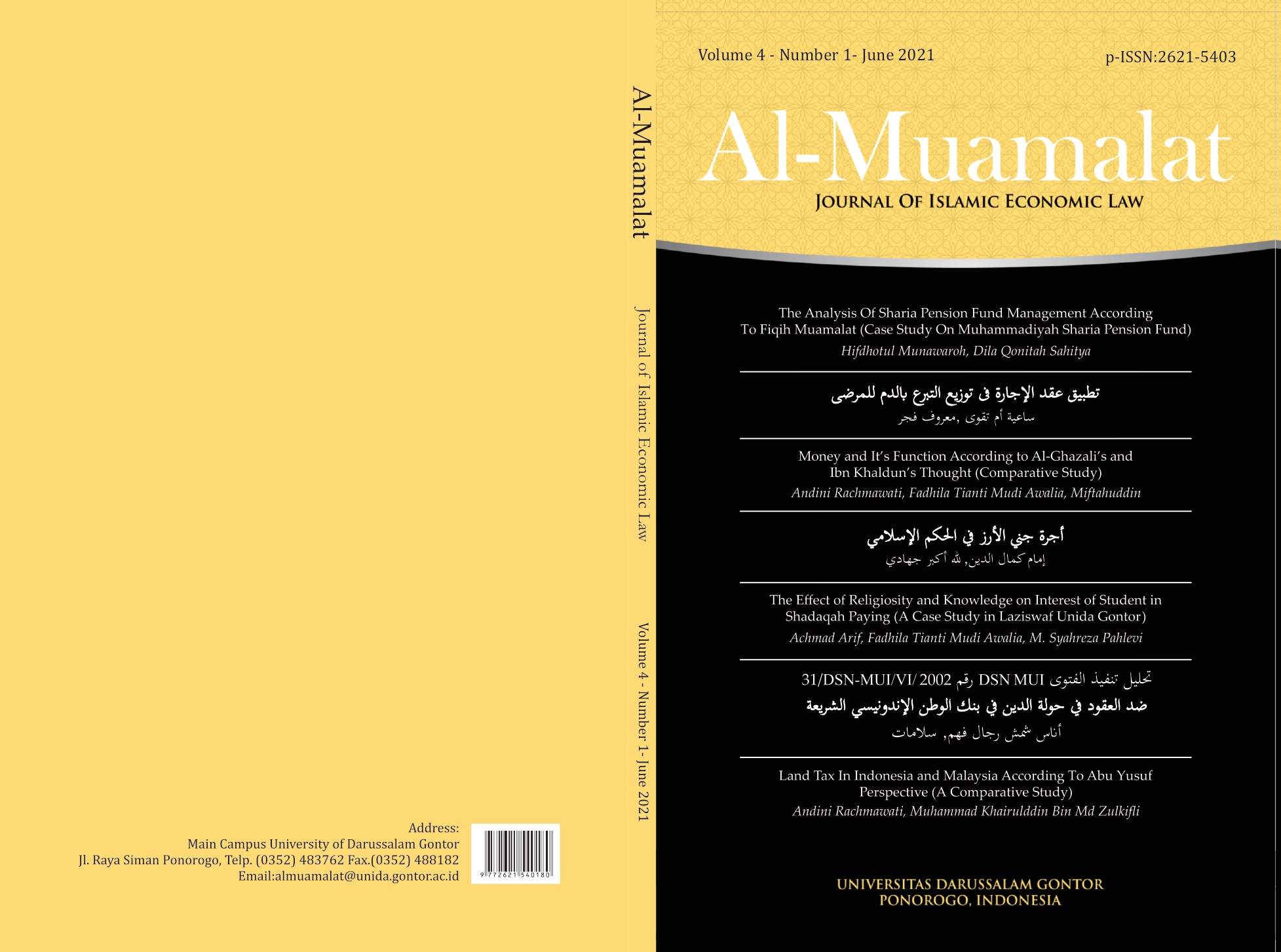
Land Tax In Indonesia And Malaysia According To Abu Yusuf Perspective (A Comparative Study)
Keywords:
Land Tax, Abu Yusuf, Indonesia and MalaysiaAbstract
Tax is an importance to a country while it is a main source of a country and of course it will give some impact at income of government, tax also have a contribution in development of country. In the history of Islamic economics, Abu Yusuf is known to have a significant contribution to taxation progress during the leadership of the Caliph Harun Ar-Rashid. He wrote a book containing recommendations on the taxation system. The land tax has been implemented in Indonesia since the Dutch colonialism. After Indonesia's independence, the Indonesian government replaced it with the Land Tax and so on became the Land Product Tax (Pajak Hasil Bumi). Whereas in Malaysia, the principle of land law was based on the Torrents system implemented by the British government during the colonial period in 1864. The legislation is still the foundation of land-related legislation to this day. However, the land taxation system in these two countries is seen to still be influenced by western taxation concepts. This study aims to find out how: the concept of land tax according to Abu Yusuf, the form of land tax in Indonesia and Malaysia and the differences and similarities in land tax in Indonesia, Malaysia, and Abu Yusuf. In presenting this discussion, researcher used a descriptive method to outline Abu Yusuf view on land tax in his lifetime, also to outline the concept of land tax in Indonesia dan Malaysia. Researcher also use analysis methods to find out the similarities and differences from Abu Yusuf’s land tax, land tax in Indonesia and Malaysia. The results of this study indicate that: in discussing the taxation system, Abu Yusuf suggested four points, namely: 1. using the muqasamah system, 2. the role of government in solving tax collection injustices, 3. the separation between fertile and infertile land, 4. the role of government assist farmers in fertilizing the land. After the analysis, it can be seen two similar points between land taxation in Indonesia and Malaysia with land taxation according to Abu Yusuf: the first is the role of the government in helping farmers and the second is in establishing a transparent tax collection system. The two different points are first is determination of the land tax rate and the second is separating the fertile land and the infertile land. At the end of the research, the researcher can conclude that land taxation in Indonesia is closer to what Abu Yusuf suggested than taxation in Malaysia.References
أبو يوس٠يعقوب بن ابراهيم. 1979 Ù…. كتاب الخراج. بيروت: دار المعرÙØ©.
Ù…Øمد ضياء الدين الريس. 1969 Ù…. الخراج والنظام المالية للدولة الإسلامية.مصر: دار المعارÙ.
Arifin, Tajul. 2014. Metode Penelitian Ekonomi Islam. Bandung: CV Pustaka Setia.
Anggoro, Damas Dwi. 2017. Pajak Daerah dan Retribusi Daerah. Malang: UB Press.
Abrari Syauqi, Ahmad Kastalani. et.al, 2016. Sejarah Peradaban Islam. Yogjakarta: Aswaja PressIndo.
Azmi, Sabahuddin. 1995. Abu Yusuf’s Contribution to The Theory of Public Finance, India: Aligarh Muslim University.
Abdul Manaf, Nor Aziah. 2006. State Government Land Tax Performance in Malaysia. Kedah: Universiti Utara Malaysia.
Chamid, Nur. 2017. Jejak Langkah Sejarah Pemikiran Ekonomi Islam. Yogyakarta: Pustaka Pelajar.
Daud, Normadiah. Perbandingan Antara Sistem Cukai Kharaj Dengan Cukai Tanah Konvensional. (Jurnal Islam dan Masyarakat Kontemporari Vol. 2. 2009)
Edianto. Bani Abbasiyah (Pembentukan, Perkembangan dan Kemajuan). (Jurnal Al Hikmah. Vol. 19 No. 2. 2017)
Gusfahmi. 2007. Pajak Menurut Syariah. Jakarta: Raja Grafindo Persada.
Hendri Hermawan Adinugraha. The Rationalization of Abu Yusuf Economic Thought. (Journal of Islamic Banking and Finance.Vol. 35 No. 4. December 2018)
Karim, Adiwarman Azwar. 2008. Sejarah Pemikiran Ekonomi Islam. Jakarta: Raja Grafindo Persada.
Mardiasmo. 2013. Perpajakan Yogyakarta: ANDI.
Majid, M. Nazori. 2003. Pemikiran Ekonomi Islam Abu Yusuf. Yogyakarta: PSEI.
Malaysia Law. National Land Code (Terengganu Land Rules, 1966).
Meriyati. Perkembangan Ekonomi Islam Pada Masa Daulah Abbasiyah. (Jurnal Islamic Banking. Vol. 4 No. 1. August 2018)
Muhammad Fauzan, 2014. Konsep Perpajakan Menurut Abu Yusuf. Skripsi. Sumatera Utara: Fakultas Syariah dan Hukum. Institut Agama Islam Negeri.
Munawwarah, Ade. et.al. Efektivitas Pengelolaan Pajak Bumi dan Bangunan oleh Daerah Terhadap Peningkatan Pembiayaan Pembangunan di Kabupaten Bogor. (Jurnal Living Law. Vol. 7 No. 2. 2017)
Munif, Nasrulloh Ali. Critical Analysis of Abu Yusuf Thought: The Role of Government in Islamic Economic. (Jurnal Eksyar. Vol. 7 No. 1. June 2019)
Rachmatullah Oky. Teori Pajak Menurut Abu Yusuf Sebuah Alternatif Solusi Perpajakan di Indonesia. (Jurnal Iqtoshoduna. Vol. 8. No. 1. April 2019)
Saad, Natrah, Zimah Zainol Ariffin. 2019. Principles of Taxation. Kedah: UUM Press.
Samudra, Azhari Aziz. 2016. Perpajakan di Indonesia. Jakarta: Raja Grafindo Persada.
Santosa, Purbayu Budi. Maslahah Dalam Pajak Tanah Perspektif Abu Yusuf. (Journal Dinamika Ekonomi & Bisnis. Vol. 12 No. 2. October 2015)
Sari, Depi Rianita. 2010. Pemikiran Yusuf Qardhawi Tentang Pajak (Dharibah). Skripsi. Riau: Fakultas Syariah dan Ilmu Hukum. Universitas Islam Negeri Sultas Syarif Kasim.
Serji, Rabiah Muhammad. Sistem Torrens dalam undang-undang tanah di Malaysia. (Jurnal ICONLEE. Vol. 2. December 2017)
Serli Mahroes. Kebangkitan Pendidikan Bani Abbasiyah Perspektif Sejarah Pendidikan Islam. (Jurnal Tarbiyah. Vol. 1 No. 1. 2015)
Sunggono, Bambang. 2006. Metodologi Penelitian Hukum. Jakarta: Raja Grafindo Persada.
Suparmoko, M. 2011. Keuangan Negara dalam Teori dan Praktek. Yogyakarta: BPFE.
Suprehaten. 2010. Pemikiran Abu Yusuf Tentang Pasar Dalam Kitab Al-Kharaj. Skripsi tidak diterbitkan. Riau: Fakultas Syariah dan Ilmu Hukum. Universitas Islam Negeri Sultan Syarif Kasim.
Undang-undang Republik Indonesia Nomor 12 Tahun 1985 Tentang Pajak Bumi dan Bangunan Tambahan Lembaran Negara Republik Indonesia Tahun 1985 Nomor 3312.
Undang-Undang Malaysia. Kanun Tanah Negara 1965 Akta 56/1965. Waluyo, Wirawan B. Ilyas. 2002. Perpajakan Indonesia. Jakarta: Salemba Empat.
Widyaningsih, Aristanti. 2013. Hukum Pajak dan Perpajakan. Bandung: Alfabeta.
Wahyuni, Purwaningdyah Murti. et.al. 2019. Pajak Bumi dan Bangunan. Tangerang Selatan: Universitas Terbuka.
Yusof, Muhammad Fathi. Undang-Undang Tanah di Malaysia. Selangor: Mus’ab E-book Publication.
Yulianti, Rahmani Tirmorita. Pemikiran Ekonomi Islam Abu Yusuf. (Muqtasid. Vol. 1 No. 1. 2010)
Alamsyah, Ichsan Emeald, DPR Setujui Perubahan Anggaran Kementan, in https://republika.co.id/berita/q5vqm5349/dprsetujui-perubahan-anggaran-kementan,
Ismail, Mohd Hafiz, Perkasa Sektor Pertanian, in https://www.sinarharian.com.m y/article/51868/KHAS/ Belanjawan-2020/Perkasa-sektor-pertanian-negara,
https://en.wikipedia.org/wiki/Land_value_tax,
Downloads
Submitted
Accepted
Published
Issue
Section
License
- You do not have to comply with the license for elements of the material in the public domain or where your use is permitted by an applicable exception or limitation.
- No warranties are given. The license may not give you all of the permissions necessary for your intended use. For example, other rights such as publicity, privacy, or moral rights may limit how you use the material.


