
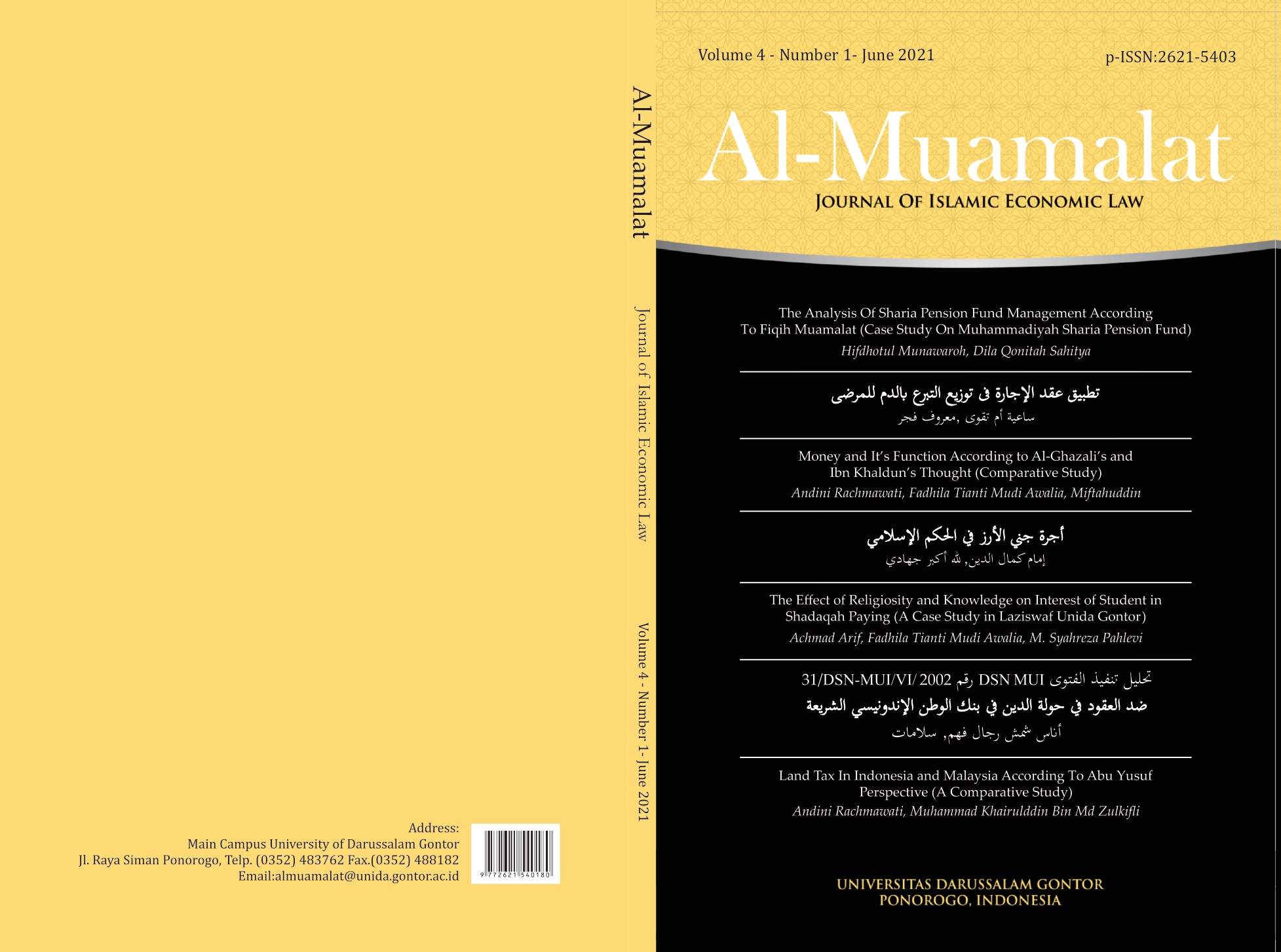
Money and It’s Function According to Al-Ghazali’s and Ibn Khaldun’s Thought (Comparative Study)
Keywords:
money, function of money, medium of changeAbstract
This research is motivated by problems that arise around us, even in the world in general. The author has the hypothesis that the function of money was not in line when money was first created, which causes money to have shifted from its original function. This paper aims to describe and reconstruct the thoughts of Al-Ghazali and Ibn Khaldun about money and its functions. The method used in this research is qualitative by using literary review and comparative studies are taken from several books, journals, and some relevant reading sources. The results of this study state that money according to them is of no intrinsic value, cannot be traded, and only as a medium of exchange. The function of money according to them is to be a unit of calculation and a medium of exchange for non-commodity activities and others as they already have in dinars and dirhams. So in Islam, the activity of hoarding money and misusing the function of money is not justified and is contrary to the main function of money itself. While there are some differences between the two of them, such as Al-Ghazali permitting the use of paper money without any guarantee of gold or silver provided the government states that paper money is an official payment instrument, the government must maintain its value and ensure there is no money trading. While Ibn Khaldun permits the use of paper money on the condition that there are gold reserves or collateral in the bank.References
أبو Øامد الغزالي.1993. Ø¥Øياء علوم الدين. بيروت: دار الخير
خلدون، ابن.1900. مقدمة. بيروت: دار الخير
Agustianto, (2005), “Pemikiran Ekonomi Ibnu Khaldun dan Signifikansinya dalam Konteks Kekinianâ€, unpublished paper.
Azyumardi Arya. (1996). Ensiklopedi Islam II, (Jakarta: Intermasa)
Azwar Karim. Adiwarman. (2001). Ekonomi Islam, Suatu Kajian Kontemporer,( Jakarta: Gema Insani Press).
_____ (2015). Ekonomi Makro Islam (Jakarta: Rajawali Pers).
D. B. Macdonald. (1902). “The Name Al-Ghazzali,†Journal of the Royal Asiatic Society.
Euis Amalia. (2010). Sejarah Pemikiran Ekonomi Islam. Depok: Gramata Publishing.
Griffel, Frank. (2009). Al-GhazÄlī’s Philosophical Theology. (Oxford: Oxford University Press)
Indra Darmawan. (1992). Pengantar Uang dan Perbankan (Jakarta: Rineka Cipta)
Mohammad Abdullah Enan. (1946) Ibn Khaldun, His Life and Work, (Lahore: Khasmiri Bazar)
Murthada Muthahari. (1995). Pandangan Islam Tentang Asuransi dan Riba (Bandung: Pustaka Hidayah).
Nur Chamid. (2010) Jejak Langkah Sejarah Pemikiran Ekonomi Islam, (Yogyakarta: Pustaka Pelajar).
Pratama Rahardja. (1997) Uang dan Perbankan, (Jakarta: Rineka Cipta)
Zainab Al-Khundairi. (1987) Filsafat Sejarah Ibn Khaldun, translated by Ahmad Rifa’I Usmani, (Bandung: Penerbit Pusaka)
Zainal Abidin Ahmad. (1979) Dasar-Dasar Ekonomi Islam, (Jakarta: Bulan Bintang)
Downloads
Submitted
Accepted
Published
Issue
Section
License
- You do not have to comply with the license for elements of the material in the public domain or where your use is permitted by an applicable exception or limitation.
- No warranties are given. The license may not give you all of the permissions necessary for your intended use. For example, other rights such as publicity, privacy, or moral rights may limit how you use the material.


