

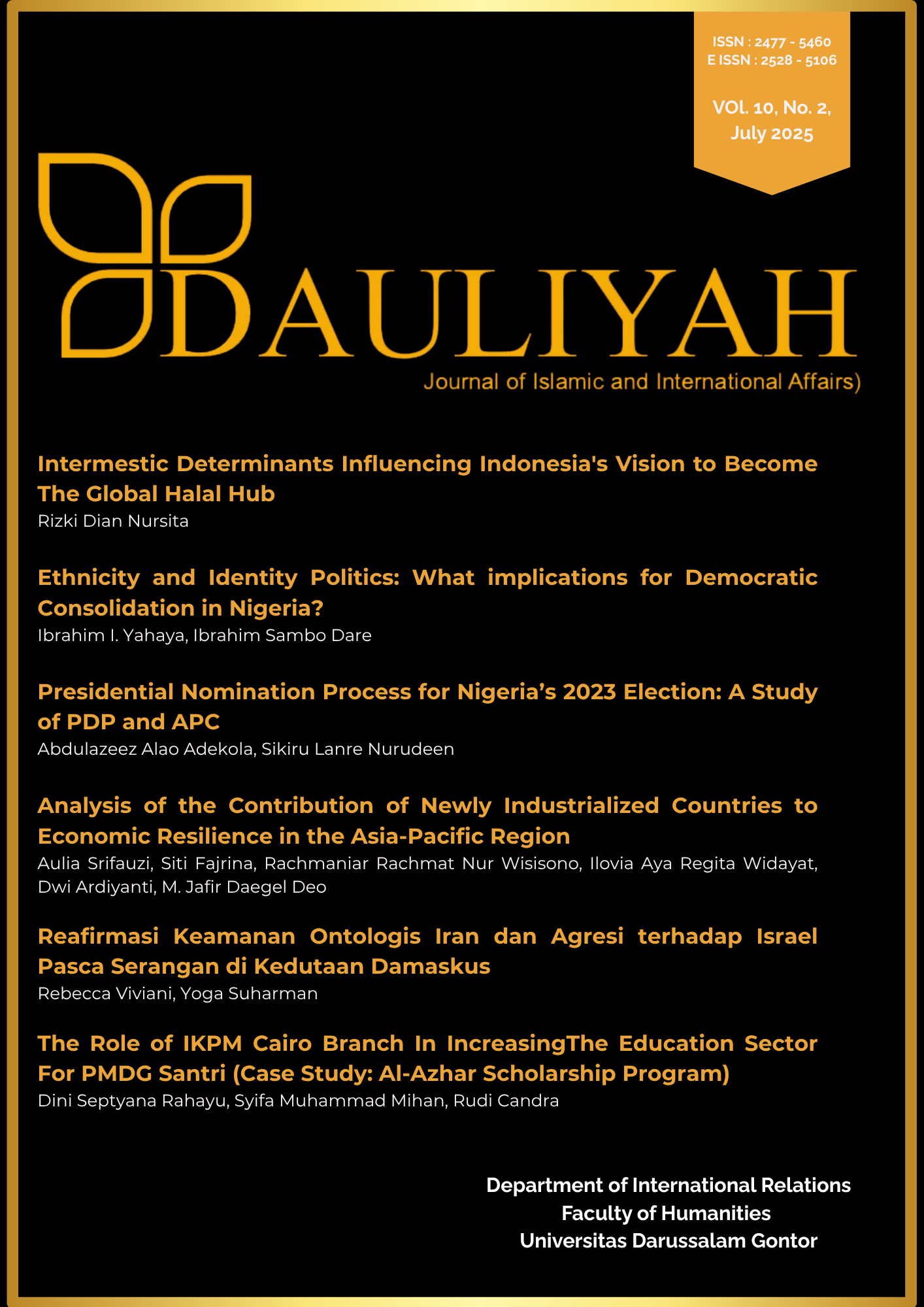
Ethnicity and Identity Politics: What implications for Democratic Consolidation in Nigeria?
DOI:
https://doi.org/10.21111/dauliyah.v10i2.14217Abstract
This study critically examines the intricate relationship between ethnicity, identity politics, and democratic consolidation in Nigeria, with a specific focus on the 2015, 2019, and 2023 presidential elections. The persistent influence of ethnic identities has been deeply rooted in Nigerias colonial legacy which has continuously shaped the political and electoral dynamics, often at the expense of national unity and democratic governance. The research employs a qualitative method, utilizing content analysis of political speeches, electoral reports, and secondary data from academic literature, to interrogate the extent to which ethnic-based voting patterns, regionalism, and identity politics have either advanced or undermined democratic consolidation. Using the theory of Ethnic Conflict, the study examines how these dynamics played out during Nigerias 2015, 2019 and 2023 presidential elections in the country and the challenges posed to electoral integrity and democratic consolidation. From the findings, the study reveals that, ethnicity and identity politics have negative implications on the political development of the country. They also serve as hindrance to democratic consolidation. The study recommends that addressing the challenges posed and attaining democratic consolidation require comprehensive electoral reforms, constitutional amendments through national dialogue, de-escalation of ethnic tensions through equitable distribution of national resources and structural adjustments aimed at fostering inclusivity and equitable representation for sustainable democracy in Nigeria.References
Alabi, A., et al (2023).Identity Politics and its Implication on the Nigerian Electoral Process African Journal of Politics and Administrative Studies (AJPAS), 16 (1):201-213
Ayoade, J. A. A. (2015). Ethnicity and the Politics of Democratic Consolidation in Nigeria
Ibadan University Press.
Babalola, D. (2020). Ethno-religious voting in Nigeria: Interrogating voting patterns in the 2019 presidential election. The Round Table, 109(5), 510-522. https://doi.org/10.1080/00358533.2020.1788763
Diamond, L. (2015) "The Crisis of Democracy in Nigeria." Journal of Democracy, 26(3), 94-108
Diamond, L (1999) Developing Democracy: Toward Consolidation. Johns Hopkins University Press.
Hayes, A. (2022). Conflict theory definition founder and examples. Investopedia.
Horowitz, D. L (1985) Ethnic Groups in Conflict University of California Press, Berkeley, CA
Jega, A. M. (2022). Democracy and the Challenge of Ethnicity in Nigeria, Zaria: Ahmadu Bello University Press.
Kew, D., & Phillips, R. (2020) Nigeria: Demanding Democratic Reforms in an Era of Uncertainty. In D. Kew (Ed.), Democratic Reform in Africa: The Quality of Progress. Lynne Rienner Publishers
Muhammad, A. A. (2023). Under the Shadow of the Siamese Twins: Ethnicity, Religion and Nigeria’s 2023 Presidential Election. Hasanuddin Journal of Strategic and International Studies (HJSIS), 2(1), 21-31.
Nnoli O (1978). Ethnic Politics in Nigeria Enugu. Fourth Dimension Publishing Co. Ltd
Nwankwo, C. (2015). Ethnicity and the 2015 General Elections in Nigeria: A Critical Review. African Journal of Political Science and International Relations, 9(3), 60-72.
Nwankwo, N (2013). Ethnic politics in Africa: The Nigerian example European Conference on African Studies
Olaniyan, A & Omotola, S (2015): Ethnic crises and national security in Nigeria, Defense & Security Analysis, Defense & Security Analysis. DOI: 10.1080/14751798.2015.1087104. Pg. 11
Oladiran, A (2013). Ethnic politics and democratic consolidation in Nigeria. International Journal of Academic Research in Business and Social Sciences. Vol. 3, No. 12
Ogundiya, I. S. 2009. “A Decade of Democratic Governance in Nigeria.” In A Decade of Re-
Democratization in Nigeria: 1999-2009, edited by Ogundiya et al. Ibadan, Nigeria: Ayayayugu Publishers.
Omotola, J. S. (2018). Ethnic Politics and Democratic Consolidation in Nigeria: Assessing the Role of the Fourth Republic. Africa Development, 43(1), 19-37.
Omotola, J. S. (2015). Elections and Democratic Consolidation in Nigeria under the Fourth Republic. African Affairs, 109(437), 535-553.
Onwumere, C. (2019). "Ethnic Tensions Under Buhari's Regime." Journal of African Politics
Ornge, C. (2014) Ethnicity and Identity Politics: Challenges for Nigeria in (ed) Victor, E.,
Terhemba, W, & Chris O, Federalism, Politics and Minorities in Nigeria. Essays in honour of Professor, G N, Hember, Sam-Adex Printers, Ibadan
Osaghae, E. E. (2021). "Ethnicity, Class, and State in Nigeria." African Affairs, 120(481), 142-165.
Osaghae, E. E. (2006). Ethnicity and the state in Africa. African Affairs, 95(378), 443-452. https://doi.org/10.1093/oxfordjournals.afraf.a007761
The Punch Newspaper (2024) available https://punchng.com/ruga-controversy-and-buharis-place-in-history/
The Punch Newspaper (2023) available at https://www.google.com/amp/s/punchng.com/suppression-violence-marred-2023-elections-us-report/%3famp
Santas, T, (2014) Ethnic Crisis and Democracy in Nigeria: Implications for National
Development in (ed) Victor, E., Terhemba, W, & Chris O, Federalism, Politics and Minorities in Nigeria. Essays in honour of Professor, G N, Hember, Sam-Adex Printers, Ibadan
Downloads
Submitted
Accepted
Published
Issue
Section
License
Copyright (c) 2025 DAULIYAH

This work is licensed under a Creative Commons Attribution-NonCommercial-ShareAlike 4.0 International License.
All articles published in Dauliyah Journal are licensed under a Creative Commons Attribution 4.0 International License (CC BY 4.0).
This license permits anyone to copy, redistribute, remix, transform, and build upon the material for any purpose, even commercially, provided the original work is properly cited.


