

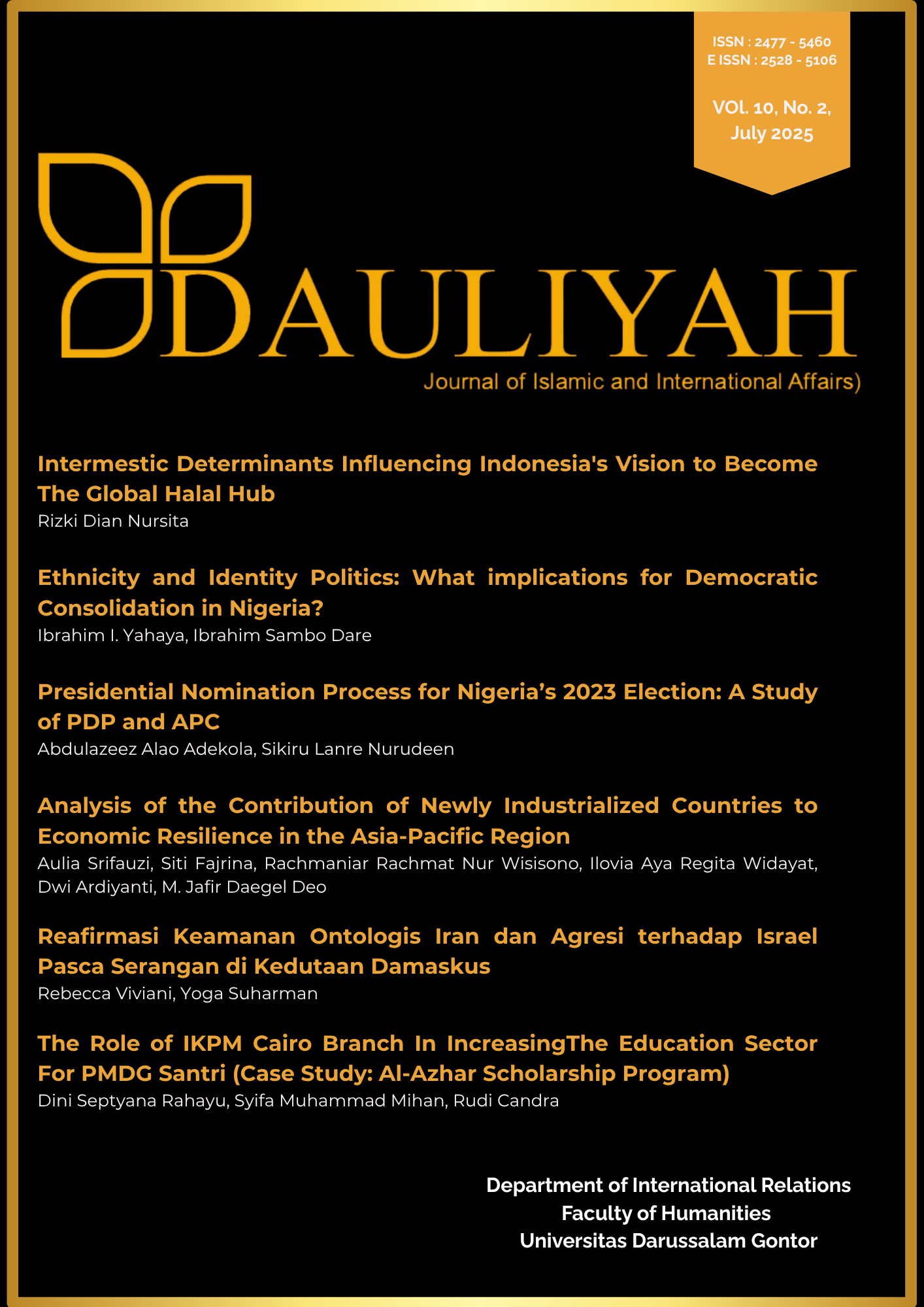
Intermestic Determinants Influencing Indonesia's Vision To Become The Global Halal Hub
DOI:
https://doi.org/10.21111/dauliyah.v10i2.13244Abstract
Islam has been the fastest-growing religion in the last decades. The world's Muslim population has reached 1.9 billion people by 2022. Such growth makes Muslims the most influential segment in the global industry, particularly the global halal industry. The halal industry is not only a matter of food but has become a lifestyle. Facing such a challenge, Indonesia has taken ambitious steps to become the Global Halal Hub. Among them are by issuing Law No. 33 of 2014, Indonesia Islamic Economic Masterplan 2019-2024, Government Regulation No. 39 of 2021, Ministerial Regulation No. 20 of 2021, and changing the governance of national halal certification and standardization. The government has become more serious about its ambition in the halal industry by declaring a vision to become the Global Halal Hub. This study tries to explain the intermestic factors influencing Indonesia's halal policy transformation. The results of this study show that domestic and international factors influence the transformation in Indonesias halal policy. Domestic factors comprise the halal values ​​in the consumption behavior of Muslims in Indonesia, the shift in the domestic policy by centralizing halal certification, and competition among stakeholders in governing halal certification in Indonesia. The international factors comprise the global halal standards, the vigorous competition in the halal industry between Indonesia and the neighboring countries, such as Malaysia, Brunei Darussalam, Singapore, and Thailand, and between Indonesia and major players of the global halal industry, such as Brazil, India, and the United States.References
Africa Economic Islamic Foundation, The Global Halal Industry: An Overview (Africa Economic Islamic Foundation, 2019), pp. 1–20
al-Ma’aniy, ‘Ta’rif Wa Ma’na Halal Fi Mu’jam al-Ma’aniy’, Al-Ma’aniy <https://www.almaany.com/ar/dict/ar-ar/%D8%AD%D9%84%D8%A7%D9%84/>
Azam, Md Siddique E., and Moha Asri Abdullah, ‘GLOBAL HALAL INDUSTRY: REALITIES AND OPPORTUNITIES’, IJIBE (International Journal of Islamic Business Ethics), 5.1 (2020), pp. 47–59, doi:10.30659/ijibe.5.1.47-59
al-Baqi, Muhammad Fu’ad’Abd, ‘Al-Mu’jam al-Mufahras Li-Alfaz al-Qur’an al-Karim’ (Daar al-Kutub al-Misriyah, 2001)
Bergeaud-Blackler, Florence, ‘The Encounter of Market and Diasporic Dynamics’, in Halal Matters: Islam, Politics and Markets in Global Perspective (Taylor and Francis Inc, 2016), pp. 91–104
Bergeaud-Blackler, Florence, Johan Fischer, and John Lever, Halal Matters: Islam, Politics and Markets in Global Perspective (Routledge, 2015)
BPJPH, ‘Visi Dan Misi Badan Penyelenggara Jaminan Produk Halal (BPJPH)’ <http://www.halal.go.id/profil/visimisi> [accessed 15 July 2022]
BPS, Indeks Perilaku Anti Korupsi (IPAK) Indonesia Tahun 2020 Meningkat Dibandingkan IPAK 2019 (Badan Pusat Statistik, 2020) <https://www.bps.go.id/pressrelease/2020/06/15/1671/indeks-perilaku-anti-korupsi--ipak--indonesia-tahun-2020-meningkat-dibandingkan-ipak-2019.html>
CBRE, ‘About: One-Stop Integrated Halal Hub’, SG Halal Hub, 2019 <https://sghalalhub.com/index.php/about> [accessed 16 June 2020]
Data Indonesia, ‘Sebanyak 86,9% Penduduk Indonesia Beragama Islam’, Dataindonesia.id, 2022 <https://dataindonesia.id/ragam/detail/sebanyak-869-penduduk-indonesia-beragama-islam> [accessed 16 July 2022]
Databoks, ‘Sebanyak 86,88% Penduduk Indonesia Beragama Islam | Databoks’, 2021 <https://databoks.katadata.co.id/datapublish/2021/09/30/sebanyak-8688-penduduk-indonesia-beragama-islam> [accessed 16 July 2022]
Deputy of the Economy Indonesian Ministry of National, ‘Indonesia Islamic Economic Masterplan 2019-2024’, Indonesian Ministry of National Development Planning, 2019 <https://knks.go.id/storage/upload/1560308022-Indonesia%20Islamic%20Economic%20Masterplan%202019-2024.pdf>
DinarStandard, State of the Global Islamic Economy Report 2019/20 (DinarStandard, 2019) <https://cdn.salaamgateway.com/special-coverage/sgie19-20/full-report.pdf>
———, State of the Global Islamic Report 2020/2021: Thriving in Uncertainty, 2020, Salaam Gateway <https://cdn.salaamgateway.com/reports/pdf/8fc62756cf0e10613760a28a8ac816bd7ab42e05.pdf>
FAO, ‘GENERAL GUIDELINES FOR USE OF THE TERM “HALAL”’, 1997 <https://www.fao.org/3/y2770e/y2770e08.htm> [accessed 11 August 2022]
Fischer, Johan, ‘Halal Training in Singapore’, in Halal Matters: Islam, Politics and Markets in Global Perspective (Taylor and Francis Inc, 2016), pp. 175–91
Idris, M, ‘Kemenperin: Halal Bukan Karena Masalah Agama, Sekarang Jadi Fesyen’, Kompas.Com, 25 October 2020 <https://money.kompas.com/read/2020/10/25/074246626/kemenperin-halal-bukan-karena-masalah-agama-sekarang-jadi-fesyen.>
Kurniawati, Dyah, ‘Intermestic Approach: A Methodological Alternative in Studying Policy Change’, PCD Journal, 5 (2017), p. 147, doi:10.22146/pcd.26293
Kusumaningrum, Demeiati N., and Dyah Estu Kurniawati, Intermestik sebagai Pendekatan Studi Hubungan Internasional: Pengantar dan Contoh Penelitian (Penerbit LeutikaPrio, 2016)
Lever, John, ‘The Postliberal Politics of Halal: New Directions in the Civilizing Process?’, Human Figurations, 2.3 (2013) <http://hdl.handle.net/2027/spo.11217607.0002.306>
Lipka, Michael, and Conrad Hackett, ‘Why Muslims Are the World’s Fastest-Growing Religious Group’, Pew Research Center, 2017 <https://www.pewresearch.org/fact-tank/2017/04/06/why-muslims-are-the-worlds-fastest-growing-religious-group/> [accessed 7 June 2020]
LPPOM MUI, ‘Diakui Internasional’, LPPOM MUI | Lembaga Pengkajian Pangan Obat-Obatan Dan Kosmetika Majelis Ulama Indonesia <https://halalmui.org/mui14/main/diakui_internasional> [accessed 15 July 2022]
Mao, Ana, ‘Brazil Eyes $1.17 Trillion Halal Food Market, Keen to Boost Its Share in Trade | Reuters’, Reuters, 2021 <https://www.reuters.com/markets/commodities/brazil-eyes-117-trillion-halal-food-market-keen-boost-farm-trade-with-islamic-2021-12-06/> [accessed 21 July 2022]
Mastercard, Crescentrating, Indonesia Muslim Travel Index (IMTI) 2019 (Crescentrating Mastercard, 2019)
Mcbeth, John, ‘Indonesia’s Halal Law Threatens to Trigger Trade Disputes’, Asia Times, 2022 <https://asiatimes.com/2022/02/indonesias-halal-law-threatens-to-trigger-trade-disputes/> [accessed 11 August 2022]
Ministry of Culture Sports d Tourism and Korean Culture and Information, ‘Malaysia: Global Hub of Halal Industry’, 2019 <http://www.korea.net/NewsFocus/policies/view?articleId=178337> [accessed 16 June 2020]
Ministry of Economy Trade and Industry, ‘Japan and Malaysia Sign Memorandum of Cooperation on Halal Cooperation’, Ministry of Economy Trade and Industry, 2018 <https://www.meti.go.jp/english/press/2018/1127_002.html>
Nik Muhammad, Nik Maheran, Filzah Md Isa, and Bidin Chee Kifli, ‘Positioning Malaysia as Halal-Hub: Integration Role of Supply Chain Strategy and Halal Assurance System’, Asian Social Science, 5.7 (2009), pp. 44–52, doi:10.5539/ass.v5n7p44
Purnomo, W.A., ‘Berebut Kuasa Di Jalur Halal’, Tempo, 15 October 2014 <https://majalah.tempo.co/read/nasional/146289/berebut-kuasa-di-jalur-halal>
Salaam Gateway, ‘India’s Halal Food Industry Sees Major Growth in Export and Domestic Markets’, Salaam Gateway - Global Islamic Economy Gateway, 2021 <https://www.salaamgateway.com/story/indias-halal-food-industry-sees-major-growth-in-export-and-domestic-markets> [accessed 21 July 2022]
Salama, ‘Brunei Confident of Becoming a World Class International Halal Trade Hub’, HalalFocus.Net - Daily Halal Market News, 2020 <https://halalfocus.net/brunei-confident-of-becoming-a-world-class-international-halal-trade-hub/> [accessed 20 July 2022]
Saputra, A, ‘Tak Lagi Punya Otoritas Halal, MUI Gugat UU JPH Ke MK’, Detiknews, 14 August 2019 <https://news.detik.com/berita/d-4664936/tak-lagi-punya-otoritas-halal-mui-gugat-uu-jph-ke-mk>
Shikoh, Rafiuddin, Mian N Riaz, and Munir M Chaudry, ‘Global Halal Economy’, in Handbook of Halal Food Production (CRC Press, 2019)
Sidqi, Adkhilni, and Akmal Ruhana, Intermestic Factors of Indonesia’s Halal Certification, 2021, doi:10.4108/eai.2-11-2020.2305029
SMIIC, ‘National Standardization Agency of Indonesia (BSN)’ <https://www.smiic.org/en/member/48> [accessed 11 August 2022]
The Halal Times, ‘Almost No Muslim Country Among Top 10 Halal Product Exporters’, The Halal Times, 2022 <https://www.halaltimes.com/muslim-country-among-top-10-halal-products-exporters/> [accessed 21 July 2022]
The Trade Arabia, ‘The Rise of Thai Halal Industry’, The Trade Arabia, 2021 <http://www.tradearabia.com/news/IND_387216.html> [accessed 20 July 2022]
Undang-Undang Nomor 33 Tahun 2014 Tentang Jaminan Produk Halal, 2014
World Population Review, ‘Muslim Majority Countries 2022’, 2022 <https://worldpopulationreview.com/country-rankings/muslim-majority-countries> [accessed 12 July 2022]
Downloads
Submitted
Accepted
Published
Issue
Section
License
Copyright (c) 2025 DAULIYAH

This work is licensed under a Creative Commons Attribution-NonCommercial-ShareAlike 4.0 International License.
All articles published in Dauliyah Journal are licensed under a Creative Commons Attribution 4.0 International License (CC BY 4.0).
This license permits anyone to copy, redistribute, remix, transform, and build upon the material for any purpose, even commercially, provided the original work is properly cited.


