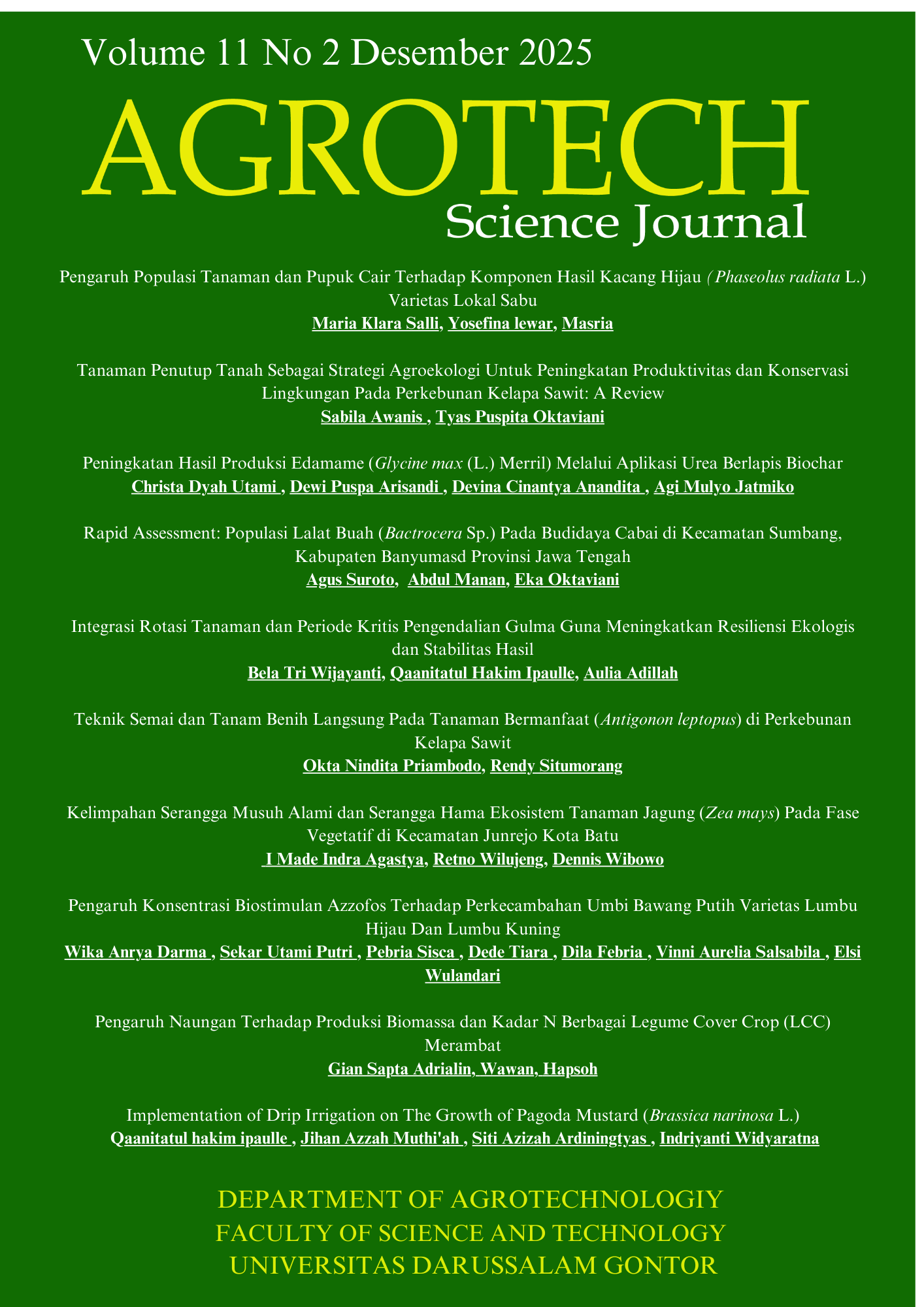
PENGARUH NAUNGAN TERHADAP PRODUKSI BIOMASSA DAN KADAR N BERBAGAI Legume Cover Crop (LCC) MERAMBAT
The Effect of Shade Levels on Growth, Biomass Production, and Nitrogen Concentration of Legume Cover Crops (LCC)
DOI:
https://doi.org/10.21111/agrotech.v11i02.15376Keywords:
LCC, Mucuna pruriens, shadeAbstract
Legume cover crops (LCCs) are widely used in large-scale plantations to improve soil fertility, reduce erosion, and enhance sustainability. However, their growth and productivity in oil palm plantations are often constrained by shading as palm canopies expand with age, reducing the light available to understory crops. While certain LCC species tolerate low light conditions, many are shade-intolerant. This study evaluated the effects of shading on biomass production and leaf nitrogen concentration of different LCC species, and identified those capable of maintaining high productivity under shaded environments. The experiment employed a split-plot design in a randomized block framework. Shade levels (0, 55, 65, and 75%) were assigned to main plots, while LCC species (Mucuna bracteata, Pueraria javanica, Calopogonium mucunoides, Mucuna pruriens, and Centrosema pubescens) were assigned to subplots, with four replications, resulting in 80 experimental units. Shading significantly reduced plant height, leaf number, leaf area, leaf nitrogen concentration, chlorophyll concentration, photosynthetic rate, and biomass production. Among the five species, Mucuna pruriens consistently exhibited the highest biomass (21.10%) and leaf nitrogen concentration (21.42%) under shaded conditions, outperforming Pueraria javanica, Centrosema pubescens, Mucuna bracteata, and Calopogonium mucunoides. These results suggest that M. pruriens is the most shade-tolerant and productive species for use as a cover crop in shaded plantation systems.References
Campbell, N. A., dan Reece, J. B. (2008). Biology (8th ed.). Pearson Benjamin Cummings.
Lukitasari, D. (2018). Pengaruh intensitas cahaya terhadap laju fotosintesis dan pertumbuhan tanaman. Jurnal Biologi Tropis, 18(2), 85–92.
Marschner, P. (2012). Marschner’s mineral nutrition of higher plants (3rd ed.). Academic Press.
Nasrul, B., A. Hamzah., dan E. Anom. 2002. Klasifikasi Tanah dan Evaluasi Kesesuaian Lahan. Volume 1(2):6-26.
Nurdin. (2011). Hubungan laju fotosintesis dengan pertumbuhan dan biomassa tanaman. Jurnal Agronomi Indonesia, 39(2), 89–95.
Rasidin. (2005). Peranan tanaman leguminosa dalam sistem pertanian berkelanjutan. Jurnal Ilmu Tanah dan Lingkungan, 7(1), 12–20.
Siagian, A. (2012). Peranan legume cover crop dalam perbaikan sifat tanah dan konservasi lahan perkebunan. Buletin Agronomi, 40(1), 25–33.
Suryawati, E., Sutaryo, S., dan Wibowo, A. (2007). Respon fisiologis tanaman terhadap perubahan intensitas dan kualitas cahaya akibat naungan. Jurnal Agronomi, 35(3), 201–209.
Zainuddin, A., Prasetyo, B. H., dan Yulnafatmawita. (2020). Pengaruh naungan tajuk kelapa sawit terhadap pertumbuhan dan biomassa legume penutup tanah. Jurnal Tanah dan Iklim, 44(2), 101–112.
Zulkarnain, I., Hidayat, T., dan Ramadhan, R. (2021). Toleransi beberapa legume cover crop terhadap tingkat naungan berbeda di bawah kelapa sawit. Jurnal Agrikultura, 32(1), 45–56.
Downloads
Submitted
Accepted
Published
How to Cite
Issue
Section
License
Copyright (c) 2026 Gontor Agrotech Science Journal

This work is licensed under a Creative Commons Attribution 4.0 International License.
The author whose published manuscript approved the following provisions:
1. The right of publication of all material published in the journal / published in the Gontor AGROTECH Science Journal is held by the editorial board with the knowledge of the author (moral rights remain the author of the script).
2. The formal legal provisions for access to digital articles of this electronic journal are subject to the terms of the Attribution 4.0 International, which means that Gontor AGROTECH Science Journal reserves the right to save, transmit media or format, Database), maintain, and publish articles without requesting permission from the Author as long as it keeps the Author's name as the owner of Copyright.
3. Printed and electronic published manuscripts are open access for educational, research and library purposes. In addition to these objectives, the editorial board shall not be liable for violations of copyright law.