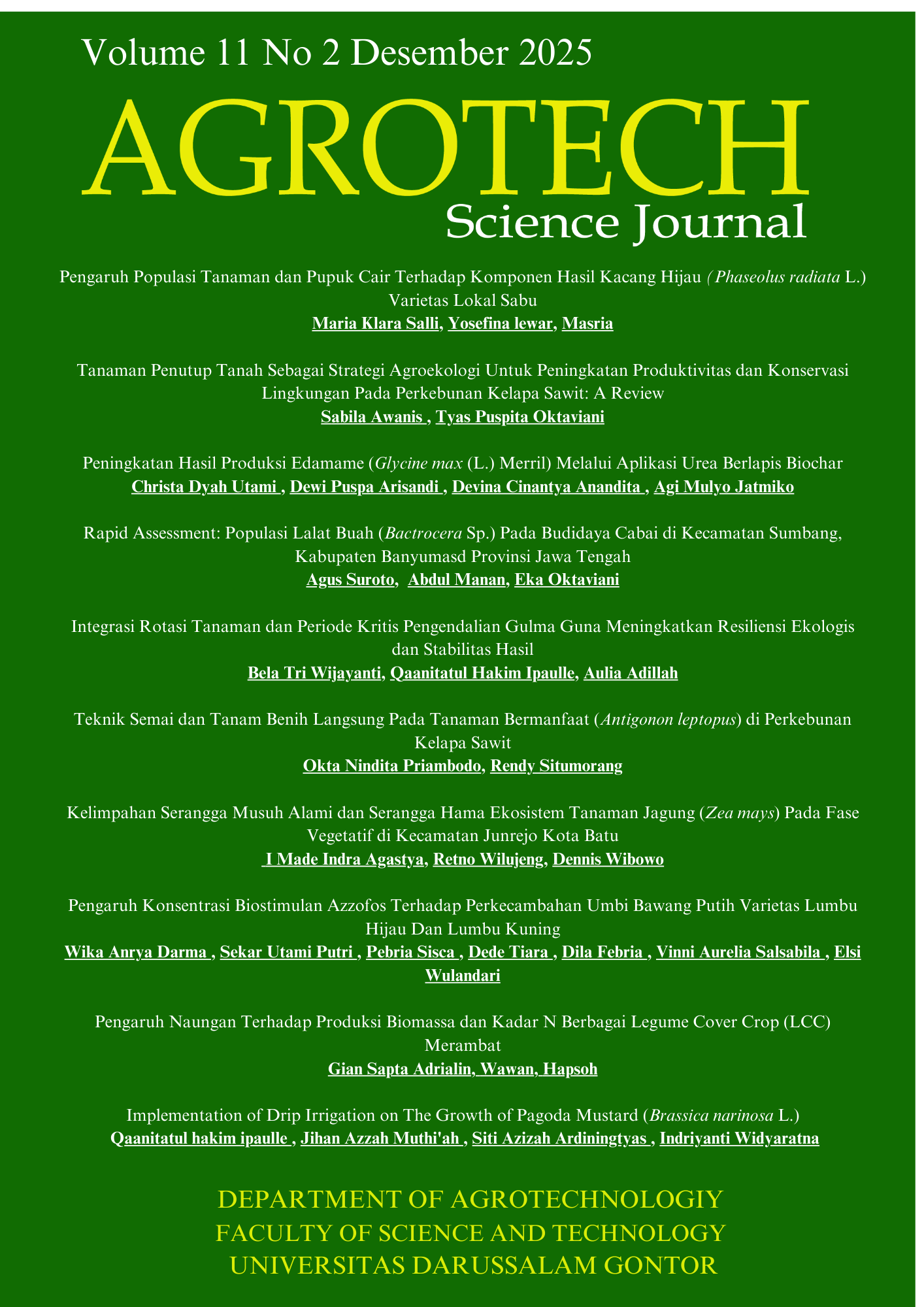
RAPID ASSESSMENT: POPULASI LALAT BUAH (Bactrocera sp.) PADA BUDIDAYA CABAI DI KECAMATAN SUMBANG, KABUPATEN BANYUMAS, PROVINSI JAWA TENGAH
Rapid Assessment: Fruit Fly (Bactrocera sp.) Population of Chili Cultivation in Sumbang District, Banyumas Regency, Central Java Province
DOI:
https://doi.org/10.21111/agrotech.v11i02.15245Keywords:
Rapid assessment, Bactrocera sp., Tanaman Cabai, Kecamatan SumbangAbstract
Tanaman cabai (family Solanaceae, kelas Magnoliopsida), yang umum dimanfaatkan buahnya, merupakan tanaman hortikultura yang memiliki nilai nutrisi dan farmakologi yang tinggi, serta rasa dan warna yang unik. Kecamatan Sumbang menjadi kecamatan dengan produksi cabai tertinggi di antara 27 kecamatan di Kabupaten Banyumas. Namun demikian, ancaman hama dari lalat buah dapat menurunkan hasil panen yang berkisar antara 30-60%, dan dapat mencapai 100% jika tidak dilakukan pengendalian yang tepat. Penelitian ini bertujuan untuk menganalisis keragaman lalat buah (Bactrocera sp.) di lahan budidaya cabai Kecamatan Sumbang, Kabupaten Banyumas. Penelitian menggunakan metode pengambilan sampel purposive random sampling. Koleksi dilakukan pada 19 (sembilan belas) lokasi, yang mewakili desa-desa di Kecamatan Sumbang. Lalat buah dikoleksi dengan atraktan berbahan aktif metil eugenol, selama kurang lebih 24 jam. Hasil identifikasi menemukan sebanyak 4 (empat) spesies lalat buah, yakni Bactrocera dorsalis, B. carambolae, B. umbrosa, dan B. papayae. Spesies B. dorsalis menunjukkan porsi terbesar (47,97%) dari segi jumlah yang dikoleksi dan diidentifikasi, dibandingkan dengan ketiga spesies lainnya. Nilai indeks keanekaragaman berdasarkan Shannon-Weiner menunjukkan kriteria sedang, di angka 1,107. Sementara itu, indeks keseragaman/kemerataan Evennes menunjukkan nilai yang dikategorikan dalam kriteria tinggi. Nilai Chao-1, berada di angka 4, yang menunjukkan estimasi jumlah spesies yang belum ditemukan. Selanjutnya, analisis kemiripan antar lokasi penelitian dengan clustering analysis menggunakan similarity index Jaccard menunjukkan bahwa spesies lalat buah yang dikoleksi dari Kecamatan Sumbang menunjukkan pengelompokan menjadi 6 grup, dengan beberapa kecamatan yang memiliki indeks kemiripan yang tinggi (100%). Penelitian ini menjadi studi awal dalam monitoring hama lalat buah di Kecamatan Sumbang.References
Ajith, N., Waluniba, Neng, P., Banik, S., Jamir, S. 2023. Effects of different abiotic and biotic factors on abundance of sucking pests of chilli (Capsicum annuum L.). Environmental Ecology, 41 (1C): 679-683
Al-Snafi, A.E. (2015). The pharmacological importance of Capsicum spesies (Capsium annuum and Capsicum frutescens) grown in Iraq. Journal of Pharmaceutical Biology, 5(3): 124-142.
Andrian, S., Purba, M. (2014). Pengaruh ketinggian tempat dan kemiringan lerengterhadap produksi karet (Hevea brasiliensisMuell. Arg.) di Kebun Hasepong PTPN III Tapanuli Selatan. Jurnal Online Agroteknologi 3(2): 981 –989
Avdiu, V., Hodolli, G., Dragusha, B., Bunjaku, K. (2023). The impact of abiotic and biotic factors on the productivity of the apple cultivars (Malus domestica). Pol. J. Environ. Stud, 32(4): 3025-3031.
Badan Pusat Statistik Kabupaten Banyumas. (2021). Kecamatan Sumbang dalam Angka 2021. Badan Pusat Statistik Kabupaten Banyumas, Banyumas.. https://banyumaskab.bps.go.id/id/publication/2021/09/24/5d87c3a9547129706286245a/kecamatan-sumbang-dalam-angka-2021.html. Diakses pada 20 Oktober 2025
Badan Pusat Statistik Provinsi Jawa Tengah. (2024). Produksi Tanaman Sayuran dan Buah-buahan Semusim menurut Kabupaten Kota dan Jenis Tanaman. Badan Pusat Statistik, Jakarta. https://jateng.bps.go.id/id/statistics-table/3/ZUhFd1JtZzJWVVpqWTJsV05XTllhVmhRSzFoNFFUMDkjMw==/produksi-tanaman-sayuran-dan-buah-buahan-semusim-menurut-kabupaten-kota-dan-jenis-tanaman---di-provinsi-jawa-tengah--2024.html?year=2024. Diakses pada 20 Oktober 2025
Badan Pusat Statistik. (2023). Produksi Tanaman Sayuran, 2023. https://www.bps.go.id/id/statistics-table/2/NjEjMg==/produksi-tanaman-sayuran.html. Diakses pada 20 Oktober 2025.
Chao, A. (1984). Non-parametric estimation of the number of classes in a population. Scandinavian Journal of Statistics, 11, 265-270.
Chao, A. (1987). Estimating the population size for capture-recapture data with unequal catchability. Biometrics 43(4): 783–791.
Deng, Y., Umbach, A.K., Neufeld, J.D. (2024). Nonparametric richness estimators Chao1 and ACE must not be used with amplicon sequence variant data. ISME J., 18(1):wrae106.
Ginting R. 2009. Keanekaragaman Lalat Buah (Diptera: Tephritidae) di Jakarta, Depok, dan Bogor sebagai Bahan Kajian Penyusunan Analisis Risiko Hama. Thesis. Institut Pertanian Bogor, Bogor.
Grozea, I., Stef, R. 2020. Pests and pathogens that affect the quality of pepper plants and theis control. In. Capsicum (Ed. Pete Norris). Nova Science Publishers, Inc, New York.
Hee, A.K., Wee, S.L., Nishida, R., Ono, H., Hendrichs, J., Haymer, D.S., Tan, K.H. (2015). Historical perspective on the synonymization of the four major pest species belonging to the Bactrocera dorsalis species complex (Diptera, Tephritidae). Zookeys, 26(540):323-338
Hidayat, Y., Fauzianty, M.R., Dono, D. (2018). The effectiveness of vegetable oil formulations in reducing oviposition of Bactrocera dorsalis Hendel (Diptera: Tephritidae) in large red chili fruits. Indonesian Journal of Entomology, 15(2): 93-100
Holis, A.I., Haryanto, H., Isnaini, M. (2023). Populasi dan intensitas serangan lalat buah (Bactrocera spp.) pada pertanaman cabai keriting (Capsicum annuum L.) di Desa Darmasari Kabupaten Lombok Timur. Jurnal Ilmiah Mahasiswa Agrokomplek, 2(2): 161-170.
Huston, M. 1979. A general hypothesis of species diversity. The American Naturalist 113:81−101.
Istiawan, N.D., Kastono, D. (2019). Pengaruh ketinggian tempat tumbuh terhadap hasil dan kualitas minyak cengkih (Syzygium aromaticum (L.) Merr. & Perry.) di Kecamatan Samigaluh, Kulon Progo. Vegetalika, 8(1): 27-41
Jaffar, S., Rizvi, S.A.H., Lu, Y. (2023). Understanding the invasion, ecological adaptations, and management strategies of Bactrocera dorsalis in China: a review. Horticulturae, 9(1004): 1-23
Kim, S.B., Park, J.J., Kim, D.S. (2020). CLIMEX simulated predictions of the potential distribution of Bactrocera dorsalis (Hendel) (Diptera: Tephritidae) considering the Northern Boundary: With special emphasis on Jeju, Korea. J Asia Pac Entomol 23:797-808
Manurung, M. (2023). Analisis Kinerja Perdagangan Cabai Merah Vol 13 No. 1E. Jakarta: Pusat Data dan Sistem Informasi Pertanian Kementerian Pertanian.
Muhlison, W., Haryadi, N.T., Kurnianto, A.S., Ahmada, B.S. (2021). Study of integrated pest management strategy on the population of fruit flies (Bactrocera spp.) in red chili cultivation (Capsicum annuum). J.Exp. Life Sci 11(1): 10-14
Nababan, R.E.O.M. (2024). Jenis-Jenis Hama Lalat Buah (Bactrocera spp.) Penyerang Tanaman Cabai Merah (Capsicum annum L.) di Balai Pelatihan Pertanian Jambi. Skripsi. Fakultas Sains dan Teknologi, Universitas Jambi.
Palma, J. M., Terán, F., Contreras-Ruiz, A., Rodríguez-Ruiz, M., & Corpas, F. J. (2020). Antioxidant profile of pepper (Capsicum annuum L.) fruits containing diverse levels of capsaicinoids. Antioxidants, 9(9), 1–19.
Pant, J., Dawadi, P. (2025). Growth and development of oriental fruit fly Bactrocera dorsalis (Hendel) (Diptera: Tephritidae) depends upon effects of climate change. International Journal of Horticulture, Agriculture and Food Science 9(1): 1-6
Parvez, G.M.M. (2017). Current advances in pharmacological activity and toxic effects of various Capsicum spesies. International Journal of Pharmaceutical Sciences and Research, 8(5): 1900-1912.
Sahetapy, B., Uluputty, M.R., Naibu, L. (2019). Identifikasi lalat buah (Bactrocera spp.) asal tanaman cabai (Capsicum annuum L.) dan belimbing (Averrhoa carambola L.) di Kecamatan Salahutu Kabupaten Maluku Tengah. Jurnal Agrikultura, 30(2): 63-74
Saputra, H.M., Sarinah, M. Hasanah. (2019). Kelimpahan dan dominansi lalat buah (Diptera: Tephritidae) pada pertanaman cabai (Capsicum annuum L.), di Desa Paya Benua, Bangka. Agrosainstek. 3(1). 36-41.
Sardhara, K., Mehta, K. (2018). Effects of abiotic and biotic stress on the plant. Academic Journal of Botanical Sciences. 1(1): 5-9
Schutze, M., McMahon J., Krosch M., Strutt F., Royer , J., Bottrill, M., Woods, N., Cameron, S., Woods, B., Blacket, M. 2018. The Australian Handbook for the Identification of the Fruit Flies by Plant Health Australia Version 3.1. Plant Healt Australia, Canberra.
Setiawan, Y., Hamdoen, F.M., Muhammad, F.N., Hata, K., Tarno, H., Wang, J. (2024). Species composition of Bactrocera fruitflies (Diptera: Tephritidae) and their parasitoids on horticultural commodities in Batu City and Malang District, East Java, Indonesia. Biodiversitas 25(1): 305-311
Shannon, C. E. (1948). A mathematical theory of communication. Bell System Technical Journal, 27, 379–423 & 623–656.
Srinivasan, K. (2015). Biological activities of red pepper (Capsicum annuum) and its pungent principle capsaicin: a review. Critical Reviews in Food Science and Nutrition, 56(9), 1488–1500.
Subedi, B., Poudel, A., Aryal, S. (2023). The impact of climate change on insect pest biology and ecology: Implications for pest management strategies, crop production, and food security. Journal of Agriculture and Food Research. 14 (100733): 1-17
Supratiwi, R., Apriyadi, R., Asriani, E. (2020). Fruit flies (Diptera: Tephritidae) diversity in horticultural farm of Merawang Sub-District, Bangka District, Bangka Belitung Islands. J.HPT Tropika, 20(1): 61-70
Suroto, A., Mugiastuti, E., Tarjoko, Oktaviani, E., Bahrudin, M. (2023). Diversity of insect carried-fungi in chili (Capsicum annuum) crop at Banyumas District, Central Java Province, Indonesia. Biodiversitas, 24(6): 3394-3406
Susanto, A., Supriyadi, Y., Tohidin, Susniahti, N., Hafizh, V. (2017). Fluktuasi populasi lalat buah Bactrocera spp. (Diptera : Tephritidae) pada pertanaman cabai merah (Capsicum Annuum) di Kabupaten Bandung, Jawa Barat. Jurnal Agrikultura, 28(3): 141-150.
Suwinda, S., Wilyus, W., Novalina, N. (2020). Effectiveness of the combination of attractants and colors in trapping fruit flies [Bactrocera spp] on chili plant [Capsicum annuum L.]. IOP Conference Series Earth and Environmental Science 497(012033): 1-8
Syamsudin, T.S., Kirana, R., Karjadi, A.K., Faizal, A. (2022). Characteristics of chili (Capsicum annuum L.) that are resistant and susceptible to Oriental Fruit Fly (Bactrocera dorsalis Hendel) infestation. Horticulturae, 8(314): 1-15
Todorova, V., Nankar, A.N., Yankova, V., Tringovska, I., Markova, D. (2024). Assessment of Balkan pepper (Capsicum annuum L.) accessions for agronomic, fruit quality, and pest resistance traits. Horticultrae, 10 (389): 1-17
Vijayalaksmi, P., Shashibhushan, S.V., Reddy, R.V.S.K., Bhat, B.N. (2017). Survey on insect pests of Capsicum (Capsicum annuum L. var. grossum Sendt.) and management of thrips under polyhouse conditions. J.Res Angrau, 45(3): 36-45.
Wang, Y., Zhou, Y., Fu, J. (2021). Advances in antiobesity mechanisms of capsaicin. Current Opinion in Pharmacology, 61: 1-5.
Yanti, S.D., Warsi. (2021). Bioactive compounds content and pharmacological activities of chili pepper (Capsicum sp.). Farmasains: Jurnal Farmasi dan Ilmu Kesehatan, 6(2): 41-60
Yasmin, A.A., Bintang, A.S., Kristanto, B.A. (2025). Identification and distribution of fruit flies in chili cultivation in Kendal Regency. International Seminar on Plant Protection Faculty of Agriculture, University of Bengkulu, 1(1): 153-164
Zhang, W., Zhang, Y., Fan, J., Feng, Z., Song, X. (2024). Pharmacological activity of capsaicin: Mechanisms and controversies (Review). Molecular Medicine Reports, 29 (38): 1-8
Downloads
Submitted
Accepted
Published
How to Cite
Issue
Section
License
Copyright (c) 2025 Gontor Agrotech Science Journal

This work is licensed under a Creative Commons Attribution 4.0 International License.
The author whose published manuscript approved the following provisions:
1. The right of publication of all material published in the journal / published in the Gontor AGROTECH Science Journal is held by the editorial board with the knowledge of the author (moral rights remain the author of the script).
2. The formal legal provisions for access to digital articles of this electronic journal are subject to the terms of the Attribution 4.0 International, which means that Gontor AGROTECH Science Journal reserves the right to save, transmit media or format, Database), maintain, and publish articles without requesting permission from the Author as long as it keeps the Author's name as the owner of Copyright.
3. Printed and electronic published manuscripts are open access for educational, research and library purposes. In addition to these objectives, the editorial board shall not be liable for violations of copyright law.