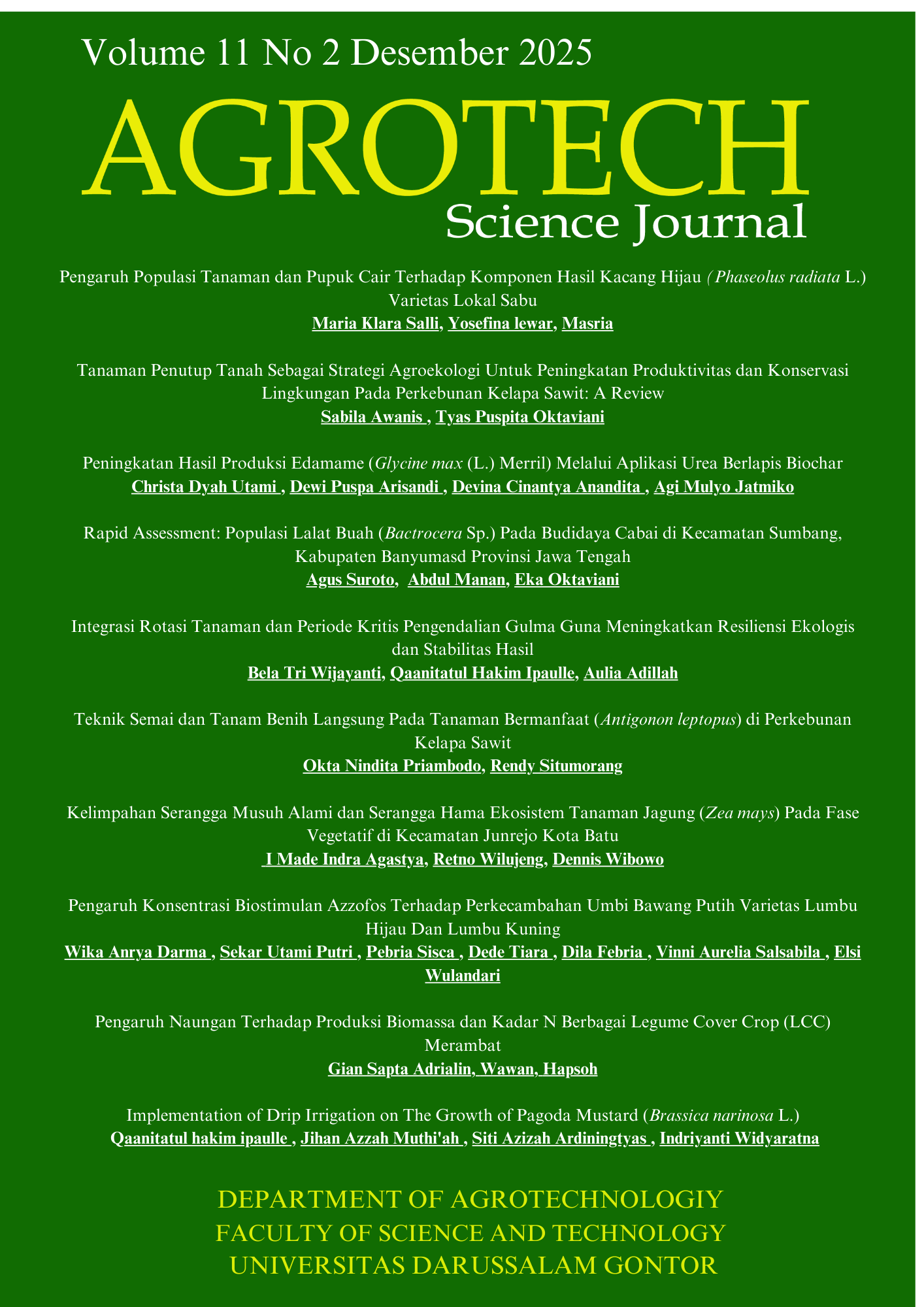
TANAMAN PENUTUP TANAH SEBAGAI STRATEGI AGROEKOLOGI UNTUK PENINGKATAN PRODUKTIVITAS DAN KONSERVASI LINGKUNGAN PADA PERKEBUNAN KELAPA SAWIT: A REVIEW
Cover Crops as an Agroecological Strategy for Improving Productivity and Promoting Environmental Conservation in Oil Palm Plantations: A Review
DOI:
https://doi.org/10.21111/agrotech.v11i02.15184Keywords:
Tanaman Penutup tanah, kelapa sawit, leguminose, keberlanjutanAbstract
Oil palm (Elaeis guineensis Jacq.) is a strategic commodity that contributes significantly to Indonesia’s economy. However, intensive cultivation practices in oil palm plantations have led to negative environmental impacts such as soil degradation, erosion, and biodiversity loss. This study aims to examine the role of cover crops in supporting the sustainability of oil palm plantations through a Systematic Literature Review (SLR) approach. The reviewed literature was sourced from scientific databases between 2015 and 2025, focusing on weed management, soil fertility improvement, and environmental conservation. The findings indicate that cover crops from the Leguminosae family, such as Mucuna bracteata, Pueraria javanica, and Centrosema pubescens, play a significant role in suppressing weed growth through light competition, allelopathic compound release, and provision of habitats for natural predators. Moreover, cover crops have been shown to improve soil fertility through nitrogen fixation, increased organic matter, and enhanced microbial activity, which collectively improve soil structure and water retention. The establishment of cover crops also reduces erosion rates, enhances infiltration, and maintains soil moisture. Nevertheless, field implementation still faces technical and socioeconomic challenges such as nutrient competition, high initial costs, and limited farmer knowledge. Overall, the adoption of cover crops aligns with the principles of the Indonesian Sustainable Palm Oil (ISPO) and the Roundtable on Sustainable Palm Oil (RSPO), contributing to the achievement of Sustainable Development Goals (SDGs) 13 and 15. This study recommends the integration of digital technologies to support sustainable oil palm plantation systems in Indonesia.References
Adetunji, A. T., Ncube, B., Mulidzi, R., & Lewu, F. B. (2020). Management impact and benefit of tanaman penutup tanahs on soil quality: A review. Soil and Tillage Research, 204, 104717. https://doi.org/10.1016/j.still.2020.104717
Al Manar, P., Hikmat, A., & Zuhud, E. A. M. (2023). The role of leguminosae plants for soil fertility in oil palm plantations. IOP Conference Series: Earth and Environmental Science, 1243(1). https://doi.org/10.1088/1755-1315/1243/1/012016
Ariful Islam, M., Sarkar, D., Robiul Alam, M., Jahangir, M. M. R., Ali, M. O., Sarker, D., Hossain, M. F., Sarker, A., Gaber, A., Maitra, S., & Hossain, A. (2023). Legumes in conservation agriculture: A sustainable approach in rice-based ecology of the Eastern Indo-Gangetic Plain of South Asia − an overview. Technology in Agronomy, 3(1), 1–17. https://doi.org/10.48130/tia-2023-0003
Ariyanti, M., Yahya, S., Murtilaksono, K., & Siregar, H. (2016). Pengaruh tanaman penutup tanah Nephrolepis biserrata dan teras gulud terhadap aliran permukaan dan pertumbuhan kelapa sawit (Elaeis guineensis Jacq). Jurnal Kultivasi, 15(2), 121–127.
Asbur, Y., Purwaningrum, Y., & Ariyanti, M. (2018). Growth and nutrient balance of Asystasia gangetica (L.) T. anderson as cover crop for mature oil palm (Elaeis guineensis jacq.) plantations. Chilean Journal of Agricultural Research, 78(4), 486–494. https://doi.org/10.4067/S0718-58392018000400486
Asbur, Y., Purwaningrum, Y., Rambe, R. D. H., Kusbiantoro, D., Hendrawan, D., & Khairunnisyah. (2019). Study of plant distance and shade on growth and potential of Asystasia gangetica (L.) T. Anderson as cover crop. Jurnal Kultivasi, 18(3), 969–976.
Austin, K. G., Mosnier, A., Pirker, J., McCallum, I., Fritz, S., & Kasibhatla, P. S. (2017). Shifting patterns of oil palm driven deforestation in Indonesia and implications for zero-deforestation commitments. Land Use Policy, 69, 41–48. https://doi.org/10.1016/j.landusepol.2017.08.036
Azwar, W., & Afrillah, M. (2023). Vegetasi gulma pada perkebunan kelapa sawit (Elaeis guineensis Jacq) Unit Perkebunan Bate Puteh Pt. Agro Sinergi Nusantara. Biofarm: Jurnal Ilmiah Pertanian, 19(1), 177. https://doi.org/10.31941/biofarm.v19i1.3030
Brookes, R. (2015). Context of glyphosate use in Indonesian agriculture. (unpublished data).
Dentika, P., Ozier-Lafontaine, H., & Penet, L. (2021). Weeds as pathogen hosts and disease risk for crops in the wake of a reduced use of herbicides: Evidence from yam (Dioscorea alata) fields and colletotrichum pathogens in the tropics. Journal of Fungi, 7(4). https://doi.org/10.3390/jof7040283
Dermoredjo, S. K., Darmawan, D. H. A., Sumedi, Mutaqin, Dani, F. Z. D. P., Yusuf, E. S., Pasaribu, S. M., Sayaka, B., Wardana, I. P., Adnyana, I. M. O., Estiningtyas, W., & Antriyandarti, E. (2025). The global sway of Indonesian palm oil: An export analysis. Journal of Agriculture and Food Research, 22, 102064. https://doi.org/10.1016/j.jafr.2025.102064
Duval, M. E., Galantini, J. A., Capurro, J. E., & Martinez, J. M. (2016). Winter cover crops in soybean monoculture: Effects on soil organic carbon and its fractions. Soil and Tillage Research, 161, 95–105. https://doi.org/10.1016/j.still.2016.04.006
Fernando, M., & Shrestha, A. (2023). The potential of cover crops for weed management: A sole tool or component of an integrated weed management system? Plants, 12(4). https://doi.org/10.3390/plants12040752
Goh, Y. K., Kim, Wong, L., Chin, ;, Lai, H., Suet, Tan, Y., Tasren, Mahamooth, N., Huang, Gan, H., You, ;, Goh, K., & Goh, K. J. (2015). Control of Mucuna bracteata DC. Ex. Kurz legume covers with herbicides in oil palm plantation: spraying volume and frequency. Advanced Agriecological Research Sdn Bhd, 70(11), 1–7. http://palmoilis.mpob.gov.my/publications/OPB/opb70-yit.pdf
Hakim, D. B., Hadianto, A., Giyanto, Hutaria, T., & Amaliah, S. (2020). The production efficiency of herbicides in palm oil plantation in Sumatera and Kalimantan. IOP Conference Series: Earth and Environmental Science, 468(1). https://doi.org/10.1088/1755-1315/468/1/012054
Halimshah, S., Juliana, W. W., & Yusoff, N. (2016). Allelopathic potential of the leaf and seed of Pueraria javanica Benth. on the germination and growth of three selected weed species. Sains Malaysiana, 45(4), 517–521. www.herbiseeds.
Herath, H. M. P. M., Herath, H. M. I. K., & Ratnayake, W. M. (2017). Potential use of Mucuna bracteata as a cover crop for coconut plantations in the low country intermediate zone of Sri Lanka. Journal of Food and Agriculture, 10(1–2), 26. https://doi.org/10.4038/jfa.v10i1-2.5210
Hutasoit, R., Sirait, J., Tarigan, A., & Ratih, D. H. (2018). Evaluation of four pasture legumes species as forages and cover crops in oil palm plantation. Jurnal Ilmu Ternak Dan Veteriner, 22(3), 124–134. https://doi.org/10.14334/jitv.v22i3.1801
Jamilah, J., Zahara, H., Kembaren, E. T., Budi, S., & Nurmala, N. (2022). Market share analysis and export performance of indonesian crude palm oil in the EU market. International Journal of Energy Economics and Policy, 12(2), 218–225. https://doi.org/10.32479/ijeep.12690
Koehler-Cole, K., Everhart, S. E., Gu, Y., Proctor, C. A., Marroquin-Guzman, M., Redfearn, D. D., & Elmore, R. W. (2020). Is allelopathy from winter cover crops affecting row crops? Agricultural and Environmental Letters, 5(1), 1–6. https://doi.org/10.1002/ael2.20015
Kour, D., Rana, K. L., Kaur, T., Yadav, N., Yadav, A. N., Kumar, M., Kumar, V., Dhaliwal, H. S., & Saxena, A. K. (2021). Biodiversity, current developments and potential biotechnological applications of phosphorus-solubilizing and -mobilizing microbes: A review. Pedosphere, 31(1), 43–75. https://doi.org/10.1016/S1002-0160(20)60057-1
Leguizamón, E. S. (2024). The Unsung Champions of Evolution: Weeds and Their Management in Agricultural Systems. Agriculture (Switzerland), 14(12). https://doi.org/10.3390/agriculture14122368
Luke, S. H., Purnomo, D., Advento, A. D., Aryawan, A. A. K., Naim, M., Pikstein, R. N., Ps, S., Rambe, T. D. S., Soeprapto, Caliman, J. P., Snaddon, J. L., Foster, W. A., & Turner, E. C. (2019). Effects of Understory Vegetation Management on Plant Communities in Oil Palm Plantations in Sumatra, Indonesia. Frontiers in Forests and Global Change, 2(July). https://doi.org/10.3389/ffgc.2019.00033
M Fahed Ramadhan, Suwardji, & Mulyati. (2025). Potensi tanaman penutup tanah dalam meningkatkan kesuburan tanah di lahan kering. Jurnal Ilmiah Mahasiswa Agrokomplek, 4(2), 479–483. https://doi.org/10.29303/jima.v4i2.7442
Ma’ruf, A., Zulia, C., & Safruddin. (2017). Legume tanaman penutup tanah di perkebunan kelapa sawit. In Forthisa Karya (Issue April). https://www.researchgate.net/publication/316349699_Legume_Cover_Crop_di_Perkebunan_Kelapa_Sawit
Magdoff, F., & van Es, H. (2021). Building soils for better crops: ecological management for healthy soils. In Sustainable Agriculture Research and Education (SARE) (Fourth edi, Vol. 156, Issue 5). https://doi.org/10.1097/00010694-199311000-00014
Mennan, H., Jabran, K., Zandstra, B. H., & Pala, F. (2020). Non-chemical weed management in vegetables by using cover crops: a review. Computers and Electronics in Agriculture, 10(257), 1–16. https://doi.org/10.1016/j.fcr.2023.108819%0Ahttps://doi.org/10.1016/j.compag.2023.107698
Molin, W. T., Wright, A. A., & Nandula, V. K. (2013). Glyphosate-resistant goosegrass from mississippi. Agronomy, 3(2), 474–487. https://doi.org/10.3390/agronomy3020474
Nugraha, K., & Guntoro, D. (2022). Dominansi dan Potensi Resistensi Gulma Eleusine indica terhadap Herbisida Glifosat di Kebun Pendidikan Kelapa Sawit Jonggol, Jawa Barat. 10(3), 340–348. https://doi.org/10.14341/conf05-08.09.22-132
Oluwatobi, A. S., & Olorunmaiye, K. S. (2021). Abundance and diversity index of weeds in oil palm and vegetable intercropping in rainforest zone of Nigeria. Caraka Tani: Journal of Sustainable Agriculture, 36(2), 227. https://doi.org/10.20961/carakatani.v36i2.48098
Pravana, N. K., Piryani, S., Chaurasiya, S. P., Kawan, R., Thapa, R. K., Shrestha, S., Brouwer, I. D., Jager, I. de, Borgonjen, K., Azupogo, F., Rooij, M., Folson, G., Abizari, R., Frempong, R. B., Annim, S. K., Boah, M., Azupogo, F., Amporfro, D. A., Abada, L. A. WHO. (2017). pengaruh leguminosa tanaman penutup tanah (LCC) Mucuna bracteata pada tiga kemiringan lahan terhadap sifat kimia tanah dan perkembangan akar kelapa sawit belum menghasilkan. JOM Faperta, 4(2), 15.vbn http://doi.org/10.1080/16070658.2018.1448503%0Awww.udsspace.uds.edu.gh%0Ahttps://doi.org/10.1080/20469047.2017.1409453%0Ahttp://dx.doi.org/10.1016/j.heliyon.2017.e00298%0Ahttp://www.gainhealth.org/wp-content/uploads/2018/03/Ghana-Development-of-Food-based
Purba, E., & Sipayung, R. (2022). Confirmation and control of glyphosate-resistant biotype of goosegrass (Eleusine indica L.). In Sumatran oil palm. Journal of the Saudi Society of Agricultural Sciences, 21(5), 318–323. https://doi.org/10.1016/j.jssas.2021.10.010
Rani, N. (2025). Dampak kelapa sawit dalam pembangunan berkelanjutan: analisis kebijakan publik Di Indonesia. Jurnal Governansi, 11(1), 73–82. https://doi.org/10.30997/jgs.v11i1.16314
Ratna, Y., Swari, E. I., & Firmansyah, A. (2022). Pertumbuhan gulma alang-alang (Imperata cylindrica L. Beauv.) pada berbagai kondisi kepadatana setelah pemotongan di Petrochina International Jabung LTD. Jurnal Media Pertanian, 7(1), 50. https://doi.org/10.33087/jagro.v7i1.135
Reza Salima, Husein Abdullah, U., & Nazahah. (2025). Analysis of weed vegetation in oil palm plants (Elaeis guineensis Jacq.) in Bekiun Plantation at PT. Langkat Nusantara Kepong. ROCE: Jurnal Pertanian Terapan, 2(1). https://doi.org/10.71275/roce.v2i1.96
Ruzlan, K. A. B. C., & Hamdani, M. S. A. (2020). Occurrence and management of resistant weed species in fgv plantation in malaysia: A review. Plant Archives, 20(1), 3057–3062.
Sahari, B., Hendarjanti, H., Yusran, A., Ibrahim, M. I. M., Ramadhan, G. F., & Prabowo, R. (2023). Weed diversity in oil palm plantation: Benefit from the unexpected ground cover community. IOP Conference Series: Earth and Environmental Science, 1220(1). https://doi.org/10.1088/1755-1315/1220/1/012011
Sakiah, Saragih, D. A., Sukariawan, A., Guntoro, & Bakti, A. S. (2021). The quality of compost made from mixture of Mucuna bracteata and oil palm empty fruit bunch. IOP Conference Series: Earth and Environmental Science, 762(1). https://doi.org/10.1088/1755-1315/762/1/012082
Samedani, B., Juraimi, A. S., Rafii, M. Y., Sheikh Awadz, S. A., Anwar, M. P., & Anuar, A. R. (2015). Effect of cover crops on weed suppression in oil palm plantation. International Journal of Agriculture and Biology, 17(2), 251–260.
Saragi, H., Asriani, E., Putri, K. (2020). Optimization of palm oil cultivation in ultisol land through the planting of Mucuna bracteata. Jurnal Lahan Suboptimal, 9(2): 160-166. https://doi.org/10.33230/JLSO.9.2.2020.494
Sarjono, A., Guntoro, D., & Supijatno, S. (2018). The role of biomulch Arachis pintoi in increasing soil infiltration rate on sloping land of oil palm plantation. Journal of Tropical Crop Science, 5(3), 89–95. https://doi.org/10.29244/jtcs.5.3.89-95
Satriawan, H., & Fuady, Z. (2019). Short communication: Analysis of weed vegetation in immature and mature oil palm plantations. Biodiversitas, 20(11), 3292–3298.
Satriawan, H., Fuady, Z., & Ernawita. (2023). Asystasia intrusa: cover crop and water balance dynamics in oil palm plantation. The Indian Journal of Agricultural Sciences, 93(4), 456–459. https://doi.org/10.56093/ijas.v93i4.132972
Scavo, A., & Mauromicale, G. (2021). Crop allelopathy for sustainable weed management in agroecosystems: knowing the present with a view to the future. Agronomy, 11(11). https://doi.org/10.3390/agronomy11112104
Sharma, P., Singh, A., Kahlon, C. S., Brar, A. S., Grover, K. K., Dia, M., & Steiner, R. L. (2018). The role of cover crops towards sustainable soil health and agriculture—a review paper. American Journal of Plant Sciences, 09(09), 1935–1951. https://doi.org/10.4236/ajps.2018.99140
Sibarani, F. T., Saidy, A. R., Priatmadi, B. J., Fredrickus Langai, B., Sukarman, Primananda, S., Sinaga, R. A., Kurniawan, A. A., & Diah Ayu Fitriana, C. (2024). exploring soil fertility variations under Nephrolepis biserrata in multi-soil type of oil palm plantations. Revista de Gestao Social e Ambiental, 18(1), 1–24. https://doi.org/10.24857/RGSA.V18N1-137
Singhal, V., Ghosh, J., & Jinger, D. (2020). Cover crop technology-a way towards conservation agriculture: A review. Indian Journal of Agricultural Sciences, 90(12), 2275–2284. https://doi.org/10.56093/ijas.v90i12.110310
Sofi, J. A., Dar, I. H., Chesti, M. H., Bisati, I. A., Mir, S. A., & Sofi, K. A. (2018). Effect of nitrogen fixing cover crops on fertility of apple (Malus domestica borkh) orchard soils assessed in a chronosequence in north-west himalaya of kashmir valley, India. Legume Research, 41(1), 87–94. https://doi.org/10.18805/LR-3508
Sujinah, S., Margaret, S., Agustiani, N., Ningsih, R. D., & Rumanti, I. A. (2023). Diversity and Allelopathic potential of weeds in Swampland. Planta Tropika, 11(2), 123–132. https://doi.org/10.18196/pt.v11i2.16491
Sumaryanto, Ramadhan, I. F., Prasetyo, I. D., Ginting, E. N., Pangaribuan, Y., Hidayat, T. C., Listia, E., Fauzi, W. R., Primananda, S., Sukarman, & Fitriana, C. D. A. (2024). Growth test of three types of legume cover crops commonly used in oil palm plantation. IOP Conference Series: Earth and Environmental Science, 1308(1). https://doi.org/10.1088/1755-1315/1308/1/012020
Suryana, Chozin, M. A., & Guntoro, D. D. (2020). Identifikasi spesies tanaman penutup tanah pada perkebunan kelapa sawit menghasilkan. Jurnal Agronomi Indonesia (Indonesian Journal of Agronomy), 47(3), 305–311. https://doi.org/10.24831/jai.v47i3.26980
Swandi, F., Rannando, R., Azmi, Y., & Mariandy, R. (2024). Identifikasi vegetasi gulma di lahan tanaman belum menghasilkan (tbm) kelapa sawit di lahan marginal. Jurnal Ilmiah Biosaintropis (Bioscience-Tropic), 10(1), 70–76. https://doi.org/10.33474/ejbst.v10i1.590
Syarovy, M., Santoso, H., & Sembiring, D. S. (2021). Pertumbuhan tanaman kelapa sawit pada lahan dengan tanaman penutup tanah Mucuna bracteata yang tidak terawat dan alang-alang (Imperata Cylindrica). WARTA Pusat Penelitian Kelapa Sawit, 26(1), 46–54. https://doi.org/10.22302/iopri.war.warta.v26i1.46
Tampubolon, K., Purba, E., Basyuni, M., & Hanafiah, D. S. (2019). Glyphosate resistance of Eleusine indica populations from North Sumatra, Indonesia. Biodiversitas, 20(7), 1910–1916. https://doi.org/10.13057/biodiv/d200717
Vani, M. R., Rohmiyati, S. M., & Yuniasih, B. (2024). Pengaruh legume tanaman penutup tanah terhadap sifat sifik tanah pada tanaman belum menghasilkan. AGROROFETECH: Jurnal Online Mahasiswa INSTIPER, 2(2), 640–647.
Viégas, I. D. J. M., Costa, M. G., Ferreira, E. V. de O., Peréz, N. L. P., Barata, H. D. S., Galvão, J. R., Conceição, H. E. O. da, & Santo, S. D. do E. (2021). Contribution of Pueraria phaseoloides L. in the cycling of macronutrients in oil palm plantations. Journal of Agricultural Studies, 9(3), 1. https://doi.org/10.5296/jas.v9i3.18577
Wang, Q., Li, S., Li, J., & Huang, D. (2024). The utilization and roles of nitrogen in plants. Forests, 15(7). https://doi.org/10.3390/f15071191
Wawan, Dini, I. R., & Hapsoh. (2019). The effect of legume cover crop Mucuna bracteata on soil physical properties, runoff and erosion in three slopes of immature oil palm plantation. IOP Conference Series: Earth and Environmental Science, 250(1). https://doi.org/10.1088/1755-1315/250/1/012021
Wisdawati, E., Vanami, Z., & Kafrawi. (2022). Identifikasi gulma pada perkebunan kelapa sawit belum menghasilkan (Elaeis guineensis Jacq.). J Agrotan, 8(1), 55–59.
Yao, J., Wu, J., Xiao, C., Zhang, Z., & Li, J. (2022). The classification method study of crops remote sensing with deep learning, machine learning, and google earth engine. Remote Sensing, 14(12), 1–22. https://doi.org/10.3390/rs14122758
Yin, C., Zhao, W., & Pereira, P. (2022). Soil conservation service underpins sustainable development goals. Global Ecology and Conservation, 33(December 2021), e01974. https://doi.org/10.1016/j.gecco.2021.e01974
Yuniarti, Chozin, M. A., Guntoro, D., & Murtilaksono, K. (2018). perbandingan Arachis pintoi dengan jenis tanaman penutup tanah lain sebagai biomulsa di pertanaman kelapa sawit belum menghasilkan. Jurnal Agronomi Indonesia (Indonesian Journal of Agronomy), 46(2), 215. https://doi.org/10.24831/jai.v46i2.16126
Zulhusni, Wijayani, S., & Suryanti, S. (2023). Kajian indeks keanekaragaman gulma pada tanaman menghasilkan di topografi datar dan berbukit di perkebunan kelapa sawit. Jurnal Agroforetech, 1(3), 1565–1574.
Downloads
Submitted
Accepted
Published
How to Cite
Issue
Section
License
Copyright (c) 2025 Gontor Agrotech Science Journal

This work is licensed under a Creative Commons Attribution 4.0 International License.
The author whose published manuscript approved the following provisions:
1. The right of publication of all material published in the journal / published in the Gontor AGROTECH Science Journal is held by the editorial board with the knowledge of the author (moral rights remain the author of the script).
2. The formal legal provisions for access to digital articles of this electronic journal are subject to the terms of the Attribution 4.0 International, which means that Gontor AGROTECH Science Journal reserves the right to save, transmit media or format, Database), maintain, and publish articles without requesting permission from the Author as long as it keeps the Author's name as the owner of Copyright.
3. Printed and electronic published manuscripts are open access for educational, research and library purposes. In addition to these objectives, the editorial board shall not be liable for violations of copyright law.