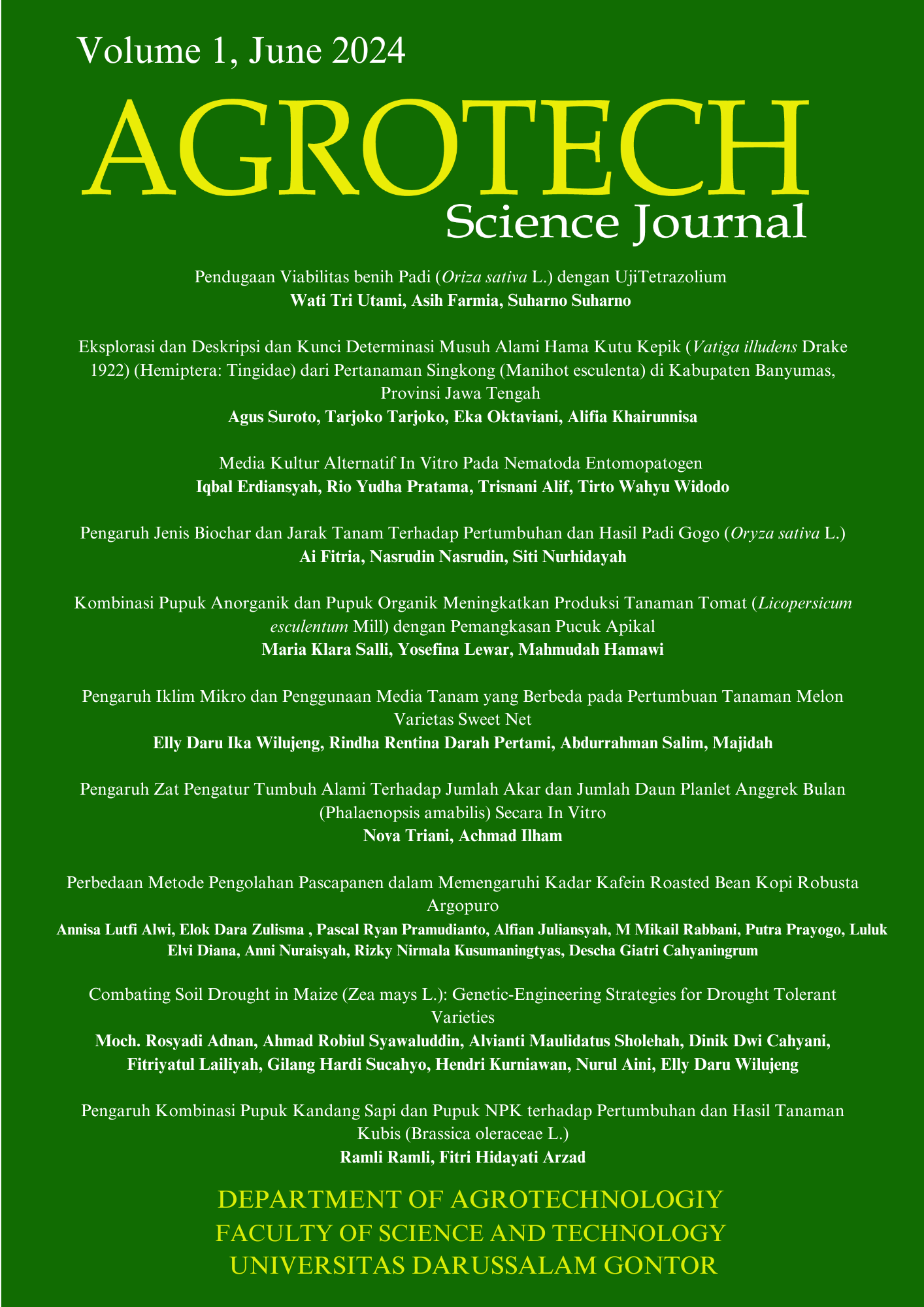
Pengaruh Iklim Mikro dan Penggunaan Media Tanam yang Berbeda pada Pertumbuan Tanaman Melon Varietas Sweet Net
The Effect of Micro Climat and Differences Planting Media on The Growth of Melon Sweet Net Varieties
DOI:
https://doi.org/10.21111/agrotech.v10i1.12126Keywords:
Fertigation, Green House, Hydroponics, Melons, Microclimat.Abstract
Melon are plants that are sensitive to environmental changes. Currently, developing technology for cultivating melons in greenhouses is used to modify the microclimate for the growth of melon plants. This research aims to determine the effect of microclimate and different types of planting media on growth response of sweet net variety melon plants that planted in the Politeknik Negeri Jember smart green house. The research was carried out in January – May 2024. The treatments tested consisted of two treatments, namely: the use of soil media+compos and cocopeat media which would be repeated 15 times. The parameters observed include microclimate (temperature and humidity) and also plant growth indicators including plant length and number of leaves, number of flowers, and potential weight of melon. The data obtained were analyzed using the T-test. The research results show that the microclimate inside the Politeknik Negeri Jember smart green house is still classified as an optimal microclimate to support the growth of melon plants. Apart from that, the use of cocopeat planting media was able to provide the best results for the length of the melon plants in the 4th to 6th week of observation, but there was no significant difference in the parameters of the number of leaves, number of flowers and potential weight of melon of. The use of cocopeat media and soil media are both good media in supporting the growth of melon plants in a greenhouse.References
Arda, G., & Kencana, D. (2015). Pemodelan Konsentrasi Gas pada Pengemasan Tertutup Jamur Tiram (Pleurotus ostreatus) Segar. Jurnal Agrotekno, 17(2), 29–34.
Baker, J. T., & Reddy, V. R. (2001). Temperature effects on phenological development and yield of muskmelon. Annals of Botany, 87(5), 605–613. https://doi.org/10.1006/anbo.2001.1381
Cahyo, A. N., Sahuri, Nugraha, I. S., & Ardikal, R. (2019). Cocopeat as Soil Substitute Media for Rubber (Hevea brasiliensis Müll. Arg.) Planting Material. Journal of Tropical Crop Science, 6(1), 24–29. www.j-tropical-crops.com
Daryono, B. S., & Qurrohman, M. T. (2009). Pewarisan Sifat Ketahanan Tanaman Melon (Cucumis melo L.) terhadap Powdery Mildew (Podosphaera xanthii (Castag.) Braun et Shishkoff). Jurnal Perlindungan Tanaman Indonesia, 15(1), 1–6.
Erniati, Suhardiyanto, H., Hasbullah, R., & Supriyanto. (2024). Photosynthetic Rate Prediction Model of Golden Melon Plant (Cucumis melo L.) at Vegetative Phase in Greenhouse using Artificial Neural Networks. HAYATI Journal of Biosciences, 31(1), 30–38. https://doi.org/10.4308/hjb.31.1.30-38
Indriawan, I. K. A., Gunadi, I. G. A., & Wiraatmaja, I. W. (2021). Pengaruh Jenis Media Tanam dan Varietas terhadap Hasil Tanaman Melon (Cucumis melo L.) pada Sistem Irigasi Tetes. Jurnal Agroekoteknologi Tropika, 10(3), 400–408. https://ojs.unud.ac.id/index.php/JAT400
Kusparwanti, T. R., Eliyatiningsih, E., Pertami, R. R. D., & Wibowo, A. T. (2023). The effect of differences in the use of cocopeat on the yield of melon (Cucumis melo L.) Honey globe with a drip irrigation system. IOP Conference Series: Earth and Environmental Science, 1168(1), 012012.
Kusparwanti, T. R., Pertami, R. R. D., Eliyatiningsih, E., Siswadi, E., & Salim, A. S. (2023). Aplikasi berbagai jenis pemberian konsentrasi asam amino sitokinin dan giberelin pada tanaman melon (Cucumis melo L.) hidroponik. AGROMIX, 14(2).
Manchali, S., Murthy, K. N. C., Vishnuvardana, & Patil, B. S. (2021). Nutritional composition and health benefits of various botanical types of melon (Cucumis melo L.). Plants, 10(9). https://doi.org/10.3390/plants10091755
Milania, A. P., Dan, E. D., Milania, A. P., Dwi Purbajanti, E., & Budiyanto, S. (2022). Effect Of Pruning And Compost Dosage On Growth And Production Of Cucumber Plant (Cucumis sativus L.).
Petrokimia Gresik. (2019). Petro Ponic. PT Petrokimia Gresik. https://petrokimia-gresik.com/product/petro-ponic?hl=en
Prasetyo, S., Ulil Hidayat, Yosafat Donni
Haryanto, & Nelly Florida Riama. (2021). Karakteristik Suhu Udara di Pulau Jawa Kaitannya Dengan Kelembapan Udara, Curah Hujan, SOI, dan DMI. Jurnal Geografi, Edukasi Dan Lingkungan (JGEL), 5(1), 15–26. https://doi.org/10.22236/jgel.v5i1.5971
Purba, L. I., Arsi, Armu, R., Purba, S. R. F.,
Amartani, K., Yasa, I. W., Saidah, H., & Setyawan, M. B. (2021). Agroklimatologi.
Setiadi Daryono, B., Dwi Maryanto, S., Nissa, S., & Riza Aristya, G. (2016). Analisis Kandungan Vitamin Pada Melon (Cucumis melo L.) Kultivar Melodi Gama 1 dan Melon Komersial, 4 (1).
Singh Rathore, A., Singh, E., Chaudhary, A., Rayeen, S., Tiwari, A., Solan, N., Pradesh, H., Saugat Khaniya, I., Deo, N., Nautiyal, P., Supyal, V., Pal, S., & Khaniya, S. (2022). Causes and control of flower drop in fruit crops: A review. The Pharma Innovation Journal, 11(2), 1165–1168. http://www.thepharmajournal.com
Tando, E., Pengkajian, B., Pertanian, T., & Tenggara, S. (2019). Review: Pemanfaatan Teknologi Greenhouse dan Hidroponik sebagai Solusi Menghadapi Perubahan Iklim dalam Budidaya Tanaman Hortikultura. In Buana Sains, 19.
Wilujeng, E. D. I., Ningtyas, W., & Nuraini, Y. (2015). Combined applications of biochar and legume residues to improve growth and yield of sweet potato in a dry land area of East Java. Journal of Degraded and Mining Lands Management, 2(4), 377–382. https://doi.org/10.15243/jdmlm.2015.024.377
Wilujeng, E. D. I., Pertami, R. R. D., Rahma, S. D., & Firmansyah, A. F. (2023). Profil Iklim Mikro pada Budidaya Tanaman Kopi Robusta di Politeknik Negeri Jember. Agropross : National Conference Proceedings of Agriculture, 314–319. https://doi.org/10.25047/agropross.2023.485
Wilujeng, E. D. I., Widyastuti, R., Tjahjono, B., & Suhardjono, Y. R. (2020). Soil collembola on land affected by pyroclastic material of Kelud Volcano, Ngantang Malang. Journal of Degraded and Mining Lands Management, 7(3), 2105–2110. https://doi.org/10.15243/jdmlm.2020.073.2105
Downloads
Submitted
Accepted
Published
How to Cite
Issue
Section
License
The author whose published manuscript approved the following provisions:
1. The right of publication of all material published in the journal / published in the Gontor AGROTECH Science Journal is held by the editorial board with the knowledge of the author (moral rights remain the author of the script).
2. The formal legal provisions for access to digital articles of this electronic journal are subject to the terms of the Attribution 4.0 International, which means that Gontor AGROTECH Science Journal reserves the right to save, transmit media or format, Database), maintain, and publish articles without requesting permission from the Author as long as it keeps the Author's name as the owner of Copyright.
3. Printed and electronic published manuscripts are open access for educational, research and library purposes. In addition to these objectives, the editorial board shall not be liable for violations of copyright law.